
ADR Class 4 covers goods that can burn fast, catch fire on their own, or give off a flammable gas when wet. It has three parts 4.1, 4.2, and 4.3. These parts include self-reactive substances, solid desensitized explosives, pyrophoric materials, self-heating substances, and dangerous-when-wet materials. Each load needs a UN number, a proper shipping name, and the right pack. ADR uses Packing Groups I, II, and III. It also needs UN-tested packs, diamond labels, orange plates, and Kemler codes. The driver must have ADR training. The load must also have papers and written instructions. Tunnel restriction codes and safety checks help control heat, sparks, friction, and water risk on the road.

What qualifies substances for ADR Class 4 classification?
ADR Class 4 covers dangerous goods that can burn easily. It also covers goods that may catch fire on their own or make flammable gas when wet. The class is split into Division 4.1, Division 4.2 and Division 4.3. These include self-reactive substances, desensitized explosives, pyrophoric substances, self-heating substances, and dangerous-when-wet substances.
ADR Class 4 is split into three main subclasses based on the main hazard. These are Division 4.1, Division 4.2, and Division 4.3. The consignor must assign a proper shipping name and UN Number to the substance based on the detailed criteria set out in ADR Part 2. The consignor may also need the correct classification code. Division 4.1 covers flammable solids, self-reactive substances, and desensitized explosives. Division 4.2 covers substances liable to spontaneous combustion. Division 4.3 covers substances that emit flammable gas when in contact with water.
- Division 4.1: It covers flammable solids, self-reactive substances, and desensitised explosives. Desensitised explosives are made less sensitive, so they are less likely to explode all at once. They may still burn at a low rate.
- Division 4.2: It covers substances liable to spontaneous combustion. These include pyrophoric substances and self-heating substances. These goods may catch fire on their own.
- Division 4.3: It covers substances which, in contact with water, emit flammable gases. These are also called dangerous-when-wet substances. They react with water and form flammable gas.
How does ADR define Class 4 flammable solids and reactive substances?
The ADR says Class 4 covers solid goods that can cause a serious fire risk. It includes solids that burn with ease and solids that may catch fire from friction. This is mainly Division 4.1. It also includes self-reactive substances and desensitized explosives. Readily combustible solids are often powder, grains, or paste. They are dangerous if a short touch from an ignition source can set them alight and the flame spreads fast. The risk may come from the fire and from toxic fumes. Some of these goods are friction-sensitive solids. Metal powders are a key example. They may need special extinguishing methods, because water or carbon dioxide can raise the risk.
According to ADR, this hazardous goods class is divided into three broad subclasses:
- Flammable solids
- Substances liable to spontaneous combustion
- Substances which, in combination with water, form flammable gases
What are the ADR Class 4 sub-divisions (4.1, 4.2, and 4.3)?
The sub-divisions 4.1, 4.2, and 4.3 are specific classifications under UN Class 4 (Flammable Solids), and their definitions are as follows:
- Division 4.1: It covers flammable solids. These include readily combustible solids, self-reactive substances, and solid desensitised explosives. Under transport conditions, they may cause or add to fire. This may happen through friction, heat generation, or an exothermic reaction. A small ignition source may also start the fire risk.
- Division 4.2 (Substances liable to spontaneous combustion): These goods are also known as spontaneously combustible substances. They may heat up on their own under normal transport conditions. Some also heat up when they come into contact with air. In ADR, this is Division 4.2. It includes pyrophoric substances and self-heating substances. Air exposure and oxidation can lead to spontaneous ignition.
- Division 4.3 (Substances which, in contact with water, emit flammable gases): Division 4.3 covers substances which, in contact with water, emit flammable gases. These are also called dangerous-when-wet substances or water-reactive substances. When they touch water or moisture, they may give off flammable gas. This can lead to flammable gas release and, in some cases, spontaneous ignition.
Why are these substances grouped by flammability and water reactivity?
These substances are grouped by flammability and water reactivity to keep transport and firefighting safe around the world. In the UN system, they are classed as Class 4.3 dangerous-when-wet substances. This rule is set out in the UN Recommendations on the Transport of Dangerous Goods Model Regulations. Countries use this system for road, rail, air, and sea transport. This includes ADR for road transport, the IMDG Code for sea transport, and IATA/ICAO rules for air transport. These substances can give off flammable gas when they touch water. Some may also catch fire at once. This creates a high fire and explosion risk and calls for special handling. A well-known example is caesium, which can react very fast. In fire safety marking, NFPA 704 may show this danger with a “W” sign in the white section.
Which materials are listed under UN Numbers 1325–1400?
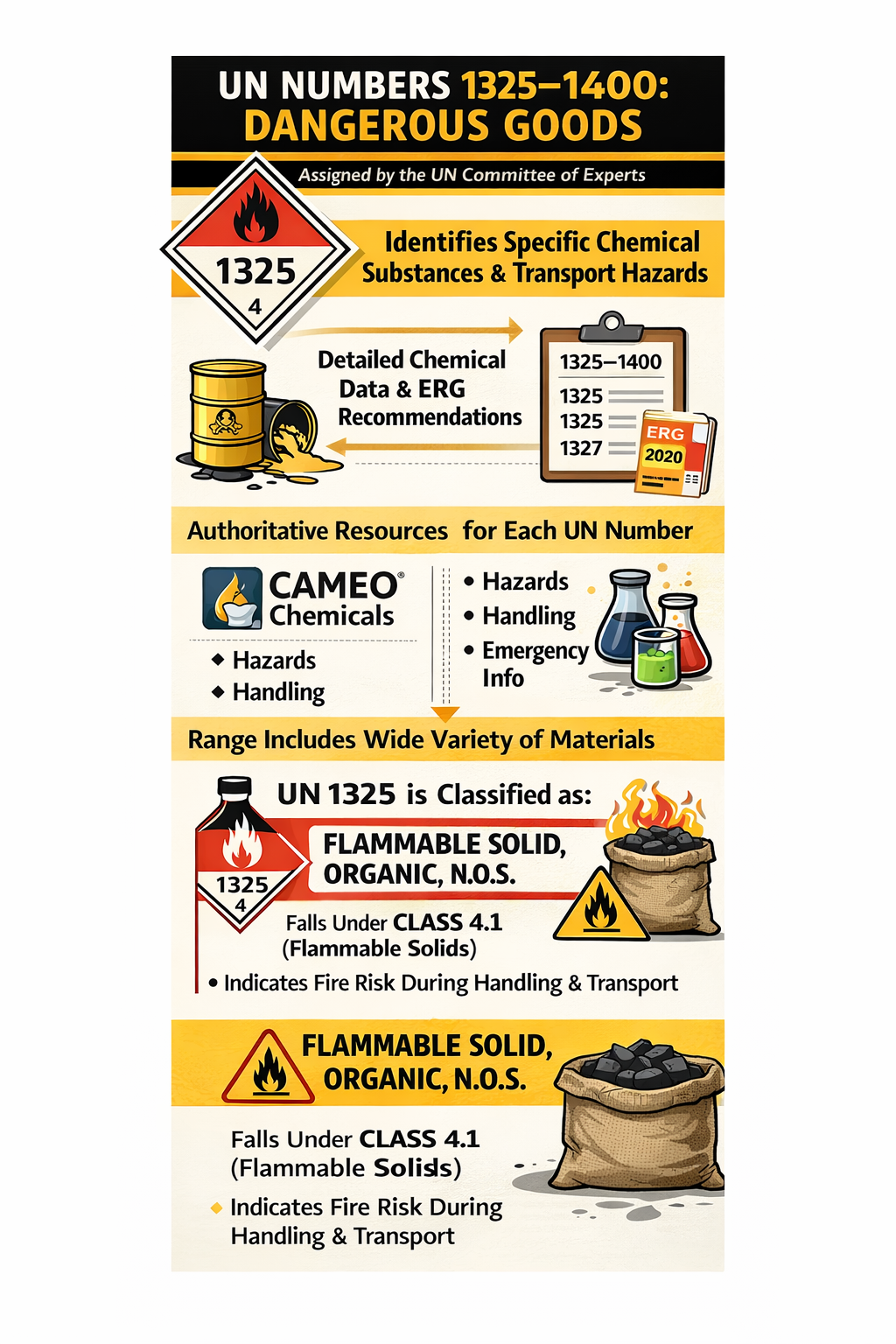
The materials listed under UN Numbers 1325–1400 are dangerous goods. These numbers are assigned by the UN Committee of Experts on the Transport of Dangerous Goods. They help with hazard identification in transport. They also help workers find the right proper shipping name, transport documents, and emergency advice. Sources such as CAMEO Chemicals, the Emergency Response Guidebook (ERG), and the Safety Data Sheet (SDS) may give chemical data and response guidance. Many of these entries relate to ADR Class 4 goods. UN 1325 is Flammable Solid, Organic, N.O.S. The term N.O.S. means Not Otherwise Specified.
What are the common examples in the UN 1325–1400 range?
The common examples in the 1325 framework centre on United Nations Security Council Resolution 1325 (UNSCR 1325), which was adopted unanimously on 31 October 2000 by the United Nations Security Council (UNSC). The resolution is seen as a landmark for women’s inclusion in peace processes and as the foundation of the Women, Peace and Security (WPS) agenda. It recognises that armed conflict has a severe and unequal effect on women and girls. It also calls for stronger roles for women in conflict prevention, participation, protection, and recovery. Many states later used National Action Plans (NAPs) to put these goals into practice and to support gender equality in peace and security policy.
Resolution 1325 says women have a key role in the prevention and resolution of conflict, peace talks, peace-building, peacekeeping, and post-conflict reconstruction. It calls on all actors and Member States to increase women’s full and equal participation and to use gender perspectives in all United Nations peace and security work. It is a core part of the Women, Peace and Security (WPS) agenda. It also stresses conflict prevention and women’s role in peacekeeping operations. It asks parties to conflict to take special steps to protect women and girls from gender-based violence during armed conflict and recovery. This includes support during repatriation, resettlement, and reintegration.
How are UN Numbers assigned to ADR Class 4 substances?
UN Numbers are assigned to ADR Class 4 substances by the consignor. The consignor must follow the descriptions and criteria in ADR Part 2. First, the substance is classified by its main hazard. This means deciding whether it falls under Division 4.1, Division 4.2, or Division 4.3. The consignor then matches the substance to the correct entry in the dangerous goods list and assigns the right proper shipping name and UN Number. The consignor may also need the correct classification code and packing group. This supports clear hazard identification and safe transport.
To assign the UN Number, the consignor must choose a four-digit UN Number and a matching proper shipping name from the Dangerous Goods List. The chosen entry must best describe the substance, its hazard class, and its composition. The consignor may also need the right packing group. These identifiers are standard technical names used to label dangerous goods. They must be shown in the Dangerous Goods Declaration and in Section 14 of the Safety Data Sheet (SDS) as part of the transport information.
What is the importance of UN numbers in hazard identification?
The importance of UN numbers in hazard identification stems from their mandatory role in identifying dangerous goods for transport and providing essential, globally recognised safety data. Each UN number gives a dangerous good a clear ID. It works with the proper shipping name and hazard class. It is used on labels and transport documents. It also helps people find the Safety Data Sheet (SDS) and the right emergency response. This supports safe handling in all countries.
UN numbers are crucial for the transport of dangerous goods by road, rail, sea, and air because they establish a consistent regulatory set of identification numbers, ensuring safety and regulatory compliance across international shipping organisations by achieving the following:
- Promoting consistency among international shipping organisations, ensuring that every entity involved in the process is immediately aware of what is inside the containers. They give each dangerous good a clear ID. They work with the proper shipping name, labels, and transport documents. This helps carriers, ports, customs, and emergency teams know what is in each container at once.
- Providing critical information about the nature of the substance, including the type of hazard (e.g., flammability or toxicity) and the degree of risk involved. A UN number helps do this. It links the substance to its proper shipping name, hazard class, and packing group. It also supports labels and emergency response. This helps people know the main danger and the level of risk.
- Enabling handlers to determine how to safely package and handle the substance, as well as specifying any special storage or receipt requirements at the destination location. A UN number helps with this. It links the substance to its proper shipping name, packaging instructions, and handling procedures. It also helps show the right storage conditions, segregation rules, and transport documents. This helps workers pack, move, store, and receive the goods in a safe way.

What packing rules apply to ADR Class 4 solids?
The packing rules for ADR Class 4 solids require most pack types to use UN performance-tested packaging. This shows that the pack meets the ADR test standard. The exact rule depends on the substance’s level of danger. This level is shown by Packing Group I, II, or III. After the UN number and proper shipping name are chosen, the user checks Table A and Column 4 to find the right packing group. That packing group then leads to the right packaging instructions. The pack must be strong enough for the risk. It must also carry the UN packaging mark. For example, Packing Group II means medium danger. A package at this level must pass a 1.2 metre drop test.
How are packaging groups assigned for ADR Class 4 materials?
Packaging groups for ADR Class 4 materials are assigned based on the level of danger and risk they pose during transport. ADR uses Packing Group I, Packing Group II, and Packing Group III. These mean high, medium, and low danger. The assigned group is usually found in Column 4 of Table A. That entry then points the user to the right classification criteria in ADR Part 2. The packing group helps the user choose the right packaging for the material.
When a substance is classified from first principles, its packing group is set by its inherent properties. For Class 4.1 material, which includes readily combustible solids, the group depends on test criteria linked to burning time, burning rate, and reactivity. ADR Part 2 uses this approach to place the substance in Packing Group I, II, or III based on its level of danger.
For example, Packing Group II is assigned on the basis of set property criteria:
- Readily combustible solids (other than metal powders) in Class 4.1 are placed in Packing Group II if the burning time is less than 45 seconds and the flame passes the wetted zone. This is a burning test for flame spread. It shows a clear transport fire risk.
- Powders of metal or metal alloys are placed in Packing Group II if the reaction zone spreads over the whole length of the test sample in 5 minutes or less.
This shows a high fire risk in transport.
What containers and materials are authorised for packing?
The containers and materials authorised for packing are usually UN-approved packaging. They are chosen after the dangerous goods are correctly classified. The user then checks Table A and Columns 8 to 14 for the permitted packing details. These columns point to the right packing instruction, packing group, and any special packing provisions. The allowed pack types may include boxes, drums, jerricans, bags, IBCs, and large packagings. The package must also match the right UN packaging code.
Packaging is broadly divided into six primary categories, identified by the first number in the packaging code, utilising a diverse range of materials designed to match the properties of the substance being held:
- Drums (Category 1): Used for liquids and powders, this category includes materials such as steel (e.g., 1A1 non-removable head), plastic (e.g., 1H1 non-removable head), and plywood (e.g., 1D).
- Barrels (Category 2): Primarily covers wooden barrels (e.g., 2C1 non-removable head) used for larger volumes.
- Jerry Cans (Category 3): Practical, stackable solutions for liquids, typically made of steel (e.g., 3A1, 3A2), aluminium (e.g., 3B1, 3B2), or plastic (e.g., 3H1, 3H2).
- Boxes (Category 4): Rigid packaging providing a high degree of protection, including steel boxes (e.g., 4A), plywood boxes (e.g., 4D), and plastic boxes (e.g., 4H2).
- Bags (Category 5): This includes various textile bags (e.g., 5L1), multi-wall paper bags (e.g., 5M1), and film plastic bags (e.g., 5H4).
- Composite Packaging (Category 6): The largest category, covering diverse, multiple-material packaging like glass, porcelain or stoneware receptacles placed within external containment, such as steel drums (e.g., 6PA1). The general range of materials authorised includes steel, plastic, aluminium, fibreboard, plywood and wood.
What compatibility requirements apply to reactive solids?
Reactive solids must meet both class rules and storage rules. They are often checked under ADR Class 4.1. Self-reactive substances are thermally unstable and may break down with heat. They are not treated as Class 4.1 if they are already classed as explosives, oxidising substances, or organic peroxides. They are also excluded if the heat of decomposition is less than 300 J/g, or if the SADT is above 75°C for a 50 kg package. For storage, they should be kept in a waterproof double container and in a normal cabinet. They also need segregation from incompatible materials, moisture protection, temperature control, dry storage, and a closed container. The SDS should be checked for compatibility data and storage limits.
What vehicle codes apply to the transport of ADR Class 4 goods?
The vehicle codes that apply to the transport of ADR Class 4 dangerous goods are not one general set of codes for the whole class. They depend on the exact UN number and ADR entry for the substance. ADR uses a nine-class system to group hazards, but the vehicle code is chosen from the ADR rules for the specific load. The consignor must check the UN number in Table A and identify the right vehicle code, such as an AT vehicle where required. Other transport controls may also apply, such as a tunnel restriction code and the use of orange plates on the vehicle. Consignors have a duty to identify the hazards of ADR Class 4 goods according to these regulatory requirements.
These regulations specify safety requirements, characteristics, and handling procedures, including details on UN package markings (which can be found in chapters 6.1, 6.3, 6.5, and 6.6 of the UN Recommendations):
- ADR: ADR means the European Agreement concerning the International Carriage of Dangerous Goods by Road. It sets rules for the road transport of dangerous goods in Europe. It uses UN numbers, proper shipping names, labels, and transport documents to support safe carriage.
- RID: RID means the Regulations concerning the International Carriage of Dangerous Goods by Rail. It sets rules for the rail transport of dangerous goods in Europe. It uses UN numbers, proper shipping names, labels, and transport documents to support safe carriage.
- IMDG: IMDG Code means the International Maritime Dangerous Goods Code.It sets rules for the sea transport of dangerous goods on ships. It uses UN numbers, proper shipping names, labels, and transport documents to support safe carriage.
- ICAO: ICAO means the International Civil Aviation Organisation. Its Technical Instructions for the Safe Transport of Dangerous Goods by Air set rules for air transport. Part 6.2 covers packaging requirements, including UN specification packaging, tests, and standards. These rules help support the safe carriage of dangerous goods by air.
What vehicle types are approved for ADR Class 4 flammable solids?
The approved vehicle types for Class 4 flammable solids are not always stated as one single rule for the whole class. Under ADR, the vehicle type depends on the exact UN number and the way the goods are carried. The user must check ADR Table A for the entry. The rule may differ for packaged goods, bulk transport, or tank transport. In some cases, an AT vehicle and other vehicle approval rules may apply. Tunnel restriction codes and orange plates may also form part of the transport rule. The provided sources focus more on classification and packaging requirements under ADR.
In ADR Class 4.1, flammable solids are often assigned to Packing Group II, which means medium danger and includes readily combustible solids and metal powders. For non-metal solids, a burning test is used. PG II is assigned if the burning time is less than 45 seconds and the flame spread passes the wetted zone. For metal powders or alloys, PG II applies if the reaction zone spreads over the whole test sample in five minutes or less. This shows a clear transport fire risk.
Materials designated under Packing Group II require UN performance-tested packaging designed to withstand a drop test from 1.2 metres. They must also be labelled and marked with the UN number and, where needed, the proper shipping name. The package should also show the UN packaging mark. According to ADR procedures, the specific vehicle type and transport requirements are found by working through the columns of Table A in ADR 3.2.1 after the substance has been correctly classified. This process helps the user find the right vehicle code and other transport requirements.
How are vehicle codes linked to fire risk and reactivity?
Vehicle codes are linked to fire risk and reactivity through ADR classification rules. They are not the same as UN packaging codes. A UN packaging code shows what kind of package is approved. An ADR vehicle code helps show what kind of vehicle or carriage rule applies. ADR uses the UN number, hazard class, packing group, and Table A entry to find the right vehicle type and carriage rules for dangerous goods during transport. This helps match the transport unit to the fire risk and reactive nature of the load.
These UN codes provide essential information about the packaging type, material, and the specific hazard level it is certified to handle, ensuring correct handling, labelling, and containment for the contents, based on the following standards:
- Hazard Levels (Risk): Codes such as “X,” “Y,” and “Z” indicate the permitted hazard level the packaging can manage, with “X” signifying high-risk, “Y” moderate-risk, and “Z” low-risk substances.
- Dangerous Goods Classes (Reactivity/Containment): Dangerous goods are divided into nine international classes, including Explosives, Flammable liquids/solids, Gases, Oxidisers and organic peroxides, and Corrosive materials, and UN-approved packaging is specifically designed to match the necessary safety standards for each class to ensure correct containment.
- Containment Specifications: The full UN marking (e.g., 1A1/Y1.6/270/…) details specifics such as the packaging material (like 1A1 for a steel non-removable head drum), the applicable packing group (Y for PG II or III), the maximum relative density of the contents, and the required test pressure (in kPa) the container must withstand, which is crucial for handling reactive or volatile substances.
What construction and safety features are required in transport units?
The construction and safety features required in transport units mainly relate to safe packing and storage for reactive and hazardous materials. The unit must support a strong containment system and leak prevention. It may also need ventilation and temperature control. Goods must be kept apart by segregation from incompatible materials. The load must use secure load restraint to stop movement in transit. The unit should also carry emergency equipment where required. These features help ensure proper containment, temperature control, and separation.
Key requirements for handling and storage containers include:
- Containers must utilise appropriate packagings proven compatible with the stored material (such as high-density polyethene/HDPE carboys often used for reactive liquids), with specific compatibility information available on Safety Data Sheets.
- Containers must be leak-proof; liquid waste should not be stored in containers that previously held solids, as they will leak.
- Storage must enforce the separation of incompatible chemical groups, requiring storage in either separate cabinets or appropriate secondary containers/tubs.
- Both containers and storage locations must be clearly and legibly labelled to indicate their compatibility group.
- For certain self-reactive substances, the temperature shall be controlled, as the rate of decomposition increases with heat and can be initiated by friction, impact, or contact with catalytic impurities (e.g., acids or heavy-metal compounds).
- The explosive potential of self-reactive substances may be modified by the addition of diluents or by the use of appropriate packagings.


How is labelling handled for ADR Class 4 substances?
The labelling for ADR Class 4 substances is handled according to the ADR regulations. These rules set specific requirements for packaging, materials, marks, and labels based on the substance’s dangerous goods class and assigned Packing Group. The package must also show the right Class 4 hazard label. This label is diamond-shaped. It must match Division 4.1, 4.2, or 4.3. The package must also show the UN number and proper shipping name. Other package marks may be needed. A subsidiary risk label may also be required if the substance has another hazard.
These requirements apply to ADR Class 4 substances, which include flammable solids, spontaneously combustible substances, and materials whose gases form flammable or explosive mixtures. These fall under Division 4.1, Division 4.2, and Division 4.3. They govern how the goods must be packed and carried. ADR rules state that all packages containing these dangerous goods must bear a warning label. The package must also show the Class 4 hazard label, the UN number, the proper shipping name, and any required package marks. A subsidiary risk label may also be needed. This label is a square set at an angle of 45°, so it has a standard diamond shape.
What hazard labels are mandatory for Class 4 divisions?
The mandatory hazard labels for ADR Class 4 divisions are determined by the specific division that covers the substance being transported. Class 4 has three divisions: Division 4.1, Division 4.2, and Division 4.3. Each division must use its own Class 4 hazard label. The label must match the main hazard of the substance. Division 4.1 uses the Division 4.1 label. Division 4.2 uses the Division 4.2 label. Division 4.3 uses the Division 4.3 label. ADR labels are diamond-shaped. The package must also show the UN number. A subsidiary risk label may also be needed.
According to ADR regulations, all mandatory package labels must be applied as a square set at a 45° angle, which gives a diamond shape. The label must be at least 100 x 100 mm. For packages with Division 4.1 substances, the label must show a black flame at the top, seven red vertical stripes on a white background, and the class number 4 at the bottom in text at least 12 mm high. This is the main hazard label for a flammable solid. It is also used for self-reactive substances and desensitised explosives in Division 4.1. The symbol, minimum size, and package marking rules help make the hazard clear in transport.
How are placards applied based on UN number and packing group?
How placards are applied based on UN number and packing group involves a sequential process that ensures accurate identification and compliant display of the hazardous material:
- The initial step is understanding the material being shipped and selecting the correct four-digit UN number based on official documentation, such as the Safety Data Sheet (SDS).
- Next, shippers use the UN number to identify the material’s specific hazard class, division, and compatibility group, which determines the type of DOT-required Hazmat placard needed.
- The process of placarding involves placing the appropriate hazard diamonds, which are analogous to package labels, on the tank, container, or cargo unit.
- Shippers must adhere to precise details regarding placard sizes (5.3.1.7), although smaller placards or “package labels” are permitted for small tanks or containers (5.3.1.7.3). The final selected label or placard must be applied to a clean, dry surface.
What are the label code specifications for ADR Class 4 goods?
The label code specifications for ADR Class 4 goods, which encompass flammable solids, self-reactive substances, substances that polymerise, desensitised solid explosives, and other solid explosive substances, are classified into three main subdivisions, each requiring specific background colours:
- Class 4.1 (Flammable solids, self-reactive substances, substances that polymerise, and desensitised solid explosives): Requires a white and red striped background.
- Class 4.2 (Self-reactive substances): Requires a white and red background.
- Class 4.3 (Substances that release flammable gases in contact with water): Requires a blue background.
Furthermore, Class 4.1 labels for packages must adhere to specific physical dimensions and design requirements. Labels must be a minimum of 100 x 100mm, set at a 45° angle, and display a black flame symbol in the top corner. The background for 4.1 labels is white with seven red vertical stripes. Edges must be indicated by a dotted outer boundary (unless applied to a background of contrasting colour), and there must be an inner 1mm border situated 5mm from the label’s edge. The class number ‘4’ must be shown in the bottom corner, using text that is at least 12mm high.
What are the key risks involved in transporting ADR Class 4 materials?
The key risks involved in transporting ADR Class 4 materials are related to their high potential for fire and hazardous reactions under uncontrolled conditions. Class 4 dangerous goods consist of solid materials that pose a serious risk of causing fires, explosions, or hazardous reactions due to their inherent flammability. To minimise these dangers during storage, handling, and transport, specialised packaging, labelling, and protocols are required. Class 4 also includes Division 4.1, Division 4.2, and Division 4.3. These cover flammable solids, substances that may self-heat, and water-reactive substances. Some goods may ignite from friction. Some may catch fire on contact with air. Some may cause flammable gas release when wet. Segregation and clear emergency response steps are also key risk controls.
The primary hazards associated with ADR Class 4 solids include:
- Spontaneous ignition or combustion, as these materials can catch fire on their own or burn rapidly when exposed to heat or friction.
- Violent or hazardous reactions occur when they come into contact with moisture, air, or other chemicals.
- The creation of fast-moving fires that release toxic gas upon combustion poses an extreme hazard to personnel and the environment.
Why are heat, friction and moisture critical hazards?
Heat, friction, and moisture are critical hazards because they can start or worsen a dangerous reaction. Heat can lead to ignition or self-heating. Friction can create sparks or enough heat to start a fire. Moisture can trigger water-reactive substances and cause flammable gas to form. These hazards pose major risks to human health and safety. They also raise fire risk and can cause serious material damage to sensitive goods and collections.
The specific critical hazards associated with these elements are:
- Human Health and Safety Risks (Heat): Exposure to extreme heat conditions can directly result in serious health issues such as heat stroke, heat exhaustion, heat cramps, and heat rashes. It increases the overall risk of injuries by causing physiological effects like dizziness and sweaty palms, or cognitive impairment that hinders the ability to make safe decisions and perform manual tasks. Burns can also occur from accidental contact with hot surfaces or steam.
- Impaired Performance (Heat/Cold and Friction): When people feel uncomfortably hot or cold, they are more likely to behave unsafely, which directly deteriorates their ability to perform manual tasks. In collections management, friction or abrasion is a direct source of damage that can cause irreparable harm to artwork and similar collections.
- Material Damage (Moisture): Moisture (often along with water and soot, such as in the case of a fire) is a significant source of damage that causes irreparable harm to sensitive materials like artwork and collected items.
What are the environmental concerns during spillage or fire?
The environmental concerns during spillage or fire include a variety of localised and far-reaching impacts on air, water, and soil quality, as well as significant threats to local ecosystems:
- Groundwater and Soil Contamination: Spills involving oil and chemicals can seep into the soil and groundwater, leading to contamination that results in long-term soil infertility and the pollution of drinking water sources.
- Ecosystem and Biodiversity Destruction: Spills that reach water bodies, particularly marine and freshwater environments, can disrupt entire ecosystems, infiltrate habitats, and cause a significant decrease in biodiversity by killing vulnerable wildlife, such as thousands of fish and other animal species, and damaging plant life.
- Air Contamination from Fire: Fires result in the contamination of the air through both carbon emissions and non-carbon toxins released via the fire plume.
- Water Contamination from Firefighting Efforts: Fires lead to water pollution caused by firefighting water run-off, which frequently contains toxic elements and harmful discharges or releases from the burned materials.
How should ADR Class 4 materials be separated during transport?
ADR Class 4 materials, specifically Class 4.3 materials, should be separated from all containers of aqueous (water-containing) solutions, even if the solutions themselves are not classified as dangerous goods. Identifying proper separation, packaging, and ventilation needs through adequate testing is crucial, as it helps protect the transport team and avoids costly incidents.


What exemptions and special provisions apply to ADR Class 4 goods?
The requirements and special provisions that apply to ADR Class 4 goods are strict because these materials can cause fire, explosion, or other dangerous reactions. Class 4 goods include substances that may catch fire on their own, burn from heat or friction, or react with moisture, air, or other chemicals. Similar to Class 3 liquids, some Class 4 solids may also give off toxic gas and create a fast fire. The exact exemptions and special provisions depend on the UN number and the ADR Table A entry. Some Class 4 goods may use limited quantities (LQ), excepted quantities (EQ), or small-load relief. Special provisions are also set out in Chapter 3.3. Packing instructions and other safety rules may still apply.
To minimise the risk of accidents during storage, handling, and transport, Class 4 materials require specialised packaging, labelling, and defined transport protocols. A critical mandatory provision is that all individuals shipping Class 4 material must be trained and certified. This is part of dangerous goods training. It should cover safety procedures, emergency response, package marking, and transport documents. Whether this training is conducted on-site or by an outside vendor, it must be reviewed by the certifying authority before a certificate of training is issued. Training records should also be kept as proof of compliance.
What limited quantity rules are available for ADR Class 4 transport?
The limited quantity rules available for ADR Class 4 transport are not the same for all substances. They depend on the exact UN number and the ADR entry in Table A. The user must check Column 7a to see if a limited quantity (LQ) value is allowed. If an LQ value is given, ADR Chapter 3.4 applies. That rule sets limits for the amount in each inner packaging and requires a suitable outer packaging. LQ packages must also bear the LQ mark. In general,
Which special ADR provisions modify standard Class 4 handling?
The special ADR provisions that modify standard Class 4 handling are not one fixed set for all Class 4 goods. They depend on the exact UN number and ADR entry. The user must check ADR Table A, especially Column 6. That column points to Chapter 3.3, where the special provisions are set out. These special provisions may change normal packing instructions, segregation, marking or other carriage conditions for the substance. So, standard Class 4 handling is modified by the entry-specific ADR special provisions linked to the exact UN number.
When are tank transport exemptions triggered?
Tank transport exemptions are typically triggered when incompatible materials are loaded, moved, or stored together in the same transport unit or storage place during transport. These conditions are important when some hazard classes are placed close to each other. For example, the restriction is triggered when Class 8 corrosive liquids are loaded above or next to Class 4 substances or Class 5.1 oxidising substances. Such goods may not be carried together unless they are kept apart by segregation and the right segregation distance, usually 3 metres or more. They may also be carried together if a compatibility check shows that the mix will not cause fire or a dangerous evolution of heat or gas.
Why is driver training important for handling ADR Class 4 materials?
Driver training is important for handling ADR Class 4 materials because it helps keep people, goods, and vehicles safe. This is part of ADR training, and the driver may need an ADR certificate. The training helps drivers understand rules, spot hazards, pack and handle goods, and use the right safety steps. It also covers Class 4.1, 4.2, and 4.3, emergency response, load securing, segregation, and transport documents. These skills help reduce accidents, injuries, fires, and damage. They also help drivers use equipment in a safe way and act fast if there is a leak, fire, or other emergency.
What certification must drivers hold for ADR Class 4 transport?
The certification drivers must hold for Class 4 transport is the ADR driver training certificate, also known as the ADR Vocational Training Certificate. As Class 4 goods are mainly flammable solids, the dangerous goods driver must hold a certificate that includes the Class 4 module to carry these goods by road transport. ADR stands for the European Agreement concerning the International Carriage of Dangerous Goods by Road.
What training content applies to flammable and reactive solids?
The training content that applies to flammable and reactive solids mainly covers ADR Class 4.1. This class includes flammable substances and articles, desensitised explosives that are solids, self-reactive liquids or solids, and polymerising substances. Since these goods have a high risk of incidents, staff must be trained on safe handling, fire prevention, emergency response, segregation, storage rules, and transport documents. This dangerous goods training should be a regular part of the job.
Key components of the necessary training content include:
- Instructing staff in specific emergency procedures to ensure everyone knows what actions to take if something goes wrong.
- Ensuring personnel understand and think about the possible problems associated with the flammable and reactive substances they handle.
- Providing ongoing instruction and assessment, emphasising preparedness for potential problems when working with these hazardous materials.
How is driver knowledge evaluated under ADR rules?
Driver knowledge and skill are evaluated under ADR rules through an ADR training course and a written exam. The driver must take mandatory training from an approved training provider and pass the tests needed to obtain the ADR certificate. The assessment often includes a core module and a specialisation module. For Class 4 work, this may include a Class 4 module. Driver knowledge is also kept up to date through refresher training.
The evaluation process includes specific mandatory requirements and comprehensive assessments:
- Training Program Requirements: Training includes a stipulated number of practical exercises designed to test competency. Initial core training requires 12 teaching units, with 5 units dedicated to practical exercises. Refresher courses require 6 units, including 2.5 practical units.
- Written Examination: Candidates must pass a multiple-choice written test covering the official course materials. These examinations typically contain 25 to 30 questions, and drivers must achieve at least 70% correct to pass. All written exams are checked by the Scottish Qualifications Authority (SQA) to maintain consistent standards across the UK.
- Practical Assessment: A practical assessment evaluates the driver’s ability to apply their knowledge and skills in real-life driving scenarios, ensuring demonstrated competence beyond theoretical understanding.


How is compliance with ADR Class 4 regulations monitored?
Compliance with ADR Class 4 regulations, particularly those concerning the handling of dangerous goods and material handling equipment, is primarily monitored and enforced by regulatory authorities. They do this through regulatory inspections, document checks, vehicle checks, and audits. They may also check package labels and marks, training records, and the driver ADR certificate.
These authorities monitor compliance by mandating that organisations prioritise and invest in comprehensive dangerous goods training, ensuring that personnel are adequately trained and possess the necessary competence. Training must cover critical aspects such as understanding regulations, identifying hazards, proper packing procedures, documentation, and implementing safety measures. If firms fail these checks, enforcement action may follow.
Monitoring bodies use legal rules, such as the Provision and Use of Work Equipment Regulations 1998 (PUWER) and the Lifting Operations and Lifting Equipment Regulations 1998 (LOLER) in the UK, to make sure employers follow the law. They do this through regulatory inspections, work equipment checks, lifting equipment checks, and reviews of compliance records. These checks support employer duties and risk control. If non-compliance is found, the result can be severe for both people and businesses. Authorities can issue penalties, heavy fines, enforcement notices, prosecution, and, in very serious cases, imprisonment.
What documents must accompany ADR Class 4 consignments?
The documents that must accompany Class 4 consignments (Flammable Solids) under ADR regulations primarily include the load-specific consignment documentation and the requisite driver certification:
- A mandatory transport document, which must accompany the load and set out detailed information on the consignment. This document includes the full classification of the substances being carried, packaging instructions, and general load specifics. When transporting internationally, this document must adhere to specific rules regarding language and the required order of information.
- The driver must hold an ADR Vocational Training Certificate (or ADR certificate) that specifically includes the Class 4 module, authorising them to legally drive a vehicle carrying these regulated hazardous substances.
What are common inspection failures and enforcement penalties?
Common inspection failures and enforcement penalties are not directly itemised in the provided sources, but the context describes key compliance areas monitored by regulatory bodies concerning hazardous materials. Inspections conducted by Health and Safety inspectors and local Fire Safety Officers focus heavily on adherence to guidance regarding the safe storage and use of flammable substances and compliance with legislation, specifically The Regulatory Reform (Fire Safety) Order 2005. A critical area of review is ensuring that a fire risk assessment has been completed, which considers safe working procedures to help prevent fires. Failure to complete or properly apply the findings of such a risk assessment constitutes a potential point of non-compliance. Additionally, inspections may cover self-reactive substances (Class 4.1), ensuring the proper application of classification principles. These substances are classified into seven types, ranging from Type A (not accepted for carriage in the tested packaging) to Type G (not subject to provisions), with types B through F being classified based on the maximum quantity allowed in one packaging, according to criteria detailed in the Manual of Tests and Criteria.
How do authorities verify packing, labelling, and vehicle compliance?
Authorities verify packing, labelling, and vehicle compliance through mandatory inspections, strict documentation checks, and ensuring personnel competence in adherence to relevant national and international requirements, such as the European ADR agreement for the road transport of hazardous materials. Verification requires tanks and vehicles to be inspected and certified, which involves checking the necessary documentation, verifying the plating of tanks and vehicles, and confirming that essential information is correctly displayed on the data plate. Compliance assurance also extends to driver training, where drivers must familiarise themselves with the governing regulations covering areas like packaging, documentation, and vehicle requirements. Driver knowledge relating to these critical safety areas including labels, proper packing of goods, and necessary vehicle equipment is formally assessed via multiple-choice tests taken after completing specialised training modules.