
ADR Class 3 covers flammable liquids defined by their flash point, vapour release behaviour and boiling point, including fuels, solvents, alcohols, paints and other common industrial liquids. These substances carry UN Numbers 1202–1993, many of which represent generic or N.O.S. entries requiring technical names for accurate identification. Packing rules and container types are determined by the assigned Packing Group (I, II or III), which reflects the degree of fire hazard and dictates packaging performance, compatibility criteria and volume limits.
Vehicle and transport requirements follow ADR and GB Carriage Regulations, with obligations varying according to hazard level, load thresholds and Transport Category. Labelling and placarding rules require Class 3 hazard diamonds, correct UN numbers and strict marking formats. Key risks include vapour ignition, leaks and environmental harm, making proper classification, training, documentation and inspections essential for safe and compliant transport.

What defines ADR Class 3 as flammable liquids?
The definition of ADR Class 3 flammable liquids is based on their physical state, vapour pressure, and specific flash point criteria.
According to the dangerous goods regulations and the ADR manual, these substances must be in a liquid state (not completely gaseous at 20°C at 101.3 kPa), have a vapour pressure under 300 kPa at 50°C, and predominantly have a flash point of not more than 60°C. However, exceptions exist for certain fuels; specifically, diesel fuel, gasoil, and light heating oil (including synthetically manufactured products) that have a flash point above 60°C but not exceeding 100°C shall also be deemed Class 3 substances.
Furthermore, substances within Class 3 are assigned to Packing Group I (the highest risk category) if they exhibit an initial boiling point of 35°C or less at an absolute pressure of 101.3 kPa, regardless of their specific flash point (such as diethyl ether or carbon disulfide).
How does ADR define flammable liquids under Class 3?
The ADR defines flammable liquids under Class 3, often referencing the UN Dangerous Goods regulations, as liquids, mixtures of liquids, or liquids containing solids in solution or suspension that meet specific physical state requirements.
The most critical criterion is the flashpoint, which must be at temperatures of 60°C or below (often stated as 140°F). The flashpoint is the lowest temperature at which sufficient flammable vapours are released to burn in the air, allowing the material to be classified according to the fire hazard it presents. Additionally, under definition 1.2.1 of the ADR manual, these flammable liquids must not be completely gaseous at 20°C at 101.3 kPa, and must have a vapour pressure under 300 kPa at 50°C.
What physical properties determine ADR Class 3 classification?
The physical properties that determine ADR Class 3 classification are based primarily on the flammability characteristics of the substance, defining them as flammable liquids. Specifically, Class 3 flammable liquids are those that are characterised by having a flashpoint of 60 to 65 degrees Celsius or lower, and the ability to give off flammable vapours at specific temperatures. This hazard class also includes aerosols and may sometimes include non-flammable aerosols if the products pose a hazard by potentially bursting when heated.
Why are flash point and boiling point critical for classification?
Flash point and boiling point are critical for material classification because they provide the necessary metrics to accurately assess the fire hazard presented by liquids in normal use, enabling compliance with dangerous goods regulations and ensuring safety protocols.
Specifically, the flash point, often measured using a closed-cup method, allows ignitable liquids (including flammable and combustible liquids) to be classified based on their potential for ignition. The lower the flash point, the higher the risk of an explosive or ignitable mixture forming when the liquid escapes its packaging or container. For instance, under dangerous goods regulations, a liquid with a flash point below 140°F (60-65°C) is typically classified as Class 3, FLAMMABLE LIQUIDS, establishing the material’s hazard profile.
The proper classification derived from both the flash point and boiling point tests ensures the liquid is placed into the appropriate GHS or UN hazard category. This classification is vital as it is used to determine the necessary protection criteria during storage, handling, and use, aids in developing mitigation strategies during emergency situations, and allows for accurate labelling and safe handling of the material.
Which substances are listed under UN Numbers 1202–1993?
The substances listed under UN Numbers 1202–1993 are primarily undefined in the provided sources, except for UN Number 1202. UN Number 1202 specifically identifies GAS OIL, DIESEL FUEL, or HEATING OIL, LIGHT (flash-point not more than 60℃). Diesel fuel is a liquid fuel designed for use in a diesel engine, a type of internal combustion engine where fuel ignition takes place without a spark, resulting from the compression of the inlet air and subsequent fuel injection. For this specific UN/NA number, resources such as CAMEO Chemicals provide nine chemical datasheets with response recommendations from the Emergency Response Guidebook (ERG).
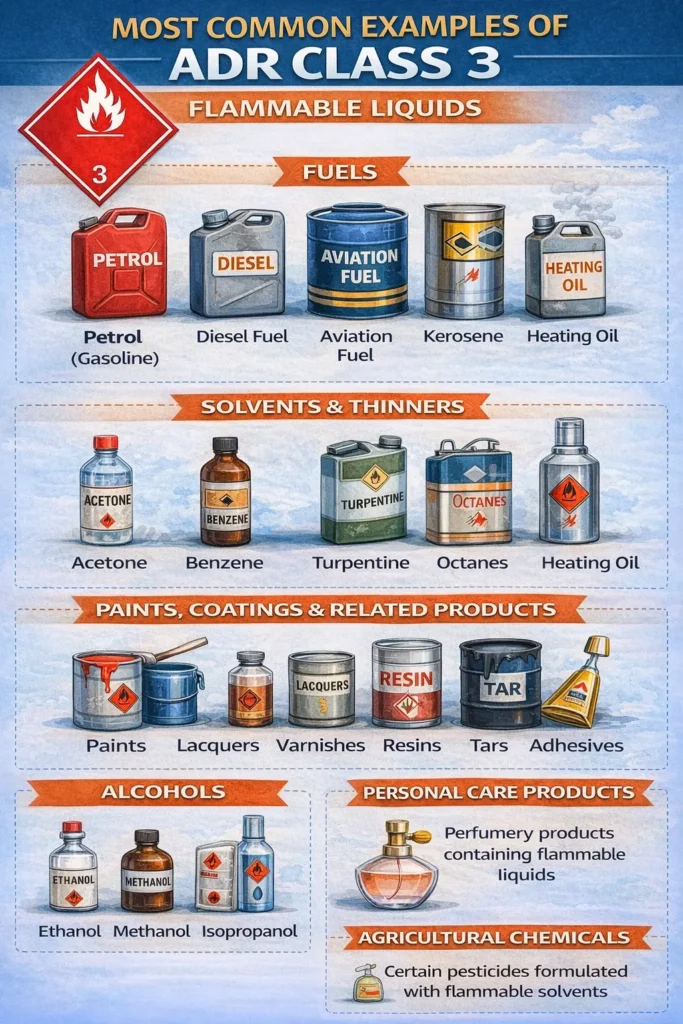
What are the most common examples of ADR Class 3 flammable liquids?
The most common examples of ADR Class 3 flammable liquids include a wide array of products and chemicals that are frequently shipped as dangerous goods, primarily comprising various fuels, solvents, and household products.
- Fuels: This category includes Petrol, Diesel Fuel, Aviation Fuel, Kerosene, and Heating Oil.
- Solvents and Thinners: Common examples are Acetone, Benzene, Turpentine, and various Octanes.
- Paints, Coatings, and Related Products: This includes Paints, Lacquers, Varnishes, Resins, Tars, and Adhesives.
- Alcohols: Key examples include Ethanol, Methanol, Butanols, and Isopropanol.
- Personal Care Products: Perfumery products often fall under this classification.
- Agricultural Chemicals: Some Pesticides that utilise flammable solvents are classified as Class 3 liquids.
How are substances assigned UN numbers between 1202 and 1993?
The assignment of UN numbers, including those between 1202 and 1993, is determined by the specific classification and composition of the substance.
Generally, UN numbers, which range from UN0001 to about UN3500, are assigned by the United Nations Committee of Experts on the Transport of Dangerous Goods. These numbers are published as part of their Recommendations on the Transport of Dangerous Goods, also known as the Orange Book, and are adopted by the regulatory organisations responsible for different modes of transport.
For hazardous mixtures or articles, determining the accurate UN number and proper shipping name requires significant effort and expertise, as multiple entries may seem applicable. Numbers within the 1202 to 1993 range often correspond to generic or “not otherwise specified” (N.O.S.) proper shipping names. When an N.O.S. entry is used (for example, UN1993 FLAMMABLE LIQUID, N.O.S.), the description must be supplemented with the technical name(s) of the goods. The technical names shall be entered in brackets immediately following the proper shipping name, and modifiers such as “mixture,” “solution,” “contains,” or “containing” may be used to specify the constituent, as seen in the designation: “UN1993 FLAMMABLE LIQUID, N.O.S. (CONTAINS XYLENE AND BENZENE).
What is the significance of these UN numbers in transport?
The significance of UN numbers in transport is that they serve as a mandatory, four-digit identification system required for the transport of dangerous goods by road, rail, sea, and air.
This standardised system is critical for safety and consistency across borders for the following reasons:
- UN numbers provide important information about the nature of the substance, including the type (e.g., flammability or toxicity) and degree of hazard, and detail any special handling and storage requirements.
- They ensure dangerous goods are handled, packaged, and transported safely and consistently across borders, thereby reducing the risk of accidents.
- The system supports coordinated emergency response and management efforts in the event of a spill or release.

What packing rules apply to ADR Class 3 liquids?
The packing rules that apply to ADR Class 3 liquids (flammable liquids) are detailed within the general packing instructions provided by the modes of transport regulations. Class 3 substances and articles are initially classified by being listed in Table A of Chapter 3.2. Substances not explicitly mentioned by name in Table A shall be assigned to the relevant entry of 2.2.3.3 and the relevant packing group in accordance with the provisions of that section.
Flammable liquids must be assigned to one of the following packing groups based on the degree of danger they present during carriage. Furthermore, limited quantity and excepted quantity provisions may also apply to the packaging requirements for these dangerous goods.
What packaging groups are used for ADR Class 3 substances?
The packaging groups used for ADR Class 3 substances, which are flammable liquids, are assigned based on the degree of danger the substance presents, just like most other dangerous goods (including explosive, toxic, and corrosive materials). These groups are denoted by Roman numerals and specific codes used in certification marks:
- Packaging Group I (Code X): Used for goods presenting great danger, requiring packaging to pass a drop test from at least 1.8 meters.
- Packaging Group II (Code Y): Used for medium danger, requiring packagings to pass a drop test from at least 1.2 meters.
- Packaging Group III (Code Z): Used for low danger, requiring packagings to pass a drop test from at least 0.8 meters.
How does ADR regulate container types and capacity?
The ADR regulates container types and capacity through specific packaging instructions assigned to each hazardous substance. Each hazardous substance is assigned an identifying UN number accompanied by these instructions, which establish the exact types of containers and packages that may be used, the materials they must be made of, and their maximum capacity. Furthermore, different packaging requirements apply according to the substance’s assigned Packing Group (PG), which may limit the availability of certain container types and restrict their maximum volume, such as limiting drums to 250 litres.
What compatibility requirements must be followed for ADR Class 3 packaging?
The compatibility requirements that must be followed for ADR Class 3 packaging relate to the physical characteristics of the dangerous goods, the material interaction, and specific coding standards.
First, the approved packaging must only contain dangerous goods that have similar or the same physical characteristics as the test substances or articles for which the packaging was successfully tested. Furthermore, the packaging materials must be compatible with the contents. The filler, packer, or consignor is ultimately responsible for ensuring this material and physical compatibility.
Second, packaging groups must be coded, defining certain requirements for the packaging per se. These standards make a distinction between X-coding, Y-coding, and Z-coding.
What vehicle codes are required for transporting ADR Class 3 goods?
The vehicle codes and specific requirements necessary for transporting Class 3 goods are primarily dictated by the international regulatory framework known as ADR (European Agreement concerning the International Carriage of Dangerous Goods by Road).
ADR sets out comprehensive requirements covering the classification, packaging, labelling, certification, and specific vehicle and tank requirements for dangerous goods, and these rules are applied in Great Britain (England, Wales, and Scotland) by the Carriage of Dangerous Goods and Use of Transportable Pressure Equipment Regulations 2009 (as amended). While Class 3 defines the type of danger (flammable liquids), the necessary specific operational requirements, vehicle needs, and applicable small load exemptions depend on secondary classifications, which determine the severity of the danger and the load threshold:
- Packing Group (PG): This classification defines the degree of danger the substance presents. PG I indicates the most dangerous, PG II represents a moderate danger, and PG III is the least dangerous. These groups are written in Roman numerals to differentiate them from the Class numbers.
- Transport Category (TC): The TC determines the load limits (thresholds) and eligibility for small load exemptions relating to the total quantity of dangerous goods carried by the transport unit (van or lorry). The TC is essential for compliance and is typically found in column 15 of Table A in ADR (Chapter 3.2).

What vehicle types are authorised for Class 3 flammable liquids?
The vehicle types authorised for Class 3 flammable liquids are those generally defined as a ‘transport unit’ under dangerous goods regulations, which utilise a classification system where substances are assigned to one of nine classes depending on the nature of the danger. A ‘transport unit’ means either a motor vehicle without an attached trailer, or a combination consisting of a motor vehicle and an attached trailer. Class 3 covers substances that are liquids having a flash-point of not more than 60 °C, a vapor pressure of not more than 300 kPa (3 bar) at 50 °C, and are not completely gaseous at 20 °C. Furthermore, the class includes liquid substances and molten solid substances carried while heated at temperatures equal to or higher than their flash-point (assigned to UN No. 3256), and liquid desensitised explosives (such as UN Nos. 1204, 2059, 3064, 3343, 3357, and 3379).
How are vehicle codes determined based on hazard level and volume?
The vehicle codes, specifically the Automotive Safety Integrity Levels (ASIL), are determined by classifying the severity, exposure, and controllability of identified hazardous events. This process involves assessing three primary factors: Severity (S), which quantifies the potential for injury (e.g., S3 for fatal injuries); Exposure (E), which relates to the probability or volume of the hazardous situation occurring (e.g., E3 for medium probability, or E4 for the highest probability); and Controllability (C), which is assigned based on the operational situations and unsafe control actions, indicating how difficult or uncontrollable the situation is for the driver (e.g., C3). The combination of these classifications dictates the final ASIL. For example, a hazardous event classified as S3, E3, and C3 results in an ASIL C designation. Conversely, the combination of extremes, such as S3, E4, and C3, refers to a highly hazardous, severely life-threatening situation, resulting in ASIL D, which requires the most stringent levels of safety measures.
What construction and safety standards apply to these vehicles?
The construction and safety standards that apply to these vehicles are primarily defined by the Road Vehicles Construction and Use Regulations 1986, which cover the design, manufacture, maintenance, construction, and use of motor vehicles and trailers used by road transport operators.
It is necessary to look for the appropriate section of the Regulations to discover specific legal requirements, which include:
- The legal weight of a vehicle and its axles.
- The legal maximum dimensions of the vehicle and its load, including maximum length, width, and height of various classes of vehicles.
- Regulations concerning any overhang or projection forward or rearward.
It is important to note that while associated guidance includes useful and practical advice not available in other HSE publications, officials are aware that a number of references, including the applicable and relevant legislation cited within the guidance, may be out of date.

How are ADR Class 3 loads labelled for ADR transport?
The labelling requirements for Class 3 loads being transported under ADR are determined by a logical progression starting with proper classification, which is the precursor for all subsequent requirements.
For Class 3 dangerous goods, which are defined as flammable liquids or molten substances (such as alcohol or petrol) that ignite when a certain temperature or pressure is reached, classification is based primarily on their flash point and any additional hazards posed (e.g., toxic, explosive, or corrosive). Specific letter codes reflect these hazards, such as F1 (flash point of maximum 60°C), F2 (flash point higher than 60°C), or FTC (flammable liquids that are toxic and corrosive).
Once a substance or article has been properly classified, all packaging, marking, and labelling requirements, including the suitability of packaging materials and the specific marks and labels they must bear, are ascertained by working logically through the columns of Table A (ADR 3.2.1). Together, the final determined Class and its corresponding Packing Group (PG) dictate exactly how the goods must be packaged, labelled, and carried.
What hazard labels are mandatory for flammable liquids?
The hazard labels mandatory for flammable liquids are the internationally recognised Flammable GHS labels, which are required for all dangerous substances under regulations such as the GB CLP Regulation (aligned with the United Nations Globally Harmonised System). This standardised warning label, which is legally valid for cross-border shipments, features the specific pictogram or symbol of a flame to indicate flammability.
Specific physical requirements apply to the mandatory Flammable Liquid Class 3 label for packages:
- The label must be at least 100 x 100mm, from edge to edge, and set at an angle of 45°.
- The label must show the class number ‘3’ in the bottom corner, utilising text that is at least 12mm high.
- It must show a dotted outer boundary line unless the label is being applied on a background of contrasting colour.
What placards must appear on transport units?
The placards that must appear on transport units carrying dangerous goods are two rectangular, plain orange-coloured plates, set in a vertical plane. These plates shall be affixed one at the front and the other at the rear of the transport unit, perpendicular to its longitudinal axis, and must be clearly visible. This requirement applies to dangerous goods transport, including IMDG journeys carried out internationally or within Great Britain. If a trailer containing dangerous goods is detached from its motor vehicle during carriage, an orange-coloured plate must remain affixed to the rear of the trailer. When tanks on the transport unit are marked in accordance with specific regulations, the plate affixed to the rear must correspond to the most hazardous substance carried in the tank.
How are labelling instructions linked to packing group and UN number?
Labelling instructions are directly linked to the packing group (PG) and the dangerous goods class because proper classification is the essential first step for safe, correct, and legal packaging. Dangerous goods fall into nine classes, such as flammable liquids or toxic substances, and each class has specific packaging and labelling rules that must be followed. Together, the assigned class and the PG dictate how you must package, label, and carry the dangerous goods, including determining the suitability of packaging materials, requirements for both inner and outer packaging, and the mandatory marks and labels the package must bear.
What are the primary risks in transporting ADR Class 3 liquids?
The primary risks in transporting Class 3 liquids are centred around their inherent flammability, but may also include additional hazards depending on the substance’s specific properties. Class 3 dangerous goods, such as alcohol or gasoline, are defined as liquid or molten substances that ignite when a certain temperature or pressure is reached. Their overall degree of danger is classified based predominantly on their flash point, which dictates their assigned packing group (PG) according to regulations like ADR.
The specific hazards associated with the transport of Class 3 flammable liquids include:
- Flammability: This is the predominant hazard, measured by the substance’s flash point (e.g., F1 denotes a flash point of maximum 60°C, while F2 is higher than 60°C).
- Toxicity: Certain Class 3 substances may pose an additional toxic hazard.
- Corrosiveness: Some flammable liquids are also classified as corrosive (e.g., reflected in the FTC classification: flammable liquids, toxic, corrosive).
- Explosiveness: Additional hazards posed by these dangerous goods can include explosiveness.
Why is vapour release a key risk for ADR Class 3 goods?
Vapour release is a key risk for ADR Class 3 goods because this class covers flammable liquids and liquid desensitised explosives, and the primary hazard is directly tied to their flashpoint (FP). The flashpoint is defined as the lowest temperature at which just sufficient vapour is given off by the liquid to be ignited when coming into contact with a naked flame, making the release of vapour the essential precursor for ignition. Furthermore, specific activities involving these materials, such as when employees decant flammable liquids from one container to another, can also release toxic fumes, requiring protective measures like respirators.

What measures are required to prevent ignition or leaks?
The measures required to prevent ignition or leaks involve ensuring compliance with all relevant parts of ADR, including required driver training and appropriate vehicle equipment. Furthermore, appropriate measures shall be taken to ensure that there is no dangerous build-up of pressure.
If dangerous goods are being carried in tanks, a telephone number where specialist advice concerning the dangerous goods in question can be obtained in English at any time during carriage must be prominently displayed. This required display must utilise black digits of not less than 30mm in height against an orange-coloured background and must be shown in the following locations:
- At the rear of the transport unit.
- On both sides of any tank, the frame of any tank, or the transport unit; and
- In the immediate vicinity of the orange-coloured plates displaying the emergency action codes.
What environmental risks are associated with ADR Class 3 spills?
The environmental risks associated with ADR Class 3 spills are the hazards that the strict classification and safety measures for transporting dangerous substances are designed to prevent. The system assigns a class to each dangerous substance or article to define the type of danger it presents, with the level of danger further classified by a packing group (PG I, PG II, or PG III).
Because the shipping of these hazardous items involves certified containers that meet specific safety performance levels, a spill could result in the high risks these measures are intended to prevent, including leaks, explosions, and environmental contamination.

What special provisions and exemptions apply to ADR Class 3 goods?
The special provisions and exemptions that apply to ADR Class 3 goods primarily cover stabilisation requirements for carriage and quantity exemptions for specific goods and packagings.
For substances (other than self-reactive substances or organic peroxides) that are liable to react dangerously under conditions normally encountered during carriage, the word “STABILIZED” must be added as part of the proper shipping name (e.g., “TOXIC LIQUID, ORGANIC, N.O.S., STABILIZED”). This rule applies unless the stabilisation status is already indicated in capital letters in Column (2) of Table A of Chapter 3.2.
Specific exemptions applicable to Class 3 substances include:
- Empty Uncleaned Packagings: Empty, uncleaned packagings (including IBCs and large packagings) that have contained Class 3 substances are not subject to the conditions of ADR if adequate measures have been taken to nullify all associated hazards.
- Quantity Exemptions for Paint (UN 1263 PG II): The ADR agreement does not apply to Paint (UN 1263 PG II) when packaged in limited quantities, provided the boxes or trays are appropriately marked. This includes cans up to 5 litres packed in a box not exceeding a gross weight of 30 kg, or cans up to 1 litre placed on a shrink-wrapped tray not exceeding a gross weight of 20 kg.
What ADR special provisions modify standard rules for Class 3?
The ADR special provisions that modify standard rules for Class 3 substances primarily address specific classification limits and packaging requirements:
- Special Provision 28 (SP28) relates to numerous UN numbers assigned to Class 3 (and 4.1), specifying that when packed, the percentage dilution must not fall below a stated level.
- A specific modification exists regarding the classification of petrol (gasoline) based on vapor pressure: even if petrol in certain climatic conditions has a vapor pressure at 50 °C exceeding 110 kPa (1.10 bar) but not more than 150 kPa (1.50 bar), it is required to continue to be considered a substance having a vapor pressure of not more than 110 kPa (1.10 bar) for classification purposes.
When do limited quantity exemptions apply to flammable liquids?
Limited quantity exemptions apply to flammable liquids and other hazardous materials when they are shipped in smaller amounts, which presents a lower risk and allows for reduced regulatory requirements during transport.
However, the applicability of this exemption is not universal; if a specific good’s limit in Table A, column 7a, is zero, it cannot be shipped as a limited quantity.
A specific example illustrating when these exemptions apply is Paint (UN 1263 PG II). For this flammable liquid, the requirements of ADR (European Agreement concerning the International Carriage of Dangerous Goods by Road) do not apply, provided the following quantity and weight limits are observed, and the container is appropriately marked:
- Cans up to 5 litres may be packed in a box, provided the gross weight of the box does not exceed 30 kg.
- Cans up to 1 litre may be placed on a shrink-wrapped tray, provided the gross weight of the tray does not exceed 20 kg.
How does ADR treat mixed loads containing Class 3 substances?
The ADR treats mixed loads containing Class 3 substances by implementing strict co-loading and segregation rules based on the danger labels packages bear. Packages bearing different danger labels shall not be loaded together in the same vehicle or container unless explicit mixed loading is permitted according to a specific compatibility table referenced in the regulations. These classifications directly impact how goods can be loaded together; for instance, a flammable liquid classified as Class 3 (such as toluene) must be segregated from food items or substances with low ignition thresholds to prevent chemical reactions, fire, or spoilage during transit. Additionally, depending on the substances and package size, if there are mixed loads, the specific aggregation rules detailed in ADR section 1.1.3.6.4 must be applied.
Why is driver training critical for ADR Class 3 flammable liquids?
Driver training is critical for Class 3 flammable liquids because general training for the driver (ADR 1.3.2) remains a mandatory obligation under transport regulations, even when the vehicle is carrying dangerous goods under the small load threshold. Although many ADR requirements may not apply in these small load scenarios, the remaining obligations, which include keeping a training record (ADR 1.3.3), properly stowing the dangerous goods (ADR 7.5.7), and carrying safety equipment like a 2 kg dry powder fire extinguisher (ADR 8.1.4.2), still require the driver to have fundamental knowledge. This ensures the safe handling and transport of these substances, whether they are specific Class 3 UN numbers (such as UN No. 3343) or generic flammable liquids (like UN 1993, FLAMMABLE LIQUID, N.O.S.).
What certification is needed for drivers transporting ADR Class 3 goods?
The certification needed for drivers transporting Class 3 goods, which fall under the scope of dangerous goods carried by road, is the ADR vocational certificate. This requirement, specified under ADR section 8.2.3, applies to personnel involved with the carriage of dangerous goods. The overall ADR system dictates all training and regulatory requirements based on the proper classification of the substance (ADR 3.2.1). However, drivers who possess training in accordance with 8.2.1 for the specific carriage of substances in tanks may not need additional training for the transport of related additives.

What training modules cover ADR Class 3 handling and response?
The training modules that cover Class 3 handling and response are primarily integrated within the General training for the driver (ADR 1.3.2), which addresses the necessary knowledge for handling Dangerous Goods. Since Class 3 (Flammable Liquids) must be identified and classified by appropriate handling codes within transport networks, this general training ensures compliance with safety protocols. Essential requirements related to this process includes,
- Completion of general driver training covering the classification and handling of Dangerous Goods (ADR 1.3.2).
- The maintenance of a record documenting the completed training (ADR 1.3.3).
- Understanding that exemptions exist for ‘limited quantities’ of dangerous goods, which waive the need to follow all normal packaging and labelling regulations or utilise a dangerous goods safety adviser.
How is training verified under ADR rules?
Verification of training under ADR rules is primarily ensured through the mandatory requirement that any person involved in preparing, handling, or transporting dangerous goods, including drivers, warehouse workers, and supervisors, must undergo formal instruction aligned with the ADR framework (ADR 1.3.2). To verify that this training is completed, a formal record of the general instruction must be kept, as required by ADR 1.3.3. Without proper certification documenting this instruction, personnel risk non-compliance and penalties.

How is ADR Class 3 compliance enforced through inspections?
The enforcement of ADR Class 3 compliance through inspections is achieved by verifying adherence to required safety measures, including specific labelling, documentation, and operational protocols, particularly when operating under small load exemptions.
For Class 3 substances, inspectors check specific classification and documentation requirements. For example, unless the substance is already classified as a self-reactive substance or organic peroxide, the word “STABILIZED” must be added as part of the proper shipping name of a substance that would otherwise be forbidden from carriage because it is liable to react dangerously under normal transport conditions.
When a vehicle is carrying dangerous goods under the small load threshold (meaning the quantity does not exceed the values indicated in the relevant transport category table), inspection enforcement focuses on the critical remaining obligations that are still mandatory:
- The driver must have general training (ADR 1.3.2), and a corresponding record of this training should be maintained (ADR 1.3.3).
- The vehicle must carry at least one 2 kg dry powder fire extinguisher or an equivalent firefighting device (ADR 8.1.4.2).
- The dangerous goods must be stowed and secured properly within the transport unit (ADR 7.5.7).
- Compliance with specific requirements that are not exempted, such as certain security provisions (Chapter 1.10), vehicle monitoring, and specific operational rules related to supervision and prohibition of opening packages (Sections 8.3.3, 8.3.4, and 8.3.5).
What documentation is required during transit of ADR Class 3 goods?
The documentation required during transit of Class 3 goods (flammable liquids) must adhere to strict transport regulations, such as those defined by ADR, where proper classification is the precursor for determining all subsequent requirements found in Table A (ADR 3.2.1). A mandatory transport document must be prepared for the dangerous consignment, and this documentation specifically needs to be kept accessible in the driver’s cab during transit.
If the Class 3 goods are carried under special provisions (such as waste), the transport document must be declared in accordance with section 5.4.1.1.3 and include the necessary sequence of elements, such as the UN number, proper shipping name, hazard class, packing group, and tunnel code. For instance, the declaration for waste paint must follow one of the specified formats:
- UN 1263 WASTE PAINT, 3, II, (D/E)
- UN 1263 WASTE PAINT, 3, PG II, (D/E)
What are common non-compliance issues and penalties?
Common non-compliance issues in the transportation of dangerous goods typically stem from the failure to meet requirements that are not exempted, even when shipping goods in limited quantities. While exemptions simplify the shipping process by removing the need to follow all normal packaging and labelling regulations or employ a dangerous goods safety adviser, certain strict obligations always remain and become common areas of non-compliance if ignored.
These common non-compliance issues include:
- Failing to ensure the driver has the general training required for the transport of dangerous goods (ADR 1.3.2).
- Neglecting to maintain a formal record of driver training (ADR 1.3.3).
- Not carrying the mandatory fire safety equipment, such as at least one 2 kg dry powder fire extinguisher or equivalent (ADR 8.1.4.2).
- Improperly stowing the dangerous goods (ADR 7.5.7).
Although the transportation of dangerous goods is strictly regulated to ensure safety, the specific penalties associated with these non-compliance issues were not detailed in the provided sources.
How do authorities verify correct packing and vehicle use?
Authorities verify correct packing and vehicle use through a combination of mandatory documentation checks and adherence to specific loading and safety requirements:
- Key documents prepared by shippers before loading are examined, including the Dangerous Goods Declaration (DGD), which confirms the classification, packaging, and handling of hazardous materials and must be signed by a trained, certified individual.
- The Container Packing Certificate (CPC) is checked to verify that the container has been packed in accordance with all applicable safety standards and segregation rules.
- Compliance with segregation rules is verified by ensuring that packages bearing different danger labels are not loaded together in the same vehicle or container unless mixed loading is expressly permitted according to regulatory tables.
- For vehicles carrying goods under the small load threshold, authorities still ensure adherence to remaining obligations, such as the driver having general training (with a record kept), the carrying of necessary safety equipment like one 2 kg dry powder fire extinguisher or equivalent, and that dangerous goods are properly stowed.