
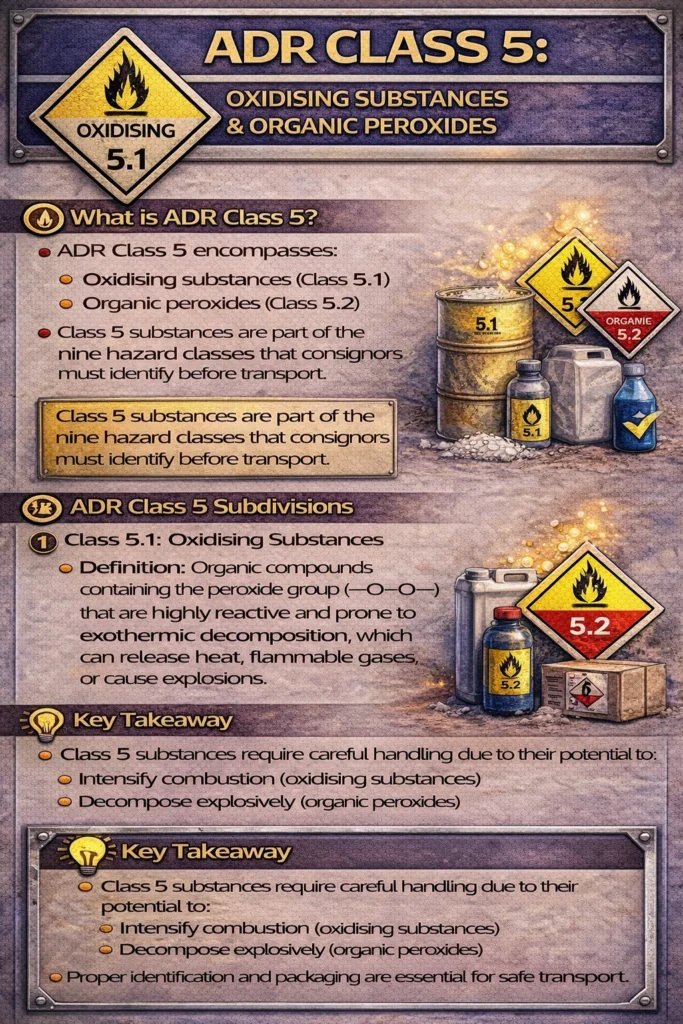
ADR Class 5 covers oxidising substances (Class 5.1) and organic peroxides (Class 5.2), both of which present significant fire and decomposition risks during transport. Consignors are required to correctly identify these hazards, as oxidisers can intensify combustion while organic peroxides are prone to exothermic decomposition, potentially releasing heat, flammable gases, or causing explosive reactions.
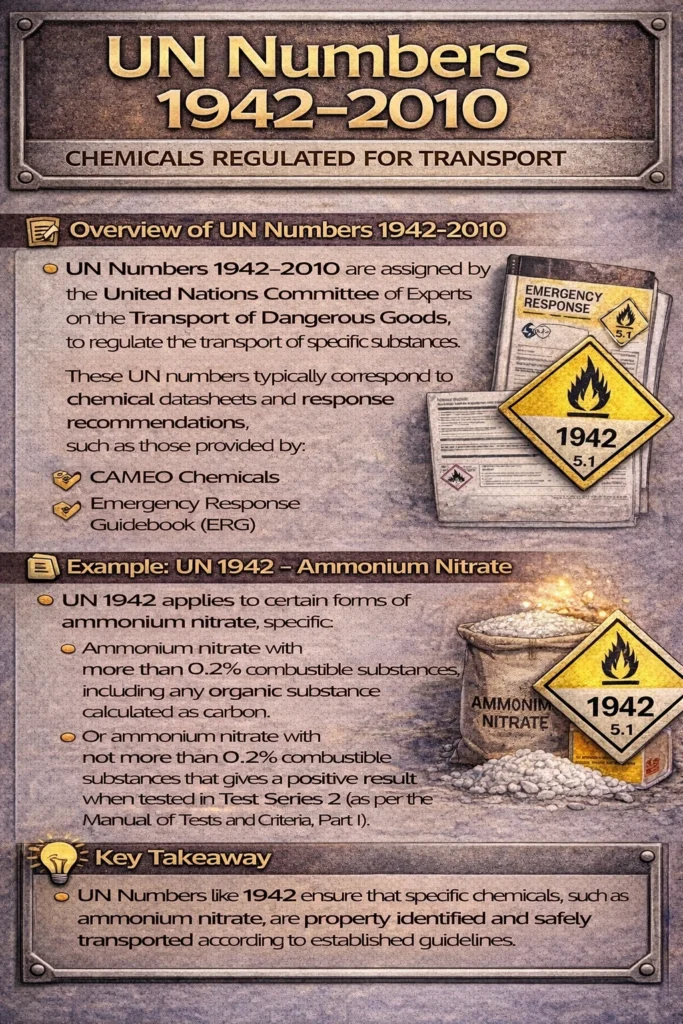
UN Numbers 1942–2010 are assigned to Class 5 substances by the United Nations Committee of Experts on the Transport of Dangerous Goods. These entries include specific chemicals such as certain forms of ammonium nitrate (UN 1942), classified based on combustible content and test results defined in the UN Manual of Tests and Criteria.
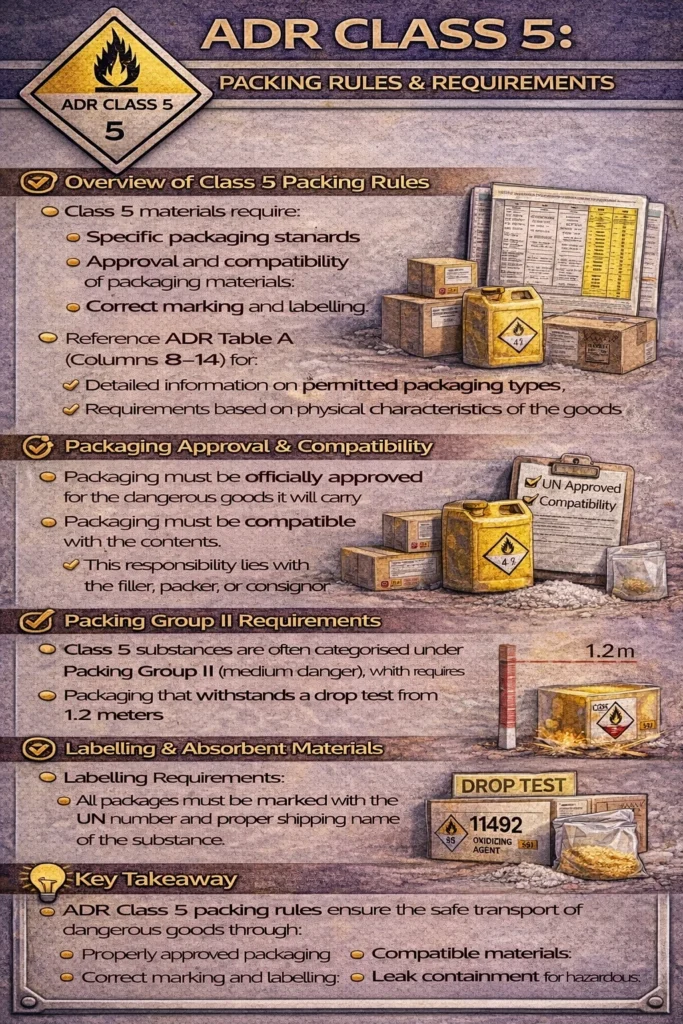
Packing rules for Class 5 materials are determined through ADR Table A (Columns 8–14) and require the use of UN-approved, compatible packaging that has been performance tested. Many Class 5 substances fall under Packing Group II (Y), requiring packagings capable of withstanding a 1.2-metre drop test, correct marking with the UN number and proper shipping name, and, where necessary, the use of absorbent materials to retain leakage.
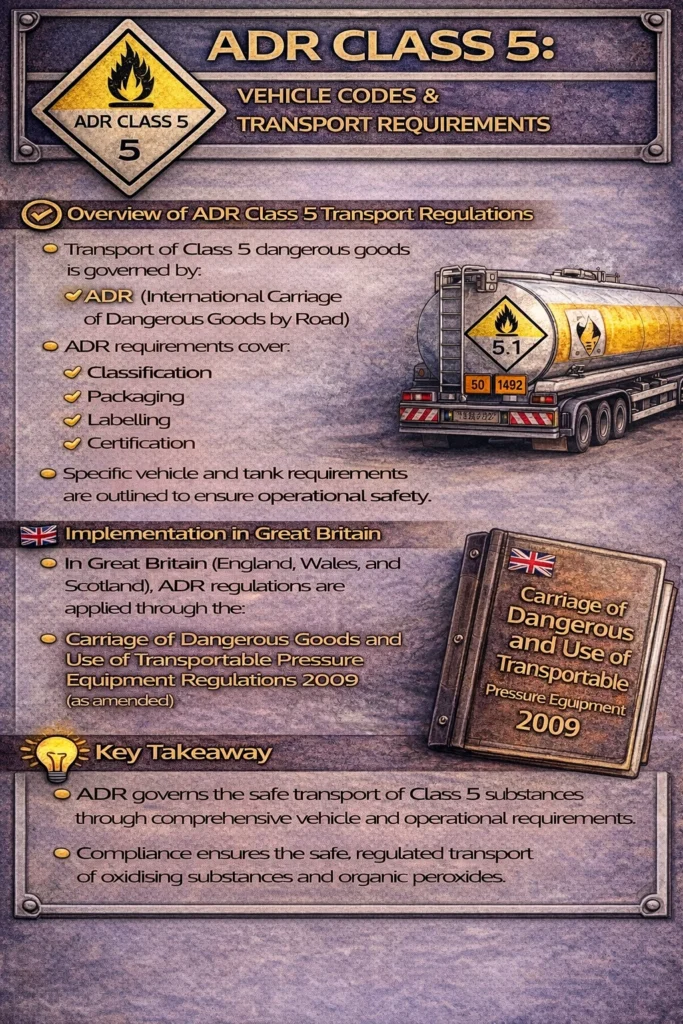
Vehicle codes and transport requirements for Class 5 goods are governed by ADR and implemented in Great Britain through the Carriage of Dangerous Goods and Use of Transportable Pressure Equipment Regulations 2009 (as amended). These rules define vehicle, tank, and operational standards to ensure the safe and compliant transport of oxidising substances and organic peroxides by road.
What substances are classified under ADR Class 5?
The substances classified under ADR Class 5 are oxidising substances and organic peroxides. ADR classifies dangerous goods into nine distinct classes, and consignors have a duty to identify the hazards of the goods they intend to transport. Class 5 dangerous goods are comprised of these oxidising substances and organic peroxides, which are further separated into 2 subdivisions.
How does ADR define oxidising substances and organic peroxides?
ADR defines oxidising substances and organic peroxides as Class 5 dangerous goods, which are part of the nine hazard classes that consignors have a duty to identify prior to transport. Class 5 dangerous goods are categorised into two subdivisions:
- Class 5.1: Oxidising substances
- Class 5.2: Organic peroxides
The definition provided for Class 5.1 specifies that oxidising substances are materials, which can be in both solid or liquid form, that are not necessarily combustible themselves. However, they may cause or contribute to the combustion of other materials and articles, generally by yielding oxygen.
What differentiates ADR Class 5.1 from ADR Class 5.2?
The factor that differentiates ADR Class 5.1 from Class ADR 5.2 is their specific chemical classification within the overall ADR Class 5 dangerous goods, which encompasses both types.
ADR Class 5.1 is specifically defined as an oxidising substance. These are materials, which can be found in both solid and liquid forms, that are not necessarily combustible themselves but may cause or contribute to the combustion of other articles and materials, generally by yielding oxygen.
In contrast, ADR Class 5.2 is defined as an organic peroxide.
Why are ADR Class 5 materials a fire and decomposition hazard?
ADR Class 5 materials are a fire and decomposition hazard primarily because they consist of oxidising substances and organic peroxides. The critical hazard stems from organic peroxides, which are liable to exothermic decomposition, a process that releases heat at both normal and elevated temperatures. This decomposition can be readily initiated by external factors such as heat, friction, impact, or contact with impurities, including acids and heavy metal compounds. As the rate of decomposition increases with temperature, this process can result in the evolution of harmful or flammable gases and vapours. Furthermore, certain organic peroxides may decompose explosively, particularly if confined, necessitating controlled temperatures during transport. In addition to the explosive decomposition risk, many organic peroxides burn vigorously, significantly contributing to their classification as a serious fire hazard.
Which substances are listed under UN Numbers 1942–2010?
The substances listed under UN Numbers 1942–2010 are chemicals designated by the United Nations Committee of Experts on the Transport of Dangerous Goods, which assigns numbers in the range of UN 1901 to UN 2000 to regulate the transport of these materials. These UN numbers generally correspond to chemical datasheets and response recommendations, such as those provided by CAMEO Chemicals and the Emergency Response Guidebook (ERG). Specifically, UN No. 1942 applies to certain forms of ammonium nitrate. This entry covers ammonium nitrate with either more than 0.2% combustible substances (including any organic substance calculated as carbon, to the exclusion of any added substance) or ammonium nitrate with not more than 0.2% combustible substances that gives a positive result when tested in accordance with Test Series 2 (Manual of Tests and Criteria, Part I).
What are the common examples in the UN 1942–2010 range?
The common examples of UN numbers in the 1942–2010 range encompass various classes of hazardous materials, including solids, gases, and flammable liquids:
- Ammonium nitrate (UN 1942): This classification applies primarily to ammonium nitrate containing not more than 0.2% combustible substances (including any organic substance calculated as carbon, to the exclusion of any other added substance). Related UN entries cover ammonium nitrate with higher combustible substance percentages or those that give a positive result when tested according to Test Series 2.
- Safety matches (UN 1944).
- Aerosols (UN 1950): Various types of aerosols.
- Class 2 Compressed or Liquefied Gases: Examples include Argon (UN 1951), Ethylene (UN 1962), Helium (UN 1963), Liquid hydrogen (UN 1966), Methane (UN 1971/1972), Nitrogen (UN 1977), and Propane (UN 1978).
- Class 3 Flammable Liquids: These contain different types of Alcohols (e.g., UN 1986, 1987), Flammable liquids, n.o.s. (UN 1993), and Tars, liquid (UN 1999).
- Other Specific Entries: Items such as Iron pentacarbonyl (UN 1994) and Celluloid (UN 2000).
How are UN numbers assigned to ADR Class 5 substances?
The assignment of UN numbers to ADR Class 5 substances is governed by criteria established by the United Nations Committee of Experts on the Transport of Dangerous Goods.
Substances receive UN numbers in one of two ways: either the dangerous substance or article is assigned its own specific UN number, or, if not mentioned by name, the substance is assigned to a generic or n.o.s. (not otherwise specified) entry. This assignment to a generic entry must be performed in accordance with the specific criteria and “decision trees” detailed in Part 2 of the regulations. For example, specific ranges such as UN1901 to UN2000 are allocated for various ADR Class 5 assignments.
In the United States, these designated hazardous materials, their UN numbers, and their classifications for purposes of transportation are listed in the Hazmat Table found in 49 CFR 172.101.
What is the function of UN numbers in classification and labelling?
The function of UN numbers in classification and labelling is to serve as a unique, numerical identifier that links dangerous substances or articles to their comprehensive regulatory requirements in the Dangerous Goods List or Hazmat Table. The UN number contains the designation for either a substance that has been assigned its own specific number, or it points to a generic or ‘n.o.s.’ (not otherwise specified) entry. N.o.s. entries are collective entries assigned to substances, mixtures, or articles not explicitly mentioned by name, provided they exhibit chemical, physical, and dangerous properties corresponding to the Class, classification code, and packing group of that entry. Once identified via the UN number, corresponding datasheets display essential classification details required for proper labelling and shipping, including the proper shipping name, hazard classes and divisions (and compatibility group letters for explosives), relevant label codes, and special notes, such as whether the material is an inhalation hazard.
What packing rules apply to Class 5 materials under ADR?
The packing rules that apply to Class 5 materials under ADR are multifaceted, requiring specific standards for packaging selection, approval, compatibility, and marking. To determine the detailed, permitted packaging for these dangerous goods, reference should be made to ADR’s Table A, specifically accessing the information provided in Columns 8 through 14. Packaging must be officially approved and may only contain dangerous goods whose physical characteristics are similar or identical to the test substances for which the packaging was successfully tested. Furthermore, the packaging materials must be compatible with the contents, a crucial responsibility that rests with the filler, packer, or consignor.
For ADR Class 5 materials, often categorised under Packing Group II (considered medium danger and marked ‘Y’), the packaging is required to withstand a drop test from 1.2 meters. All packages containing these dangerous goods must be labelled and marked with the appropriate UN number followed by the name of the substance. Additionally, absorbent material may be required for use as an inner package or a packing aid to ensure that any liquid or solid leakage is completely retained within the packaging.
How are packaging groups determined for ADR Class 5 substances?
Packaging groups for ADR Class 5 substances, similar to other hazardous materials (dangerous goods including explosive, flammable, toxic, and corrosive substances), are determined by a classification system that categorises them based on the degree of danger and the level of risk they pose during transportation.
This classification system divides the material classes into three distinct Packing Groups, each corresponding to a specific level of risk and having its own set of requirements and restrictions:
- Packing Group I: High danger
- Packing Group II: Medium danger
- Packing Group III: Low danger
Once the dangerous goods have been correctly classified and assigned a packaging group, detailed information on permitted packaging types is typically accessed via regulatory documents such as Table A, generally found in columns 8 through 14.
What materials and container types are authorised for packing?
The materials and container types authorised for packing include a range of single, intermediate, and bulk options, with specific requirements detailed in the ADR (European Agreement concerning the International Carriage of Dangerous Goods by Road), particularly in chapter 4.1. Authorised construction materials for packages include fibreboard, plastics, and metal, among others. Additionally, absorbent material may be used as an inner package or packing aid to ensure that leakage, especially of dangerous liquids or solids associated with categories like Packing Group II (medium danger), is retained within the container.
Authorised container types, which are further defined within ADR Chapter 1.2 and subject to compliance with additional regulations (such as protection against impacts), include:
- Single packages, such as boxes, bags, jerricans, and drums.
- Packagings (a general regulatory term).
- Intermediate bulk containers (IBCs).
- Large packagings.
- Bulk containers, including various sorts of tanks and freight containers.
How do temperature and contamination risks affect packaging decisions?
Temperature and contamination risks significantly affect packaging decisions by dictating material choice, structural integrity requirements, and specific risk mitigation strategies that ensure the contents remain contained and uncompromised.
The fundamental packaging decision requires that the materials be chemically compatible with the contents, and that the filler, packer, or consignor ensure the packaging only contains dangerous goods that have similar physical characteristics to the test substances for which the package was successfully approved. These risks also require specific design choices and precautions:
- Environmental and Temperature Degradation: Packaging must account for environmental stressors. For instance, plastic large packaging stored outside in sunlight and subjected to regular sterilisation for over five years may degrade and fail to meet the UN test standard.
- Contamination Control and Leakage Retention: For medium danger substances (such as those in Packing Group II, including corrosive, toxic, and flammable liquids), the packaging must be structurally sound enough to withstand rigorous tests, such as a drop test from 1.2 meters. Additionally, to manage internal contamination risks, absorbent material may be required as an inner package or packing aid to ensure any liquid or solid leakage is retained within the external packaging boundaries.
- Risk Identification: Packages containing dangerous goods must be clearly labelled and marked with the UN number and the substance’s name to prevent mishandling or cross-contamination.
What vehicle codes apply to ADR Class 5 transport operations?
The vehicle codes that apply to Class 5 transport operations are primarily governed by the International Carriage of Dangerous Goods by Road (ADR). The ADR establishes comprehensive requirements for the safe transport of dangerous goods, covering their adr classification, packaging, labelling, and certification, and also includes specific vehicle and tank requirements necessary for operational compliance. In Great Britain (England, Wales, and Scotland), the regulations for the carriage of dangerous goods, including Class 5 operations, are implemented through the Carriage of Dangerous Goods and Use of Transportable Pressure Equipment Regulations 2009 (as amended).
What vehicle types are approved for transporting ADR Class 5 goods?
The vehicle types approved for transporting ADR Class 5 goods are determined by the specific requirements detailed in the Agreement concerning the International Carriage of Dangerous Goods by Road (ADR), which governs the adr classification, packaging, labelling, certification, and operational requirements for dangerous goods. The ADR sets out these comprehensive requirements, including specific vehicle and tank requirements, with vehicle construction and approval procedures covered explicitly in Part 9 of its framework. This regulatory system, which applies in Great Britain through the Carriage of Dangerous Goods and Use of Transportable Pressure Equipment Regulations 2009 (as amended), defines relevant transport vehicles, such as “Category N3,” which refers to vehicles used for the carriage of goods and having a maximum mass exceeding 12 tonnes.
How are vehicle codes linked to hazard severity and quantity?
Vehicle codes are linked to hazard severity and quantity through an integrated adr classification system that defines both the danger level of the substance and the maximum load capacity permitted for transport.
Hazard severity is established by the UN Model Regulations, which assign dangerous substances a specific Class defining the type of danger, and a further adr classification via a Packing Group (PG I, PG II, or PG III) determining the exact level of risk. These severity levels correspond directly to specific Transport Categories (0, 1, 2, or 3) that impose strict limits on the maximum volume or mass of the load concerned. For instance, dangerous goods in Transport Category 3, when carried in packages, must not exceed 1500 litres or kilograms.
The specific Vehicle Codes, such as Category N3 (vehicles used for the carriage of goods with a maximum mass exceeding 12 tonnes), then govern the physical capacity and operational limitations of the transporting vehicle, ensuring that the mass and volume restrictions associated with the hazard adr classification and transport category are not violated.
What construction and ventilation requirements apply to ADR Class 5 vehicles?
The construction and ventilation requirements for vehicles related to the transport of dangerous goods are primarily governed by the ADR (Agreement concerning the International Carriage of Dangerous Goods by Road) framework, which is legally applied in Great Britain (England, Wales, and Scotland) by the Carriage of Dangerous Goods and Use of Transportable Pressure Equipment Regulations 2009.
The ADR sets out specific vehicle and tank requirements, including operational requirements, documentation, and the adr classification, packaging, and labelling of dangerous goods. The construction and approval standards for such transport vehicles are detailed across several specialised parts of the ADR process:
- Part 4: Specifies Packing and tank provisions.
- Part 6: Covers the construction and testing of packagings, intermediate bulk containers (IBC), large packagings, and tanks.
- Part 9: Details the mandatory requirements for the construction and approval of vehicles.
It is important to note that “Category L5” refers to a general vehicle classification, defined as a three-wheeled vehicle symmetrically arranged with an engine capacity exceeding 50 cm3 or a maximum design speed exceeding 50 km/h, and is a distinct category separate from the dangerous goods Class 5 designation (Oxidizing substances and Organic peroxides), though any vehicle used to carry dangerous goods must adhere to the construction standards set forth by the ADR.
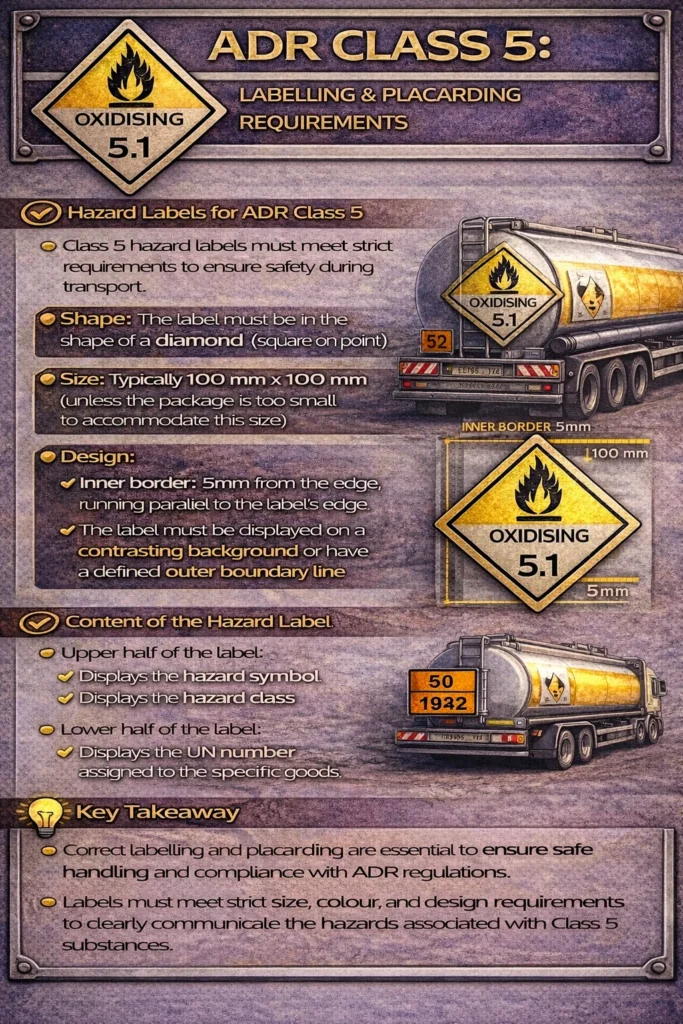
How are ADR Class 5 loads labelled and placarded?
The labelling and placarding requirements for ADR Class 5 loads involve specific formatting for the hazard labels and mandatory plates on the transport unit. Transport units carrying these loads, such as tanks, must be marked in accordance with relevant regulations, and typically require the display of plain orange plates on both the front and back of the unit. The specific hazard labels must meet detailed specifications regarding colour, symbols, numbers, and general format.
The specifications for the hazard label itself are as follows:
- The label must be shaped like a diamond, which is a square standing on its tip (square on point), and must meet dimensional requirements (typically 100 mm x 100 mm, unless the package is too small to accommodate this).
- The label must feature an inner border 5mm in, running parallel to the edge, and must be displayed on a contrasting background or have a defined outer boundary line.
- The upper half of the label contains the hazard symbol and the hazard class, while the lower half displays the UN number assigned to the specific goods.
- The Hazard Class must be shown as a number in the bottom corner of the label, with a height of not less than 10mm.
- The label must be weather-resistant and durable enough to withstand the conditions incident to transportation.
What hazard labels are required for ADR Class 5.1 and ADR Class 5.2?
The hazard labels required for ADR Class 5.1 and 5.2 serve as universally recognised identifiers, otherwise known as hazard warning diamonds, conveying the potential risks associated with the materials contained within a package. ADR Class 5.1 materials are oxidising substances that can cause or intensify a fire, such as hydrogen peroxide or sodium chloride. ADR Class 5.2 consists of organic peroxides, which often contain specific amounts of active oxygen and hydrogen peroxide.
Furthermore, the necessary marking and placarding requirements for tanks and tank containers carrying these materials are dependent on the mode of transport; requirements to comply with IMDG standards for sea passage differ from the ADR regulations relevant to vehicles.
How are placards displayed for mixed loads involving ADR Class 5?
Placards displayed for mixed loads involving ADR Class 5 dangerous goods are the large, visible diamond identifiers on the vehicle or container, meant to alert emergency responders to the hazards present. For these loads, the hazard diamonds (placards) representing both the primary hazard class and, where applicable, the secondary hazard class must be displayed on all four sides of the tank container or vehicle. Furthermore, when a transport contains various dangerous goods (mixed loads), the main hazard board, which normally displays the hazard and UN numbers, often remains empty. The empty board signifies that dangerous goods are being transported and directs users to find more detailed hazard information on the individual hazard labels or placards present on the specific items.
How are labelling rules tied to UN number and packing group?
The display of labelling rules and UN numbers is primarily tied to the mandated hazard plate used in dangerous goods transport regulations, such as the European Agreement concerning the International Carriage of Dangerous Goods by Road (ADR). The hazard plate is normally divided into two sections: the upper part shows the Hazard Identification Number (HIN, sometimes known as the Kemler code), which corresponds directly to the hazard class and related labelling rules; the lower part displays the four-digit UN number, which identifies the specific substance being carried.
ADR specifically requires that both the UN Number and the HIN are displayed on an orange plate on at least two sides of the transport unit. However, if a transport contains various dangerous goods, the main hazard board may remain empty, meaning that detailed safety information, which includes compliance with labelling rules and other handling instructions (sometimes provided by ‘marks’), must be sourced from individual hazard labels or placards on the packages themselves.
What are the key risks when handling ADR Class 5 substances?
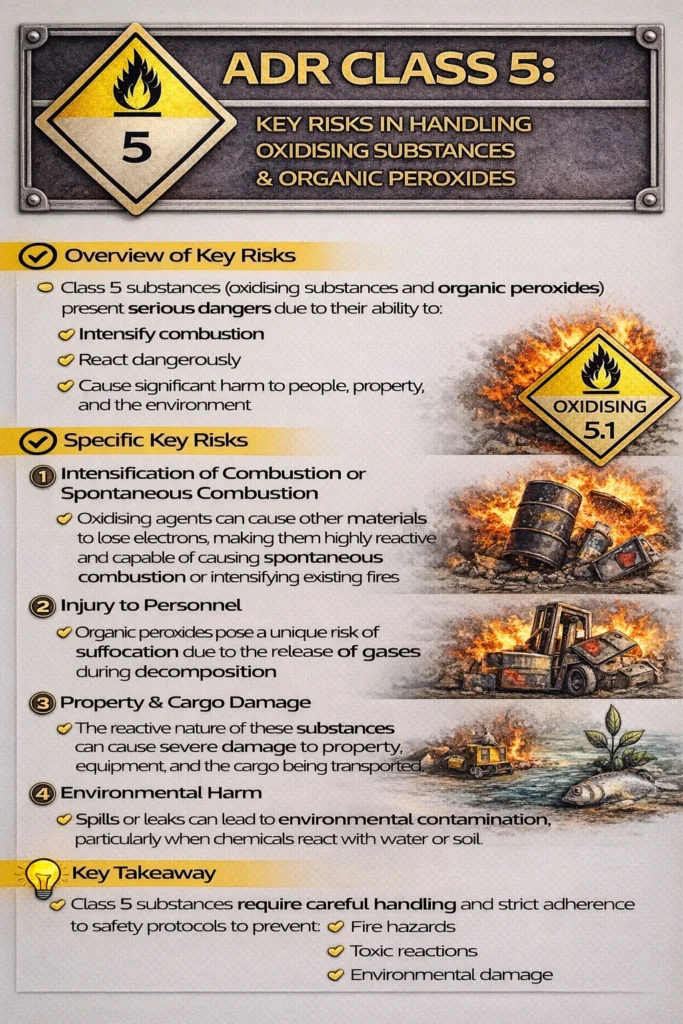
The key risks when handling ADR Class 5 substances, which consist of oxidising substances and organic peroxides, are primarily related to their ability to intensify combustion, react dangerously, and cause significant harm.
These substances are classified as dangerous goods due to their capability to oxidise other materials, which means they can cause spontaneous combustion or intensify existing fires. The specific key risks associated with Class 5 substances are:
- Intensification of combustion or spontaneous combustion occurs when oxidising agents cause other materials to lose electrons and react readily.
- Dangerous reactions with other substances.
- Injury to personnel, including the specific risk of suffocation posed by organic peroxides.
- Property damage and cargo damage.
- Environmental harm.
- Operational consequences such as insurance invalidation and potential criminal prosecution if regulations are not followed.
Why are oxidisers dangerous in contact with combustible materials?
Oxidisers are dangerous in contact with combustible materials primarily because of their chemical reactivity and oxygen supply. Although oxidising substances are typically not combustible themselves, they act as oxidising agents, causing other materials to lose electrons. This reaction allows them to emit oxygen, which significantly increases the overall fire risk and gives them the capability to react with other substances, potentially leading to spontaneous combustion.
What storage and segregation rules apply during transport?
The storage and segregation rules that apply during transport are primarily determined by mandatory adr classification and strict adherence to essential safety and security protocols. For dangerous goods, the process begins with proper adr classification, which, in systems like ADR, allows every subsequent requirement—including segregation—to be logically ascertained using resources such as Table A (ADR 3.2.1).
Furthermore, material safety data sheets (MSDS/SDS) are essential documents that must be easily accessible, up to date, and available to all staff and emergency services, explaining the properties, hazards, and required control measures for the goods being carried. Specific transport and storage rules include:
- Risk assessments must be kept updated throughout the transport process.
- Cargo must be segregated from any reactive cargo to prevent dangerous interactions.
- All loads must be properly secured.
- Compliance with the CTU Code is mandatory.
- Ignition sources must never be allowed near the cargo.
- A specific security plan must be in place for high-consequence loads.
What emergency measures are required for ADR Class 5 leaks or fires?
The emergency measures required for ADR Class 5 leaks or fires involve stringent handling and comprehensive preparedness protocols, especially considering that these oxidising agents can cause other substances to spontaneously combust, and organic peroxides pose a suffocation risk. Key measures include:
- Never expose the cargo to temperature deviations, as temperature changes can accelerate the oxidising reaction.
- Avoid all physical mishandling; cargo must never be thrown, dropped, or dragged.
- Maintain comprehensive emergency response plans that are readily actionable.
- Communicate clearly and effectively across the entire supply chain regarding the substance and necessary precautions.

What exemptions and special provisions affect ADR Class 5 goods?
Exemptions and special provisions that affect ADR Class 5 goods primarily relate to the total quantity carried, the specific condition of packaging, and corresponding documentation requirements. These special provisions are detailed below:
- Small Load Exemptions and Documentation: Class 5 goods are subject to general “small load exemptions” which relate to the total quantity of dangerous goods carried in packages by a transport unit (such as a van or lorry). The load limits (thresholds) are determined by the Transport Category (TC), which is generally found in column 15 of Table A in ADR Chapter 3.2, or by consulting the table in ADR part 1.1.3.6.3. For goods of Classes 2 to 6, 8, and 9 (which includes Class 5), the documents typically required to be carried on the transport unit by ADR 8.1.2.1(a) need not be carried if the quantity of dangerous goods does not exceed the maximum total quantity calculated in accordance with ADR 1.1.3.6.
- Empty Uncleaned Packagings: Empty uncleaned packagings (including IBCs and large packagings) that have contained substances of Class 5.1 (among other specified classes) are not subject to the conditions of ADR if adequate measures have been taken to nullify all hazards of Classes 1 to 9.
When do limited quantity and excepted quantity exemptions apply?
Limited quantity (LQ) exemptions apply when certain dangerous goods are packaged in accordance with the specific conditions set out in Chapter 3.4 of the European Agreement concerning the International Carriage of Dangerous Goods by Road (ADR).
The principle behind the LQ exemption is that an acceptable level of safety is assured providing the receptacles containing the dangerous goods are placed securely in a box or a shrink-wrapped tray. When these packaging conditions are met, the application of other ADR requirements is generally suspended, allowing for:
- The transportation of certain dangerous goods packaged in limited quantities in accordance with ADR 3.4.
- Retail distribution of LQ packages, even when they have been “broken down,” is subject to certain specified conditions being met.
- Note that transport units carrying more than 8 tonnes of LQ packages are required to be marked (as specified in ADR 3.4.10).
What ADR special provisions modify handling of Class 5 materials?
The ADR special provisions that modify the handling of Class 5 materials relate to load exemptions, residual packaging, and packaging/marking requirements for final-stage delivery:
- Empty Uncleaned Packagings: Empty uncleaned packagings (including IBCs and large packagings) that have contained substances of Class 5.1 (Oxidising substances) are not subject to the conditions of ADR, provided adequate measures have been taken to nullify all hazards associated with the residue.
- Small Load Exemptions: Modifications to handling restrictions are determined by small load exemptions, which relate to the total quantity of dangerous goods carried. These load limits (thresholds) are determined by the substance’s Transport Category (TC), which is found in column 15 of Table A in ADR Chapter 3.2.
- Final-Stage Packaging and Markings: The requirements for combination packaging (ADR 3.4.2 or 4.1) and the affixing of markings (ADR 5.2 and 6.1.3) do not need to be complied with during the final stages of carriage (such as between a distribution center and an end-user, or retailer and end-user), provided the goods were originally packed in limited quantities (ADR 3.4) and the quantity carried on the transport unit does not exceed a total of 333 kilograms or litres.
What differences exist between bulk and tank transport regulations?
The differences between bulk and tank transport regulations exist across several regulatory aspects, structural requirements, and definitional standards:
- Applicability of Exemptions: Small load exemptions, which often apply to general dangerous goods transport, do not apply to transport carried out using tankers or bulk carriage methods.
- Technical and Jurisdictional Requirements for Tanks: Tanks, including pressure receptacles forming the elements of a battery vehicle or wagon, are subject to stringent regulations regarding their construction, intended use (liquid, gaseous, powdery, or granular material), and certification requirements. These units often must adhere to specific national legislation or international provisions (such as RID, ADR, or the Transportable Pressure Equipment Directive—TPED) based on their construction date, and may be restricted in their geographical use (e.g., suitable for use in the UK only).
- Definition of Quantity Measurement: Regulations define the “maximum total quantity per transport unit” differently based on the physical state and class of the dangerous goods being transported. For liquids, quantity is measured in total litres; for solids, liquefied gases, or dissolved gases, it is measured by net mass in kilograms; and for compressed gases, it is determined by the water capacity of the receptacle in litres.
Why does ADR require certified drivers for Class 5 goods?
The ADR requires certified drivers for Class 5 goods (Oxidising substances and Organic Peroxides) primarily because of the extreme dangers and unique risks these substances present, necessitating specialised knowledge for accident avoidance and safe transport. The ADR licence ensures the driver has the knowledge required for the correct adr classification and handling of dangerous goods that could otherwise cause serious injury or environmental damage. Specifically, the Class 5 training module provides drivers with an understanding of the particular dangers associated with these substances, including how the oxygen they produce can sustain fires, requiring specific awareness and protocols on how to deal with potential incidents.
What ADR training is required to handle Class 5 substances?
The ADR training courses required to handle Class 5 substances is an ADR certificate that specifically includes the Class 5 module. Drivers transporting dangerous goods primarily classified as oxidising substances (oxidisers) must hold this certificate. ADR training courses are legally required to be approved by the Department of Transport and typically involve courses split into modules covering various categories of dangerous goods.
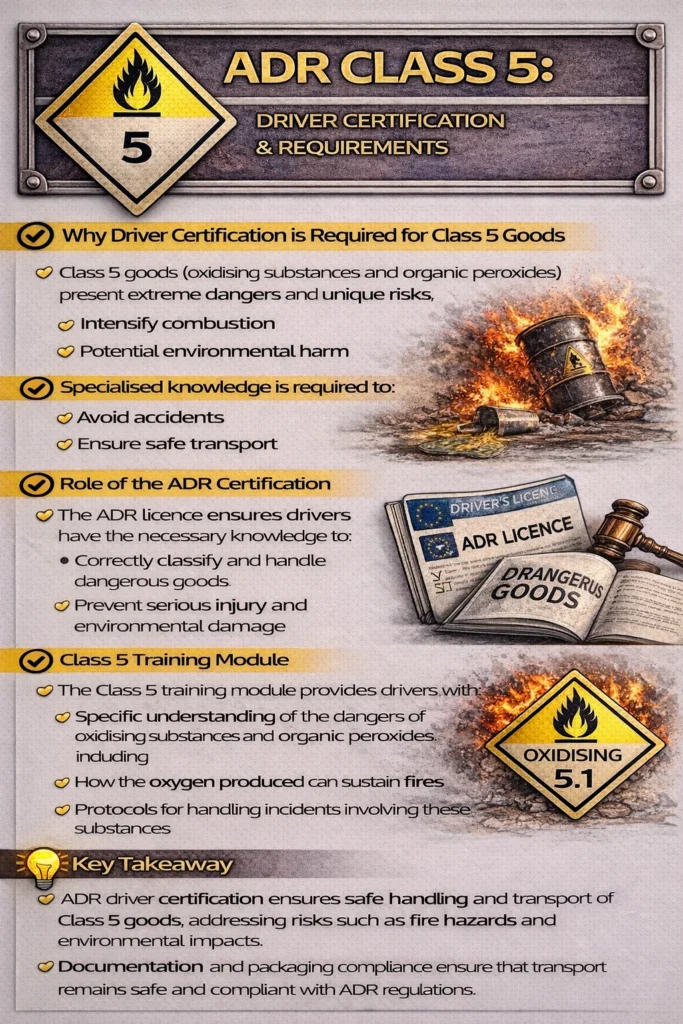
What certification process applies to oxidiser and peroxide transport?
The certification process that applies to oxidiser and peroxide transport requires drivers to hold an approved ADR certificate that specifically includes the Class 5 module, as these substances are primarily classified as ADR Class 5 dangerous goods.
By law, all ADR training courses must be approved by the Department of Transport (DoT) and are typically split into various modules. Since Class 5 (Oxidisers/Peroxides) falls within the common characteristics category known as Group B dangerous goods (alongside Classes 4 and 9), drivers may have the option to qualify for the entire Group B rather than taking only the individual Class 5 module.
How often must driver competence be reassessed?
Driver competence for transporting dangerous goods, which requires the ADR qualification as defined by the ADR Agreement, must be reassessed through mandatory refresher training and exams every 5 years to stay qualified. All necessary ADR training courses must be approved by the Department of Transport.
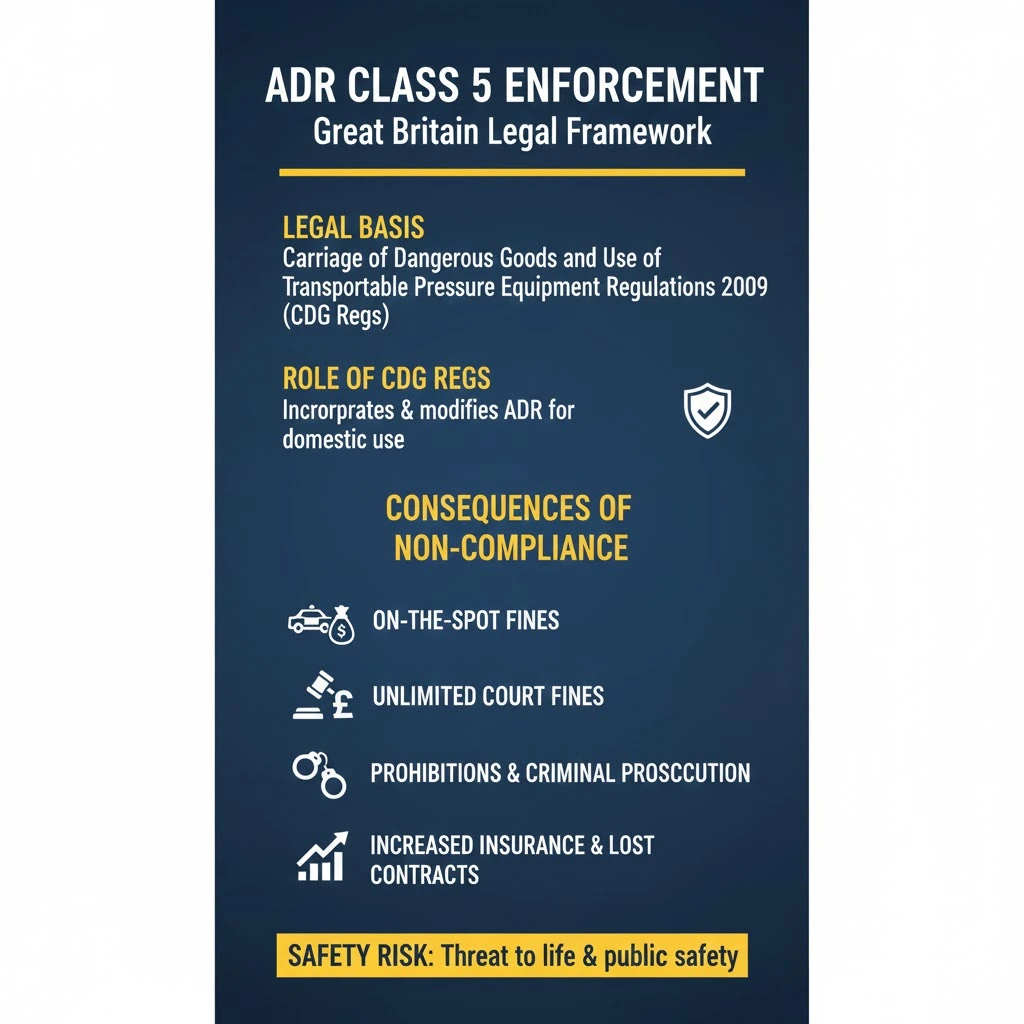
How is compliance with ADR Class 5 regulations enforced?
Compliance with ADR Class 5 regulations is enforced through a specific legal framework in Great Britain, as the ADR agreements themselves have no direct provision for enforcement.
The legal framework in GB is set by the Carriage of Dangerous Goods and Use of Transportable Pressure Equipment Regulations 2009 (CDG Regs). These regulations incorporate and modify the ADR requirements—including providing exemptions and making substantial changes for the domestic carriage of many explosives—and breaching these requirements can lead to severe financial, legal, and operational repercussions, including:
- On-the-spot fines are issued during roadside inspections.
- Unlimited court fines for major breaches of the regulations, which can result in devastating financial consequences.
- Prohibitions and potential criminal prosecution, emphasising that non-compliance poses a significant risk to life and injury, not just to the business.
- Increased insurance premiums following proven violations.
- Loss of contracts with clients who demand strict ADR compliance.
What documentation must accompany ADR Class 5 consignments?
The documentation that must accompany ADR Class 5 consignments (hazardous goods), as part of required consignment procedures (Part 5), includes several essential documents vital for transport and mandatory during inspections by enforcement authorities:
- Dangerous Goods Note (DGN): This note lists the specific hazardous goods being transported within the load.
- Consignment Documents: These documents must contain critical information such as the UN number, the specific shipping name, the hazard class (e.g., Class 5), and the assigned packing group.
- Instructions in Writing (IiW): This document functions as a safety guide, providing the driver with the necessary process and instructions to follow in the event of an accident or emergency.
What penalties apply for incorrect packing or labelling?
The penalties that apply for incorrect packing or labelling are severe, as breaching these requirements which often fall under ADR rules enforced in Great Britain by The Carriage of Dangerous Goods and Use of Transportable Pressure Equipment Regulations 2009 (CDG Regs) is treated as a criminal offence.
Depending on the severity of the violation, offenders may face immediate prohibitions and criminal prosecution, along with the following specific consequences:
- Court appearances.
- Receiving criminal records.
- Revocation of transport licences.
- Potential imprisonment in cases involving extreme negligence.
How do authorities inspect and verify transport of ADR Class 5 goods?
Authorities inspect and verify the transport of dangerous goods, including ADR Class 5 materials, primarily through the legal framework established by the Carriage of Dangerous Goods and Use of Transportable Pressure Equipment Regulations 2009 (CDG Regs) in Great Britain. These regulations set the domestic legal framework for enforcement, as the international ADR agreement itself provides no provision for enforcement.
Inspections can and do happen regularly by enforcement authorities, often as roadside inspections. It is vital that drivers carrying ADR loads possess the correct, non-optional documents. If even one item is missing, the driver may face penalties, and the vehicle can be stopped from completing its journey.
To ensure successful verification during these inspections, drivers must carry documents that contain crucial information, including:
- The specific UN number for the transported goods.
- The shipping name and designated hazard class.
- Written instructions detailing the process the driver must follow in the event of an accident.