
ADR Class 7 applies to substances containing radioactive components, identified by the presence of radionuclides, including fissile or low-dispersible radioactive material. These substances may be nuclear fuel, by-products, or waste from nuclear reactions and present serious health risks due to ionising radiation, which cannot be detected by human senses. Consignors are therefore required to identify and declare these hazards accurately before transport.
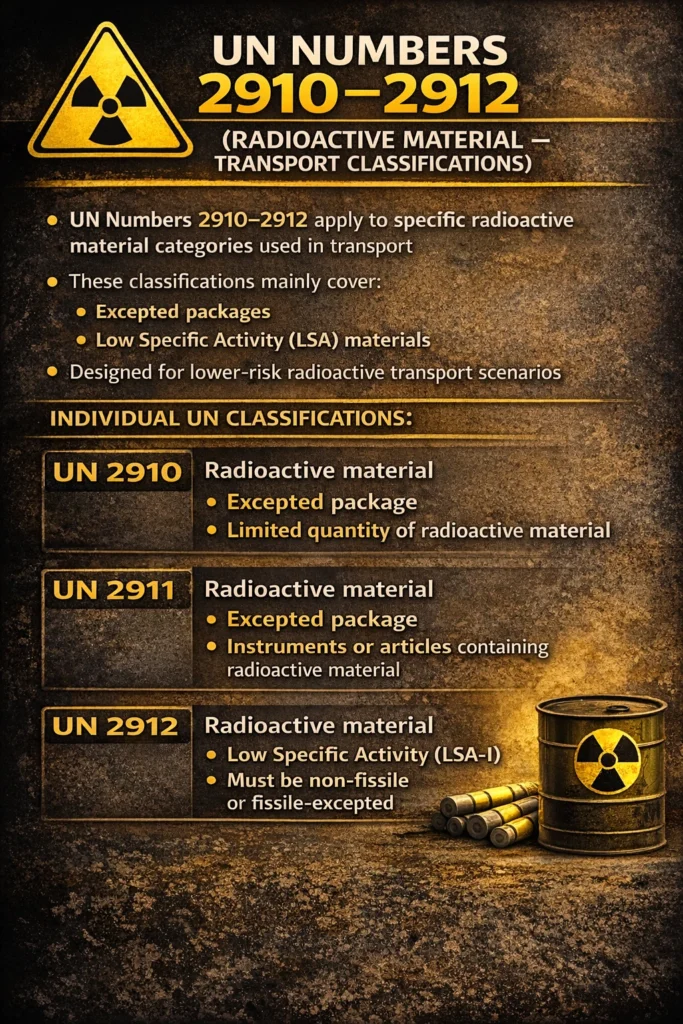
UN Numbers 2910–2912 cover specific radioactive material categories intended for lower-risk transport scenarios. UN 2910 and UN 2911 relate to excepted packages containing limited quantities or radioactive instruments and articles, while UN 2912 applies to low specific activity (LSA-I) radioactive material that is non-fissile or fissile-excepted. These classifications define the regulatory controls applied during carriage.
Packing rules for Class 7 materials are highly prescriptive and require UN-certified packaging approved by a national competent authority. Except for limited and excepted quantities, packages must withstand defined mechanical and pressure tests, retain any leakage through absorbent materials, and be clearly marked with the correct UN number and proper shipping name. Packaging must be specifically designed to meet the radiological hazards of the contents.
Vehicle codes and transport requirements for Class 7 focus on radiation control, operational approval, and clear identification. Certain shipments require multilateral approval, especially where activity levels or fissile indexes exceed defined thresholds. Vehicles must meet strict interior radiation limits and, where used exclusively for radioactive material, display dedicated markings and remain closed except during loading and unloading, ensuring controlled and compliant transport.

What qualifies a substance for ADR Class 7 classification?
What qualifies a substance for ADR Class 7 classification is the presence of radioactive components and materials. These dangerous goods contain radionuclides, which may include fissile nuclides, such as uranium-223, or low dispersible radioactive material. Class 7 substances are often categorised as usable fuel sources or waste products of nuclear reactions. Due to the nature of radioactivity, which can neither be tasted nor smelt, these substances pose a particular danger capable of altering human and animal DNA and causing serious health damage if accidents occur during handling or use. Consignors have a duty to identify these specific hazards for transport.
How does ADR define radioactive material under ADR Class 7?
The ADR defines radioactive material under Class 7 as dangerous goods encompassing all objects and substances that contain radioactive components and/or materials. These substances pose a particular danger because radioactivity can neither be tasted nor smelled, risking serious damage to health, such as altering human and animal DNA, if accidents occur during handling and use. Specifically, these materials contain radionuclides, which may be either fissile nuclides (such as uranium-223) or low dispersible radioactive material, functioning either as usable fuel sources or as waste products of nuclear reactions. As part of the classification process detailed in Part 2 of the ADR, which sets out criteria in logical sequence, the consignor must assign a “proper shipping name” and UN Number to the substance.
What distinguishes radioactive material from other hazardous goods?
Radioactive material, categorised as Dangerous Goods Class 7, is distinguished from other hazardous goods primarily by the unique, insidious nature of its danger and its specific composition. Class 7 substances contain radionuclides, which are often fissile nuclides (like uranium-223) or low dispersible radioactive material, serving as usable fuel sources or waste products of nuclear reactions. The key distinction is that radioactivity can neither be tasted nor smelled, meaning these substances pose a particular danger because their presence is undetectable by human senses.
Accidental exposure or improper handling can cause serious health damage, including the alteration of human and animal DNA. Consequently, these unique and severe risks necessitate significantly different and stringent requirements for storage, transport regulations, and packaging compared to other classes of hazardous goods, such as gases (Class 2) or flammable liquids (Class 3).
What are the main transport categories within ADR Class 7?
The main transport categories within Class 7 (Radioactive Material) are determined by the classification of the package required for shipment, which is based on the substance’s radioactive content, toxicity, and physical state. These Class 7 substances contain radionuclides, such as fissile nuclides (like uranium-223) or low dispersible radioactive material, and often include usable fuel sources or waste products of nuclear reactions.
Packages for Class 7 materials are subject to several legal regulations and are categorised into the following five primary transport types:
- Excepted packages
- Industrial packages
- Type A packages
- Type B packages
- Type C packages
Which substances are listed under UN Numbers 2910–2912?
The substances listed under UN Numbers 2910–2912 are specific classifications of radioactive material for transport, primarily categorised as excepted packages or low specific activity materials:
- UN 2910: Radioactive material, excepted package, limited quantity of material.
- UN 2911: Radioactive material, excepted package, instruments or articles.
- UN 2912: Radioactive material, low specific activity (LSA-I), non-fissile or fissile-excepted.
What are common examples of radioactive materials in the UN 2910–2912 range?
Common examples of radioactive materials in the UN 2910–2912 range are primarily defined by their classification type, as specific detailed material examples are often contained in external dangerous goods documentation.
The common classifications and one specific example found within this UN number range, covering excepted packages and low specific activity materials, are:
- UN 2910: Radioactive material, excepted package, limited quantity of material.
- UN 2911: Radioactive material, excepted package, instruments or articles.
- UN 2912: Radioactive material, low specific activity (LSA-I), non-fissile or fissile-excepted. A specific example of a material categorised under UN 2912 is Radon gas.
How are UN numbers assigned to radioactive goods?
The UN numbers assigned to radioactive goods are part of a specific range designated for dangerous goods by the United Nations Committee of Experts on the Transport of Dangerous Goods, encompassing numbers from UN2901 to UN3000. This assignment system, which applies broadly to hazardous substances, allows some substances (like Acrylamide, UN 2074) to have their own unique UN number, while groups of chemicals or products with similar properties often receive a common number (such as lighters and flammable gases, UN 1057). Additionally, UN numbers can differ based on factors such as the substance’s physical state (solid versus liquid phase), if the hazardous properties differ significantly, or according to varying levels of purity or concentration in solution.
What role do UN numbers play in labelling and documentation?
The role UN numbers play in labelling and documentation is to provide a standardised, four-digit identifier for dangerous goods, which is essential for acquiring the necessary transport information. These numbers are allocated to dangerous goods along with their proper shipping names and classes to ensure consistent identification globally. The UN number acts as a key identifier, allowing users to quickly look up comprehensive transport data associated with the article or dangerous good by entering the four-digit number or the proper shipping name.
The specific documentation and labelling requirements that are informed by the UN number include:
- Transport labels
- Hazard class
- Packing group
- Special provisions

What packing rules apply to ADR Class 7 substances?
The packing rules that apply to ADR Class 7 substances (radioactive materials) are stringent, requiring packaging to be designed and constructed to specific UN specification standards, often aligning with the requirements for Packing Group II (Y), which is designated for medium danger substances.
Key packing requirements for these dangerous goods, excluding limited and excepted quantities, include:
- Packaging must be designed and constructed to UN specification standards and certified by a national competent authority.
- Packages must pass practical transport-related tests, such as being subjected to pressure demands, being held in a stack, and withstanding a drop test (for Packing Group II, this requires surviving a fall from 1.2 metres).
- Absorbent material must be used as an inner package or packing aid to ensure that any liquid or solid leakage is retained within the package.
- Packages must be clearly labelled and marked with the appropriate UN number followed by the name of the substance.
- The packaging must also meet the specific needs and hazardous properties of the substance it is designed to contain.
What types of packaging are used for radioactive materials?
The types of packaging used for radioactive materials are governed by strict international specifications and classifications designed to ensure safety during transport.
Radioactive materials are classified as dangerous goods, often falling under Packing Group II (Y), which signifies medium danger. General packaging requirements are detailed in Part 4, Chapter 4.1 of the ADR regulations. These regulations cover the use of general packagings, intermediate bulk containers (IBCs), and large packagings, as well as various sorts of tanks (covered in Chapters 4.2 to 4.5 of ADR).
Except for limited and excepted quantities, packaging must be designed and constructed to UN specification standards, must be certified by a national competent authority, and must pass practical transport-related tests. These required performance criteria include:
- The packaging must be able to withstand a practical drop test (specifically a 1.2-meter drop for materials classified in Packing Group II).
- The containers must pass tests related to stacking and being subjected to pressure demands.
- The packaging must meet the specific needs of the substance it is intended to contain, often utilising absorbent material as an inner package or packing aid to retain any liquid or solid leakage.
- Packages must be clearly labelled and marked with the substance’s UN number followed by its name.
How are activity levels linked to package categories (Excepted, Type A, Type B)?
The linkage between activity levels and required package specifications is based on the principle that the degree of danger or hazard determines the necessary packaging strength and design standards. Once dangerous goods have been correctly classified, regulatory resources, such as Table A, allow details of permitted packaging to be accessed for substances classified as highly dangerous or having high activity levels; the strongest standards, such as Packing Group I (X), are required. This type of packing must be able to pass rigorous safety requirements, including a drop test from 1.8 meters, to ensure security during shipment, and is typically required for materials like toxic chemicals or explosives.
Furthermore, packaging (other than for limited and excepted quantities) must be designed and constructed to UN specification standards, passing practical transport-related tests such as being dropped, held in a stack, and subjected to pressure demands, and must be certified by a national competent authority.
What shielding and containment requirements apply to packaging?
The shielding and containment requirements that apply to packaging are governed by comprehensive standards designed to ensure the secure containment of dangerous goods during transport.
Part 6 of the ADR regulations sets out detailed requirements for the construction and testing of both packagings and tanks. Unless the contents are limited or excepted quantities, the packaging must be designed and constructed to meet stringent UN specification standards. Furthermore, packaging must be certified by a national competent authority and meet the specific needs of the substance it is intended to contain.
To ensure containment integrity, packaging must pass several practical, transport-related tests, including:
- Being subjected to pressure demands.
- Being dropped from a specified height.
- Being held securely in a stack.
For the strongest level of containment, Packing Group I (X), which is required for very dangerous goods such as cyanide, infectious materials, toxic chemicals, and explosives, the packaging must pass a particularly rigorous drop test from 1.8 meters to ensure that it remains secure and will not open during shipment, preventing potential harm or damage should the substance be released.
What vehicle codes apply to ADR Class 7 radioactive material?
The vehicle codes and regulatory requirements that apply to Class 7 (radioactive) material include stipulations for operational approvals, interior radiation limits, and specific exterior markings.
Operational codes often require multilateral approval for shipments that involve high-activity radioactive material, specifically for Type B(M) packages that do not conform to standard requirements or are designed for controlled intermittent venting, packages containing activity greater than 3,000 A1 or A2 (or 1,000 TBq, whichever is lower), or shipments where the sum of the criticality safety indexes for fissile material packages in a single vehicle or container exceeds 50.
Specific requirements for vehicles used to transport Class 7 materials include:
- The figure “7,” used in the required hazard identification markings, must measure not less than 25 mm in height.
- Transport vehicles used solely for Class 7 materials may be exempt from certain regulations if an interior surface survey shows the radiation dose rate does not exceed 0.1 mSv per hour (10 mrem per hour) at the interior surface or 0.02 mSv per hour (2 mrem per hour) at 1 meter (3.3 feet) from any interior surface.
- If a vehicle is designated for dedicated use, it must be stencilled in a conspicuous place on both sides of the exterior with the words “FOR RADIOACTIVE MATERIALS USE ONLY.” This lettering must be at least 7.6 cm (3 inches) high, and the vehicle must be kept closed at all times other than during loading and unloading.
What vehicle types are approved for ADR Class 7 transport?
The vehicle types and containers approved or required for Class 7 (radioactive material) transport are dependent on the specific material and shipping provisions:
- For general carriage of radioactive material (other than excepted packages), specific containers and conveyances such as the freight container, tank container, tank wagon, and wagon must display danger signs appropriate to the category of material.
- If packages are shipped under exclusive use provisions due to external radiation levels exceeding 2 mSv per hour (200 mrem per hour) at the package surface, the transport vehicle must meet the requirements for a closed transport vehicle.
- In the transport of high-level packages under exclusive use, the radiation level may not exceed 0.02 mSv per hour (2 mrem per hour) in any normally occupied position in the transport vehicle or adjacent rail car.
- Shipment approval is required if the sum of the criticality safety indexes of fissile material packages in a single vehicle or container exceeds 50.

How are vehicle codes determined based on activity level and packaging type?
The classification codes related to vehicle activity level and packaging type are primarily determined by assessing the packages, overpacks, or containers based on the transport index and the surface radiation level. Packages are assigned to one of three hazard categories—I-WHITE, II-YELLOW, or III-YELLOW—in accordance with specified regulatory conditions. Both the transport index and surface radiation level must be taken into account; if they satisfy conditions for different categories, the higher category is assigned (with I-WHITE being the lowest).
For instance, packages bearing RADIOACTIVE YELLOW-II or RADIOACTIVE YELLOW-III labels must adhere to specific segregation distances based on the total transport index number. Furthermore, any package or overpack having a surface radiation level greater than 2 mSv/h must be carried under exclusive use, and packages under special arrangement are typically assigned to category III-YELLOW. Separately, the standardised identification mark (or vehicle code) for the approval certificate is structured as “VRI/Number/Type Code,” where “VRI” represents the international vehicle registration identification code of the issuing State, “Number” is a unique identifier assigned by the competent authority, and “Type Code” denotes the specific type of approval certificate issued.
What structural features and radiation protection standards must be met?
The structural features and radiation protection standards that must be met pertain primarily to the transport of radioactive and fissile materials, often requiring specific structural controls or multilateral approval depending on the material’s activity and type.
Standard radiation limits often dictate that external surfaces of any package or overpack may not exceed 10 mSv/h. When package external radiation levels exceed 2 mSv per hour (200 mrem per hour) at the package surface, shipments must often utilise exclusive use provisions, requiring specific structural and operational controls.
Furthermore, multilateral approval shall be required for specific high-risk shipments:
- Shipment of Type B(M) packages not conforming with the requirements of 6.4.7.5 or designed to allow controlled intermittent venting.
- Shipment of Type B(M) packages containing radioactive material with an activity greater than 3,000 A1 or 3,000 A2, as appropriate, or 1,000 TBq (whichever is the lower).
- Shipment of packages containing fissile materials if the sum of the criticality safety indexes of the packages in a single vehicle or container exceeds 50 (unless a competent authority specifically authorises carriage without shipment approval).
For packages shipped under exclusive use provisions with external radiation levels exceeding 2 mSv per hour at the surface, the following structural and operational standards must be met:
- The transport vehicle must meet the requirements for a closed transport vehicle, or the freight container or wagon must be equipped with an enclosure that prevents the access of unauthorised persons to the interior during routine carriage.
- Each package or overpack must be secured so that its position within the transport vehicle remains fixed under conditions normally incident to transportation.
- The radiation level may not exceed 0.02 mSv per hour (2 mrem per hour) in any normally occupied position in the transport vehicle or adjacent railcar.
- There must be no intermediate loading or unloading operations during the carriage of that consignment.

How are ADR Class 7 materials labelled and placarded during transport?
ADR Class 7 materials are labelled and placarded during transport using specific regulations unique to radioactive materials.
For labelling, radioactive material is the only hazardous material that utilises three possible labels, with the choice depending on the relative radiation levels external to the package. Furthermore, Class 7 labels are the only ones that require the shipper to manually write specific information: a number called the Transport Index (TI). The TI represents the highest radiation level measured at 1 meter from the surface of the package.
For placarding, the standard placard used for the transportation of ADR Class 7 materials is square-on-point, typically sized at approximately 10 x 10 inches (or 250x250mm). The placard features a distinctive design that is yellow on the top portion and white on the bottom portion. It includes black lettering and a black radiation symbol within the yellow area. Critically, the bottom corner of the placard must prominently display the DOT hazard class number “7,” which denotes the material as radioactive.
What hazard labels are required for radioactive materials?
The hazard labels required for radioactive materials are unique among hazardous materials because they are categorised based on relative external radiation levels and are the only labels that require the shipper to write the Transport Index (TI) on the label, which represents the highest radiation level measured at 1 meter from the package surface.
Radioactive material has three primary hazard labels, depending on the intensity of radiation, along with two other specialised labels:
- Radioactive White-I: This label signifies the lowest level of external radiation and does not require a Transport Index (TI) to be displayed.
- Radioactive Yellow-II: This label is required when the Transport Index (TI) is greater than zero but no greater than 1.
- Radioactive Yellow-III: This label is required when the Transport Index (TI) is greater than 1, indicating the highest relative radiation level of the three primary types.
- Fissile
- Empty
What are the placarding rules for different package categories?
The placarding rules for different package categories depend on the quantity and type of dangerous goods being transported. Placards are large identification signs, typically standardised at 25 cm x 25 cm, primarily used on cargo vehicles, trucks, and containers transporting significant quantities of dangerous goods under specific transport conditions.
For radioactive material, package categories are defined by three labels, Radioactive White I, Radioactive Yellow II, and Radioactive Yellow III, which are distinguished by their colour, Roman Numeral, and their associated Transport Index (TI). The White I label has no TI; the Yellow II label must have a TI no greater than 1; and the Yellow III label would have a TI greater than 1.
Not all shipments of radioactive material require vehicle placarding. Rail or highway shipments containing the following package categories or conditions DO NOT require vehicle placarding:
- Excepted quantities of radioactive material.
- Packages with the EMPTY label.
- Packages with the Radioactive White-I label.
- Packages with the Radioactive Yellow-II label.
How are labels linked to UN numbers and transport index?
The links between labels, UN numbers, and the Transport Index involve different functions related to identifying specific hazardous substances and the external risks they pose during transportation.
The Transport Index (TI) is directly linked to the label specifically for radioactive material packages. Radioactive material is the only hazardous substance for which the label (which is based on the external radiation hazard, not the activity inside the package) requires the shipper to write a number, the TI, on it. The TI is defined as the maximum radiation level (measured in mrem/hr) at one metre (3.3 feet) from the surface of an undamaged package. This measured value quantifies the external hazard and establishes a critical baseline for determining if package integrity has been compromised during an incident.
The UN Number, conversely, functions as a unique identifier for the transported substance itself, supplementing other warning indicators. This number is typically displayed alongside orange warning plates, which feature Kemler hazard numbers that describe the type and intensity of the danger posed by the material.
What safety risks are associated with ADR Class 7 transport?
The safety risks associated with Class 7 transport, which involves radioactive materials such as nuclear fuel, medical isotopes, and radioactive waste, encompass direct health and environmental hazards, general transport incident risks, and high-consequence security threats.
Specific safety risks include:
- Radiation Exposure and Health Effects: The materials emit ionising radiation that can harm living organisms. Exposure to high levels of this radiation can cause severe health effects in people.
- Environmental Contamination: If the radioactive materials are released, they can cause widespread contamination of the environment, including the air, water, soil, surfaces, plants, buildings, people, and animals.
- Transport Incidents: As with all dangerous goods transported by road or rail, traffic accidents or incidents like spillage can occur, potentially leading to immediate hazards like fire, explosion, chemical burn, or subsequent environmental damage.
- High-Consequence Misuse: Class 7 goods are defined as high-consequence dangerous goods due to their potential for misuse in a terrorist event. Such misuse may produce serious consequences, specifically mass casualties, mass destruction, or mass socio-economic disruption.
Why is radiation shielding essential in ADR Class 7 logistics?
Radiation shielding is essential in ADR Class 7 logistics primarily to ensure safety, mitigate extreme risks, and comply with mandatory regulations. This shielding, achieved through advanced packaging designs, provides enhanced containment capabilities crucial for reducing the risk of radiation release in the event of an accident. Furthermore, Class 7 materials are classified as High Consequence Dangerous Goods (HCDG) due to their potential for misuse in a terrorist incident, which could produce serious consequences such as mass casualties, destruction to infrastructure or the environment, or significant socio-economic disruption.
Therefore, regulations, such as those set out in the Carriage of Dangerous Goods and Use of Transportable Pressure Equipment Regulations 2009 (CDG) Act, mandate extreme care and careful packing to protect everyone involved, including consignors, carriers, emergency services, and the general public.

What are the risks of exposure to transport workers and the public?
The risks of exposure to transport workers and the public involve both general transportation hazards and specific dangers related to the nature of the goods being moved, particularly radioactive materials and High Consequence Dangerous Goods (HCDG).
Radioactive materials, such as medical isotopes, nuclear fuel, and waste, emit ionising radiation, which can harm living organisms and the environment, potentially causing severe health effects upon exposure to high levels. The primary hazards resulting from the transport of dangerous goods, whether accidental or intentional, include:
- General transport risks, such as traffic accidents during carriage by road or rail.
- Incident-related hazards resulting from a spillage of dangerous goods, including fire, explosion, or chemical burns, potentially leading to environmental damage.
- Contamination of the environment, including air, water, surfaces, soil, plants, buildings, people, or animals, if radioactive materials are released.
- Serious consequences resulting from the potential misuse of HCDG in a terrorist incident, which may produce mass casualties, mass destruction (to infrastructure, the environment, or the economy), or mass socio-economic disruption.
How should ADR Class 7 loads be segregated from other goods?
ADR Class 7 loads should be segregated from other goods primarily through the use of specialised, enhanced packaging. This packaging must incorporate superior containment and shielding capabilities designed to minimise the risk of radiation release in the event of an accident.
To ensure proper segregation and carriage, consignors and carriers must adhere strictly to all applicable legal guidelines and regulations, particularly those set out by the Carriage of Dangerous Goods and Use of Transportable Pressure Equipment Regulations 2009 (CDG) Act. Key steps for regulatory compliance regarding the transport of Class 7 Radioactive Material include:
- Following the published guidance aimed at carriers and consignors transporting these goods by road and rail within Great Britain (GB).
- Ensuring compliance with the CDG requirements, understanding that the competent authority for the transport of Class 7 is the Office for Nuclear Regulation (ONR).
- Obtaining specific advice and requesting relevant inspections regarding the secure carriage of Class 7 material directly from the ONR.

What exemptions and special provisions apply to radioactive materials?
The exemptions and special provisions that apply to radioactive materials are primarily based on the principle that the radiological consequences, meaning radiation doses to persons, are trivial and remain below the dose limits recommended by the International Commission on Radiological Protection (ICRP).
Being “exempt” means that no permit is required under regulations such as EPR or RSA93 to keep, use, accumulate, or dispose of the radioactive sources or waste, provided that specific conditions relating to the manner of handling (such as waste disposal) are strictly complied with in order to meet established dose thresholds.
Special provisions related to the transport and handling of dangerous goods, including radioactive materials, are detailed in Part 3 of The Carriage of Dangerous Goods and Use of Transportable Pressure Equipment Regulations (CDG09). These provisions include:
- Authorisations (regulation 12)
- Derogations and transitional provisions (regulation 11)
- Exceptions (regulation 11A)
When do excepted package provisions apply to ADR Class 7 shipments?
Excepted package provisions apply to Class 7 shipments when the radioactive materials are being transported or stored in transit in the course of a journey, as these provisions are governed by the applicable transport regulations for hazardous materials and wastes. Nothing in subsequent storage legislation affects the exemption thresholds or conditions, including labelling, established under these transport regulations.
The applicability of these transport regulations, and thus the excepted package provisions, ends when the material’s “storage in transit” transitions into permanent storage. This transition occurs, bringing the material within the remit of radioactive substances legislation, when it is stored in one location for a period exceeding 14 days; it is unpackaged, or it arrives at the destination where it will be used or disposed of.
What conditions permit the use of limited quantity exemptions?
The conditions that permit the use of limited quantity exemptions are based primarily on risk level and administrative necessity, allowing certain activities to be exempt from formal permitting requirements because their radiological consequences are trivial.
These conditions include:
- The radiological consequences, meaning the radiation doses to persons, are deemed trivial and fall below the dose limits and thresholds recommended by international bodies such as the International Commission on Radiological Protection (ICRP). Specific conditions are often placed on the manner of activities, such as waste disposal, to ensure compliance with these limits.
- The practices or products involving radioactive substances are classified as both low risk and very widespread, often including cases where the radioactivity is an essential property (e.g., smoke detectors).
- Exemptions prevent a massive administrative burden that would result if regulatory bodies were required to issue individual permits to every user in cases involving low-risk, widespread products or practices.
It should be noted that the authority to grant such exemptions or issue exceptions from requirements and prohibitions such as those arising under Part 2 of CDG09 may be exercised by the Secretary of State for Transport.
How do special provisions vary based on isotope or intended use?
Special provisions for handling and disposing of radioactive material vary based on isotope, concentration, substance type, and intended use, often implemented through restrictions and conditions set out in legislation to minimise waste generation and mitigate consequences.
These special provisions impose limits and conditions on specific aspects of waste management:
- Provisions address concentration by defining “out of scope” values for very low concentrations of Naturally Occurring Radioactive Material (NORM) in solids, liquids, and gases, and for “relevant liquids” and solids of other radioactive substances, as detailed in legislative schedules (e.g., EPR2010 and RSA93).
- Restrictions are placed on the type of substance or article being disposed of (for example, a waste sealed source), and on the overall management of waste, including the disposal of non-radioactive waste quantities.
- Conditions dictate the disposal route, specifying appropriate limits for routes such as discharge to a sewer or disposal in a landfill.
- Provisions related to intended use allow specific organisations, such as schools and universities, which are authorised to dispose of very small quantities of radioactivity, to utilise normal refuse collection services, subject to the conditions detailed in their authorisation.
Why is driver certification essential for transporting ADR Class 7 goods?
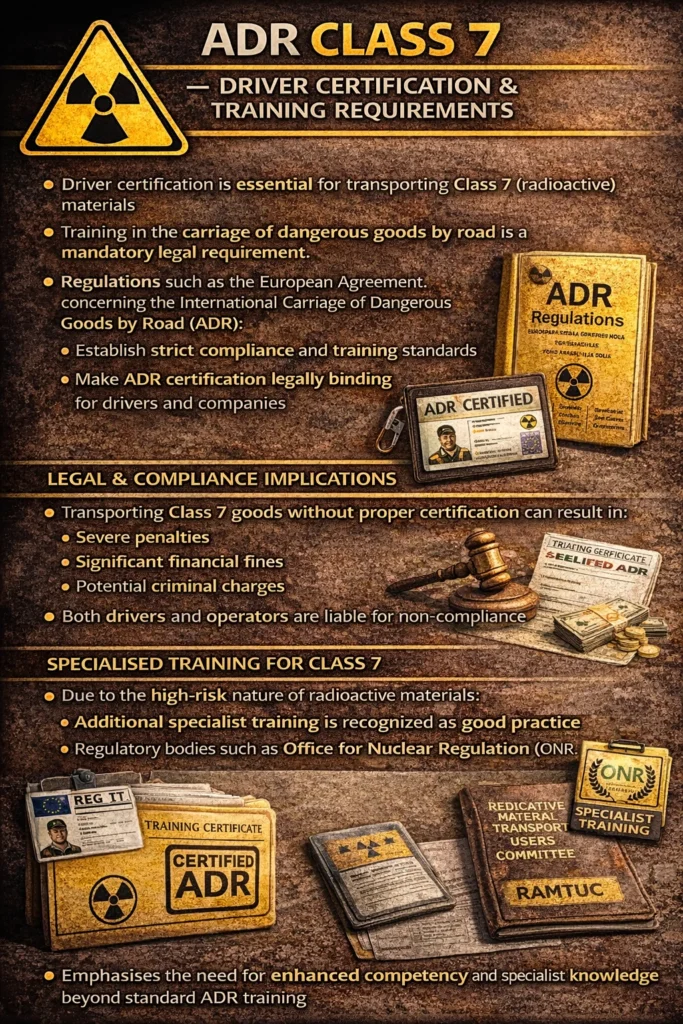
Driver certification is essential for transporting Class 7 goods (radioactive material) primarily because training in the carriage of dangerous goods by road is a mandatory legal requirement for all involved persons. Regulations such as the European Agreement concerning the International Carriage of Dangerous Goods by Road (ADR) establish strict guidelines for compliance and driver training, making ADR certification legally binding. Without proper certification, companies and drivers can face severe penalties, significant fines, and even criminal charges due to non-compliance. Furthermore, for the specialised nature of Class 7 radioactive material, regulatory bodies like the Office for Nuclear Regulation (ONR) recognise additional, dedicated training courses often based on syllabi provided by the Radioactive Material Transport Users Committee (RAMTUC) as relevant good practice, emphasising the necessity of specialised competency for these high-risk materials.
What training is required for drivers handling radioactive materials?
The training required for drivers handling radioactive materials centres on compliance with legal requirements for transporting dangerous goods by road, primarily through the Accord Dangereux Routier (ADR) framework.
As transporting dangerous goods is a high-risk operation, strict compliance with safety regulations is mandatory. Drivers must possess the appropriate ADR training and certification, which is essential to prevent accidents and comply with legal requirements. However, not all drivers transporting dangerous goods require a full “ADR Licence,” particularly those handling smaller quantities.
For those transporting Class 7 dangerous goods (radioactive material), specific training is legally required to meet awareness obligations, especially concerning specific UN numbers such as UN 2908, UN 2909, UN 2910, UN 2911, UN 2915, and UN 3332, in accordance with ADR Chapter 8.5 S12.
Furthermore, the Office for Nuclear Regulation (ONR) recognises additional specialized Class 7 training courses, such as those based on the syllabi provided by the Radioactive Material Transport Users Committee (RAMTUC), as relevant good practice for Dangerous Goods Safety Advisers (DGSA) and transport duty holders involved in the carriage of radioactive material.
What certification standards apply under ADR for Class 7?
The certification standards and training requirements that apply under ADR for Class 7 (radioactive substances) involve mandatory class-specific training focusing on these materials. Specifically, for Dangerous Goods Safety Advisors (DGSA) advising transport duty holders on Class 7 dangerous goods, the Office for Nuclear Regulation (ONR) recognises the additional Class 7 training course based on the syllabi provided by the Radioactive Material Transport Users Committee (RAMTUC) as relevant good practice. Furthermore, this specialised training course is specifically aimed at drivers and crew members responsible for the transportation of certain Class 7 UN numbers, such as UN 2908, UN 2909, UN 2910, UN 2911, UN 2915, and UN 3332, in accordance with ADR Chapter 8.5 S12.

How is ADR compliance monitored for Class 7 consignments?
ADR compliance for Class 7 consignments (radioactive material) is monitored through a combination of mandatory physical markings, careful administrative preparation, and rigorous documentation reviewed by regulatory authorities.
Monitoring includes careful preparation by authorities, such as planning specialist routing, ensuring drivers receive necessary briefings, confirming emergency information is in place, and verifying that the consignment’s records align with its labels and placards. Physical compliance for the transport unit requires fixing a plain orange plate at both the front and back, as described in ADR 5.3.2.1.1. Due to the nature of the substance, vehicles carrying Class 7 goods have an extra requirement (ADR 5.3.1.5) to display placards (hazard diamonds) on both sides and the rear of the vehicle. For documentation and reporting, Dangerous Goods Safety Advisers (DGSAs) overseeing radioactive material may utilise specific report templates, such as those included in the Office for Nuclear Regulation (ONR) DGSA guidance.
What documentation must accompany ADR Class 7 shipments?
The documentation and accompanying procedures that must accompany Class 7 shipments (radioactive materials) are governed by specific rules, such as those detailed in ADR 5.4.1.2, and require the inclusion and verification of several critical items:
- Verification that all labels, placards, and records accurately match the consignment.
- Provision of specific emergency information.
- Documentation confirming the driver briefing has occurred.
- Planning and documentation for specialist routing.
- For Dangerous Goods Safety Advisers (DGSAs), the use of a specific report template included in the Office for Nuclear Regulation (ONR) DGSA guidance for Class 7 dangerous goods is utilised.
What enforcement actions apply for incorrect labelling or packaging?
The enforcement actions that apply for incorrect labelling or packaging primarily involve assigning liability to the party best placed to ensure compliance and conducting inspections by relevant authorities.
Under the Carriage of Dangerous Goods (CDG) Regulations, the ultimate decision regarding enforcement is based on determining “who was best placed to ensure compliance with the relevant provision.” This means that responsibilities and potential duties could fall upon multiple participants, including the packer, loader, consignor, and/or carrier. For instance, even if the consignor failed to provide the proper documentation, the carrier commits a prima facie offence by travelling with non-compliant paperwork.
Enforcement is carried out through inspections conducted by the DVSA and other authorities, which may occur at the roadside or at premises, often with little notice. These checks verify that paperwork, personnel, the vehicle, and the load all align, ensuring compliance with standards such as ADR, and checking usage of LQ/EQ (Limited Quantity/Excepted Quantity) provisions.
Additionally, the Dangerous Goods Safety Adviser (DGSA) plays a crucial role in monitoring compliance, investigating any accidents or infringements of regulations, keeping detailed records of these instances through reports, and reporting serious incidents or accidents involving dangerous goods to the Department for Transport.
How do inspectors verify compliance with transport and safety standards?
Inspectors verify compliance with transport and safety standards using a combination of methods, including mandatory administrative oversight and physical inspections, while holding all participants in the logistics chain responsible.
Verification involves mandatory annual audits of dangerous goods activities, for which the Dangerous Goods Safety Advisor (DGSA) is responsible for creating the report, as well as inspections conducted by authorities like the DVSA. These physical checks can occur at the roadside or at premises, often with little notice. For an inspection to pass quickly, all components must be consistent and compliant. During these inspections, inspectors focus on:
- Confirming that the paperwork, vehicle status, load contents, and personnel (including the driver) training align, ensuring they “tell the same story.”
- Assessing the availability of evidence, adherence to established routines (such as those established by ADR compliance services), and confirmation that known defects have been fixed.
- Checking for the appropriate use and handling of specific allowances like Limited Quantities (LQ) and Excepted Quantities (EQ).
- Determining which participant the packer, loader, consignor, or carrier was “best placed to ensure compliance” with the relevant provision, as responsibilities are shared under CDG Regulations. For example, a carrier commits a prima facie offence by travelling with non-compliant documentation, even if it was the consignor’s obligation to provide it.