
ADR Class 9 covers miscellaneous dangerous substances and articles that do not meet the criteria of Classes 1–8 but still present a transport risk, with a strong emphasis on environmental hazards aligned with global systems such as GHS. This class includes a wide range of materials and articles, including lithium batteries, airbags, asbestos, dry ice, genetically modified organisms, machinery containing dangerous goods, and environmentally hazardous substances requiring the “dead fish and tree” mark.
Within Class 9, UN Numbers 3077 and 3082 are specifically assigned to environmentally hazardous substances where environmental risk is the sole dangerous goods hazard. UN 3077 applies to environmentally hazardous substances, solid, N.O.S., while UN 3082 applies to environmentally hazardous substances, liquid, N.O.S., including marine pollutants that do not fall under other hazard classes.
Packing rules for ADR Class 9 require the use of UN performance-tested packagings, with permitted packaging types identified through Table A (Columns 8–14) once classification is complete. Class 9 substances are assigned packing groups consistent with Classes 1–8, and environmentally hazardous subclasses M6–M10 require packagings approved by the competent authority due to their specific risks.
Vehicle codes and transport requirements for Class 9 goods are governed by ADR and implemented in Great Britain through the Carriage of Dangerous Goods and Use of Transportable Pressure Equipment Regulations 2009. Load thresholds, operational rules, and eligibility for Small Load Exemptions are determined by the Transport Category listed in Column 15 of ADR Table A, ensuring proportionate controls based on quantity and risk.
 What substances fall under ADR Class 9?
The substances and articles that fall under ADR Class 9 are miscellaneous dangerous goods that do not fit into the criteria of Classes 1 through 8, but still present a danger during transport. This class has a specific focus on environmental hazards, aligning with global classification systems like GHS, meaning substances meeting relevant criteria (such as UN 3077 and UN 3082) are regarded as environmentally hazardous and require the “dead fish and tree” mark. Specific examples of articles and materials classified under ADR Class 9 include:
- Batteries and related articles, such as lithium-ion batteries, lithium-metal batteries, battery-powered equipment, and battery-powered vehicles.
- Safety and initiated devices, including air bag modules and seatbelt pretensioners (electronically initiated safety devices), and life-saving appliances (both self-inflating and non-self-inflating).
- Dangerous goods are contained in machinery or apparatus, fuel cell engines, or internal combustion engines.
- Substances posing an environmental risk, specifically environmentally hazardous substances (liquids and solids).
- Biological materials, such as genetically modified organisms and genetically modified microorganisms.
- Cooling agents like dry ice (solid carbon dioxide/cardice).
- Asbestos, including amphibole, chrysotile, and blue asbestos (crocidolite).
- Various chemical compounds and mixtures, including chemical kits, first aid kits, ammonium nitrate fertilisers, polychlorinated biphenyls (PCBs), plastics moulding compounds, and products from the castor bean plant.
- Magnetised material and expandable polymeric beads (polystyrene beads).
How does ADR define miscellaneous dangerous substances and articles?
ADR defines miscellaneous dangerous substances and articles as substances and articles which, during transport, present a danger not covered by the criteria or descriptions set out for the other classes of dangerous goods. This classification, typically Class 9, specifically includes environmentally hazardous substances but excludes Class 7 radioactive material. Part 2 of ADR sets out detailed descriptions and criteria in a logical sequence for these categories, requiring the consignor to assign a proper shipping name and UN Number to the substance for transport.
What types of risks are covered under ADR Class 9?
The types of risks covered under ADR Class 9 pertain to miscellaneous dangerous substances and articles which present a danger during transport that is not specifically covered by the other classes of dangerous goods (excluding Class 7 radioactive material).
A significant category within Class 9 is environmentally hazardous substances. Classification criteria for these environmental hazards have been updated (in alignment with systems like GHS and requirements referenced in ADR 2.2.9.1.10), meaning any dangerous goods meeting the relevant criteria—not just those assigned UN 3077 or UN 3082—must now be regarded as environmentally hazardous and required to show the “dead fish and tree” mark. Other articles and substances typically covered in Class 9 include:
- Lithium-ion and lithium-metal batteries, as well as battery-powered equipment and vehicles
- Dry ice / solid carbon dioxide
- Engines, including fuel cell engines and internal combustion engines, and dangerous goods contained within apparatus or machinery
- Expandable polymeric beads/polystyrene beads
- Ammonium nitrate fertilisers
- Blue asbestos / crocidolite
- Magnetized material
- Genetically modified organisms and microorganisms
- Kits such as chemical kits, first aid kits, and lifesaving appliances
- Air bag modules and seatbelt pretensioners
- Plastic moulding compound
- Specific chemicals like Polychlorinated biphenyls and Polychlorinated terphenyls
Why are environmentally hazardous and elevated temperature materials included?
Environmentally hazardous and elevated temperature materials are included within the dangerous goods classification system because they present a danger during transport that is not covered by the nine specific classes of dangerous goods, necessitating appropriate measures for safe transport and compliance with internationally recognised classification systems, such as the United Nations (UN) hazard classification. These materials are generally grouped into Class 9 (Miscellaneous dangerous substances and articles).
Specifically concerning environmental hazards, classification requirements have changed, notably through the ADR regulations, which implemented links to the GHS system and the GB CHIP regulations. This change means that all dangerous goods meeting the relevant criteria for environmental hazards, not just those directly assigned UN 3077 (solids) or UN 3082 (liquids), are now regarded as environmentally hazardous substances and are required to show the specific ‘dead fish and tree’ mark, mirroring provisions for labels and placards.
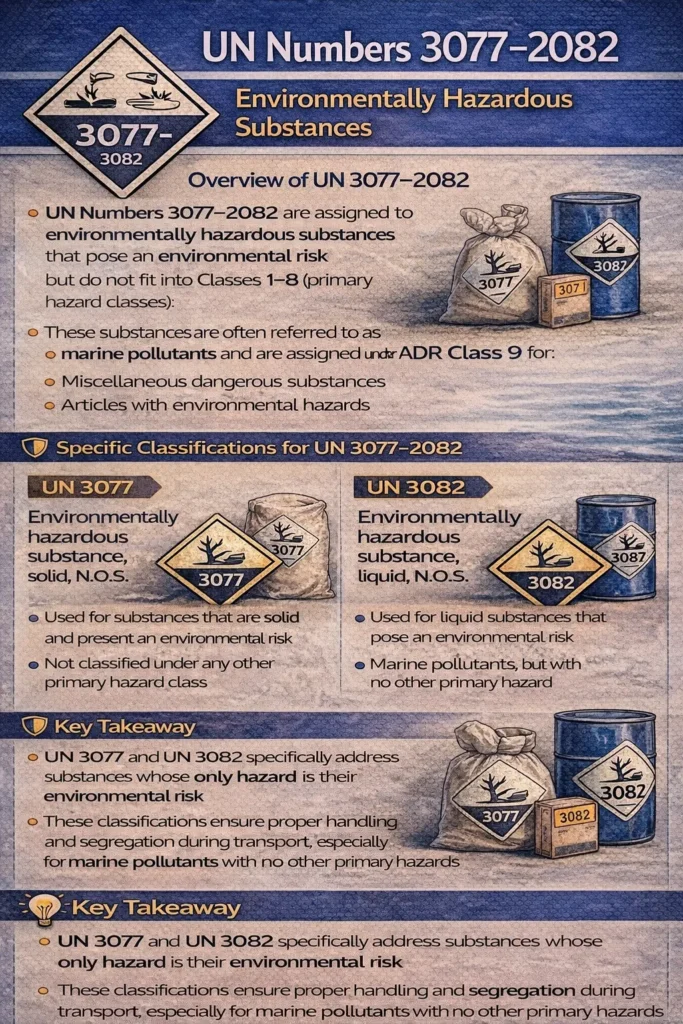 Which materials are listed under UN Numbers 3077–3082?
The materials listed under UN Numbers 3077–3082 are primarily the two specific classifications used for environmentally hazardous substances, which are also known interchangeably in some regulations as marine pollutants.
These UN numbers are unique because they are assigned to substances where the environmental risk is the only dangerous goods hazard attributable. They are typically placed under the Class 9 (Miscellaneous) hazard designation when a substance is a marine pollutant but meets no other primary hazard classes (1–8). The two specific UN classifications defined in this range are:
- UN 3077: ENVIRONMENTALLY HAZARDOUS SUBSTANCE, SOLID, N.O.S.
- UN 3082: ENVIRONMENTALLY HAZARDOUS SUBSTANCE, LIQUID, N.O.S.
What are common examples of ADR Class 9 substances within the UN 3077–3082 range?
The common examples of Class 9 substances within the UN 3077–3082 range are substances classified as ‘environmentally hazardous substances’ or ‘marine pollutants’ that do not meet the criteria for any of the other eight hazard classes.
UN 3077 and UN 3082 are unique Class 9 (miscellaneous) classifications designated for materials where the environmental hazard is the sole dangerous goods hazard attributable to the entry. These numbers are assigned when a material requires a basic shipping description but lacks a proper shipping name in the Hazardous Materials Table (HMT), and no other hazard class applies.
Specifically, UN 3077 is used for environmentally hazardous substances, solid, N.O.S., when the material meets or exceeds the hazardous substances or Reportable Quantity (RQ) limit. An illustrative example is a package containing lead that has exceeded its RQ limit but is not otherwise listed in the HMT.
Conversely, UN 3082 is used for environmentally hazardous substances, liquid, N.O.S., often representing liquid marine pollutants. An example of a substance that would be assigned UN 3082 is acroleic acid, stabilised, when it exceeds 10% concentration in a bulk package or is transported by vessel, classifying it as a marine pollutant not detailed elsewhere in the HMT.
How are UN numbers assigned to miscellaneous dangerous goods?
UN numbers are assigned to miscellaneous dangerous goods by prioritising classification in other hazard classes first; if a marine pollutant or environmentally hazardous substance meets the criteria for any of the primary hazard classes (1 through 8), it must be assigned to that appropriate class and labelled accordingly. Assignment to the Class 9 (Miscellaneous) hazard class occurs only when the material does not fit into the other eight hazard classes, lacks an accurate proper shipping name in the Hazardous Materials Table (HMT), but still requires a basic shipping description because it is hazardous (e.g., exceeding RQ limits or designated as a marine pollutant). When assigned to Class 9 as an Environmentally Hazardous Substance, the specific UN number is determined by the physical state of the material, typically falling under Packing Group III:
- UN 3077 is assigned for solids.
- UN 3082 is assigned for liquids.
How do UN numbers relate to hazard communication and documentation?
UN numbers relate to hazard communication and documentation primarily by providing a specific, necessary shipping description for substances that are hazardous but do not fit within the standard hazard classes 1 through 8.
Specifically, if a substance is identified as a marine pollutant or an environmentally hazardous substance (EHS) but does not meet the criteria for other established classes, it is assigned to the appropriate hazard class, often Class 9 (Miscellaneous). In these cases, the substance must be assigned the corresponding UN number and be appropriately labelled. The UN numbers UN 3077 and UN 3082 are specifically used for Environmentally Hazardous Substances in Class 9 and Packing Group III.
These specific UN numbers are critical when a material requires a basic shipping description but is not listed as a proper shipping name in the Hazardous Materials Table (HMT). For instance, if a package contains lead exceeding the Reportable Quantity (RQ) limit, but lead lacks a proper shipping name in the HMT, UN 3077 would be used for the shipping description. Similarly, UN 3082 is utilised for bulk packages or vessel shipments containing marine pollutants, such as acrolein, when they do not meet other established hazard classes. Although some goods may not need to be marked, labelled, or declared as dangerous goods using documents such as a shipper’s declaration or dangerous goods note (DGN) for certain transport purposes, the assignment of these UN numbers ensures clear and accurate communication of the inherent environmental hazard.
 What packing rules apply to ADR Class 9 substances?
The packing rules that apply to ADR Class 9 substances are comprehensive, requiring adherence to tested standards and specific requirements for certain environmentally hazardous subclasses.
Key packing rules and requirements for ADR Class 9 substances include:
- Most design types of packaging used to carry these dangerous goods must be tested to demonstrate they meet the minimum UN performance standards set by the regulations.
- The specific details of permitted packaging types and sorts allowed are accessed through Table A of the regulations, utilising Columns 8 to 14 once the goods have been correctly classified.
- These substances are divided into the packing groups that also apply to ADR dangerous goods classes 1 through 8.
- Substances belonging to subclasses M6 to M10 may additionally only be transported in packagings approved by the competent authority, a requirement driven by the environmentally hazardous properties they emit.
How are packaging groups determined for miscellaneous substances?
Packaging groups for miscellaneous substances (Dangerous Goods Class 9), which include explosive, flammable, toxic, and corrosive substances and articles, are determined based on the degree of danger or hazard they pose. The assignment of a specific packing group dictates the different transportation and packaging requirements that apply. Notably, substances within Class 9 subclasses M6 to M10, often due to their environmentally hazardous properties, may additionally require packagings approved by the competent authority before transport.
The substances are divided into the same three primary packing groups that also apply to ADR dangerous goods classes 1 through 8, based on the degree of hazard:
- Packing group I: Substances with high hazard.
- Packing group II: Substances with medium hazard.
- Packing group III: Substances with low hazard.
What types of authorised containers and materials are required?
The types of authorised containers and materials required include both specific packaging forms and mandatory certifications related to the carriage of dangerous goods.
Authorised ‘packages’ encompass single containers commonly made from materials such as fibreboard, plastics, and metal:
- Boxes
- Bags
- Jerricans
- Drums
Regarding authorisation, packaging (with the main exemption being limited quantities) must be certified to UN standards. These containers are known as “type-approved” or “UN certified,” requiring the design-type to be tested and approved by a national competent authority to ensure suitability for carrying dangerous goods, often marked with the UN logo and specific codes detailed in agreements like ADR Part 6. Furthermore, transport of environmentally hazardous substances belonging to dangerous goods class 9 (subclasses M6 to M10) requires packagings specifically approved by the competent authority.
How does ADR regulate the inner and outer packaging for ADR Class 9?
ADR regulates the inner and outer packaging for Class 9 dangerous goods through a combination of general table references, specific class restrictions, and detailed usage instructions.
After dangerous goods are correctly classified, ADR Table A, specifically Columns 8 to 14, allows access to the details of all permitted packaging types. For substances within dangerous goods Class 9, particularly those in subclasses M6 to M10, the packagings used must be additionally approved by the competent authority. This specialised requirement is imposed due to the environmentally hazardous properties that these substances emit, and they are divided into the same packing groups that apply to ADR Classes 1 through 8.
The regulations provide detailed instructions that cover the permitted type(s) of inner packaging, the method of assembly, how the packaging should be closed, and specific requirements for proper sealing, such as tightening the cap on a bottle or drum. Crucially, packaging should not be used unless the supplier can explicitly show that the inner packaging has been approved in combination with the outer packaging. This combination must be clearly identified by the size, type, manufacturer, material, and quantity of the packaging components. This strict requirement does not apply to special packagings, which are identified by having the letter ‘V’ suffixed to the packaging code in the approved mark.
 What vehicle codes apply to the transport of ADR Class 9 goods?
The vehicle codes that apply to the transport of Class 9 goods are governed primarily by the ADR (European Agreement concerning the International Carriage of Dangerous Goods by Road). ADR sets out comprehensive requirements for dangerous goods, including specific vehicle and tank requirements, as well as operational procedures. Class 9 goods include items such as lithium batteries, asbestos, automotive airbags, and environmentally hazardous substances that do not fit into the other eight classes. In Great Britain (England, Wales, and Scotland), these requirements are applied through the Carriage of Dangerous Goods and Use of Transportable Pressure Equipment Regulations 2009 (as amended).
Specific operational rules and the applicability of Small Load Exemptions relate directly to the total quantity of dangerous goods carried. These limits and thresholds are determined by the substance’s Transport Category (TC). The TC is typically found in Column 15 of Table A in ADR (Chapter 3.2) and dictates the load limits for the different transport categories.
What vehicle types are authorised for ADR Class 9 transport?
Vehicle types authorised for ARD Class 9 transport are generally subject to the specific vehicle and tank requirements set out by the ADR (European Agreement concerning the International Carriage of Dangerous Goods by Road), which covers the classification, packaging, and certification for dangerous goods, including Class 9 substances like lithium batteries and environmentally hazardous materials.
However, Regulation 16 specifies certain vehicle types where the main parts of the regulations (as applied in Great Britain by the Carriage of Dangerous Goods and Use of Transportable Pressure Equipment Regulations 2009) do not apply to the carriage of dangerous goods, based on their definition and operational characteristics:
- Vehicles with a maximum design speed of 25 km/hour or less.
- Vehicles that run on rails.
- Mobile machinery, which could include vehicles specially equipped for road construction purposes, such as white lining vehicles.
- Agricultural or forestry tractors (and any trailer being towed by such a vehicle) that do not travel at a speed exceeding 40 km/h when transporting dangerous goods.
- Vehicles with fewer than four wheels, which were previously exempted from ADR under the definition of a vehicle in the Dangerous Goods Directive.
How are vehicle codes selected based on hazard characteristics and volume?
Vehicle codes are selected based on hazard characteristics and volume through a multi-tiered classification system established by the UN Model Regulations for the transportation of dangerous goods. This system first assigns each dangerous substance or article a Class, which defines the specific type of danger the substance presents.
The level of inherent danger (hazard characteristic) is further classified by the Packing Group (PG), which determines how dangerous a substance is. These groups are always written in Roman numerals to differentiate them from the Class numbers:
- PG I: Represents the most dangerous substances.
- PG II: Represents a moderate danger.
- PG III: Represents the least dangerous substances.
Volume considerations and associated vehicle codes for small load exemptions relate to the total quantity of dangerous goods carried by the transport unit (such as a van or lorry). It is the Transport Category (TC) that determines the specific load limits (thresholds) for volume. Although many substances are assigned a Packing Group, TC is a separate classification and not always synonymous with the PG, requiring consultation of specific regulatory tables (like Table A in ADR) to determine the volume limits for different transport categories.
What are the minimum structural and equipment requirements for vehicles?
The minimum structural and equipment requirements for vehicles transporting dangerous goods are primarily set out by the European Agreement concerning the International Carriage of Dangerous Goods by Road (ADR). This regulatory framework governs the transport of dangerous goods to prevent accidents, property damage, and environmental harm, addressing vehicle classification, packaging, labelling, certification, and specific requirements for vehicle structure, tanks, and operations. In Great Britain (England, Wales, and Scotland), the ADR requirements are applied through the Carriage of Dangerous Goods and Use of Transportable Pressure Equipment Regulations 2009. However, if a vehicle is carrying dangerous goods under the established ‘small load threshold’, many of the comprehensive ADR requirements may not be applicable, although other essential obligations still remain required.