
ADR Class 1 covers explosives, substances or articles designed to function through ignition or detonation. These materials are assigned a UN Serial Number, hazard division, and compatibility group based on their composition and behaviour. Class 1 is divided into six subdivisions (1.1–1.6), ranging from mass explosion hazards to extremely insensitive items with no mass explosion risk.
UN Numbers for Class 1 explosives fall within the wider UN system, typically from UN0001 to UN3600. Consignors must assign the correct UN Number and Proper Shipping Name by referencing Table A of ADR Chapter 3.2 and applying the definitions and criteria found in Part 2.
Packing instructions for explosives depend on the specific UN Number and must comply with international regulations, including structural strength, prevention of accidental ignition, protection of contents, and the ability to withstand normal handling and stacking. In the US, 49 CFR 173.62 provides detailed packaging tables and instructions cross-referenced to each UN Number.
Vehicle codes for transporting Class 1 goods are defined under ADR. Transport units must display plain orange plates at the front and rear, and vehicles carrying explosives must also display hazard placards on both sides and the rear. Additional restrictions apply to passenger-carrying vehicles, as stipulated in the Carriage Regulations.
Labelling and placarding requirements include marking each explosive with its correct compatibility group letter (A–L, N, or S), which indicates how it behaves with other explosives and determines whether certain groups may be transported together.
Key risks associated with transporting explosives include unintended detonation, accidents causing significant harm, and security threats. Safety measures require thorough risk assessments, competent personnel, strict access control, adequate protective equipment, and robust emergency preparedness. All actions aim to keep risks As Low As Reasonably Practicable (ALARP) while ensuring the secure and compliant carriage of explosive materials.
 What does ADR Class 1 include under explosives?
ADR Class 1 includes explosives, which are substances or articles designed to function by ignition or detonation due to chemical reactions. An explosive assigned to this class is given an appropriate UN Serial Number, hazard division, and compatibility group depending on its composition and hazard type.
The six subdivisions of ADR Class 1 include the following:
1.1: Explosives with a mass explosion hazard (e.g., TNT, dynamite, and nitroglycerine).
1.2: Explosives with a severe projection hazard.
1.3: Explosives with a fire, blast, or projection hazard, but specifically not a mass explosion hazard.
1.4: Explosives presenting a minor fire or projection hazard (this typically includes ammunition and most consumer fireworks).
1.5: An insensitive substance that still possesses a mass explosion hazard (with an explosion similar to 1.1).
1.6: Extremely insensitive articles that pose no mass explosion hazard.
How are explosives defined in ADR regulations?
The definition of explosives in ADR regulations is provided primarily in Chapter 2.2, encompassing both chemical composition and classification status. Explosive and pyrotechnic substances are chemically defined as solid or liquid substances or mixtures capable of producing gases rapidly through chemical reaction at such a temperature and pressure that could cause damage to the surroundings. This definition also includes substances or mixtures designed to produce an effect (such as heat, light, sound, gas, or smoke) as a result of non-detonative, self-sustaining exothermic chemical reactions. For regulatory purposes, “explosives” specifically means explosive articles or substances that have either been assigned to classification to ADR Class 1, or are unclassified. The requirements for this classification are described in Chapter 2.2 of ADR, as interpreted by the 2011 amendments introduced at Regulation 3 of the Carriage of Dangerous Goods and Use of Transportable Pressure Equipment Regulations 2009 (CDG).
What are the six divisions within ADR Class 1?
The six divisions within ADR Class 1 categorise explosive substances and articles based on the nature and severity of the hazard they present during transport. Consignors have a duty to accurately identify these hazards. The divisions, ranging from 1.1 to 1.6, are defined as follows:
Division 1.1: Substances and articles which have a mass explosion hazard, meaning the explosion affects almost the entire load virtually instantaneously.
Division 1.2: Substances and articles which have a projection hazard but do not present a mass explosion hazard.
Division 1.3: Substances and articles which have a fire hazard and either a minor blast hazard or a minor projection hazard, or both. This includes items whose combustion produces considerable radiant heat or items that burn sequentially, resulting in minor blast or projection effects.
Division 1.4: Substances and articles which present no significant hazard, posing only a slight risk of explosion in the event of ignition or initiation during transport. The effects are largely confined to the package, and no projection of fragments of appreciable size or range is expected.
Division 1.5: Very insensitive substances which have a mass explosion hazard but are so insensitive that there is very little probability of initiation or of transition from burning to detonation under normal conditions of carriage.
Division 1.6: Extremely insensitive articles which do not have a mass explosion hazard. These items predominantly contain extremely insensitive substances and demonstrate a negligible probability of accidental initiation or propagation, confining the risk to the explosion of a single article.
Why are explosives categorised by hazard and compatibility?
Explosives are categorised by hazard and compatibility because this process, mandated by regulations and overseen by authorities like the Health and Safety Executive or the Secretary of State for Defence, is necessary to manage the specific type of explosive hazard they present and to control their storage and transportation. An explosive assigned to ADR Class 1 is given an appropriate UN Serial Number, hazard division, and compatibility group based on its composition and type, which allows for the specification of controls. The fundamental purpose of using compatibility group letters is to prevent an increase in hazard that might result if certain incompatible types of explosives, including explosive articles and substances, were stored or transported together.
 What are the UN Numbers assigned to ADR Class 1 explosives?
The UN Numbers assigned to ADR Class 1 explosives are chosen from the overall numbering system for dangerous goods, which typically ranges from UN0001 to about UN3600 and is administered by the United Nations Committee of Experts on the Transport of Dangerous Goods. For ADR Class 1 substances and articles specifically, a UN Number and a proper shipping name (or n.o.s. entry) must be assigned by the consignor. This assignment must align with the entries listed in Table A of Chapter 3.2, with the interpretation of the names based upon the glossary in 2.2.1.4, following the detailed descriptions and criteria set out in Part 2 of the ADR regulations.
Which substances fall under UN 0001 to UN 0099?
The substances that fall under UN 0001 to UN 0099 are predominantly explosive materials classified under Hazard Class 1, as assigned by the United Nations Committee of Experts on the Transport of Dangerous Goods. This range of numbers covers materials categorised into divisions (1.1 to 1.4) based on the severity of the explosion hazard, encompassing risks from mass explosion to minor, localised explosion hazards. It should be noted that some numbers within this specific range, such as UN 0008 and UN 0085 to UN 0091, are no longer in use due to regulatory reclassification or obsolescence.
Specific examples of dangerous goods within this series include:
- Ammonium picrate (UN 0004) presents a mass explosion hazard (Division 1.1).
- Various types of ammunition, including ammunition (incendiary) (e.g., UN 0009 and UN 0010) and bursting charge ammunition (UN 0006–0007).
- Smoke-producing devices (UN 0001 and UN 0003).
- Blasting explosives, such as dynamite (UN 0081).
- Cartridges for weapons, blank (UN 0014), which present a minor explosion hazard (Division 1.4).
- Pyrotechnic articles, such as signal flares (UN 0092).
- Fracturing devices, explosive, without detonators for oil wells (UN 0099).
How are UN Numbers determined for explosive materials?
The determination of UN Numbers for explosive materials involves a structured process that ensures the accurate identification of the substance’s hazard properties and composition. After a dangerous item has been given a UN Classification, the consignor (shipper) must assign both a four-digit UN Number and a Proper Shipping Name, which serves as the standard technical name describing the goods. This assignment is made by selecting the pairing from the official Dangerous Goods List that most accurately describes the materials, following specific rules and referencing the detailed descriptions and criteria set out in regulations, such as those found in Part 2 of ADR, which works through the categories in a logical sequence. These unique identifiers are then used to easily identify and label the dangerous goods during shipping, and must also be included in the Dangerous Goods Declaration and Section 14 of Safety Data Sheets.
What is the importance of UN numbers in shipment classification?
The importance of UN numbers in shipment classification lies in their ability to uniquely identify dangerous goods, providing essential, detailed information necessary for safe transport, handling, and storage. These unique four-digit identifiers allow shippers and handlers to immediately access comprehensive data specific to the nature of the substance, including the type (such as flammability or toxicity) and degree of its inherent hazards.
For each UN number, critical details needed for regulatory compliance and safety procedures can be found, including:
- Proper shipping names.
- Hazard classes and packing groups, along with any subsidiary risks.
- Specific requirements detailing how the goods must be packaged for transport.
- Special handling and storage requirements.
 What packing instructions apply to ADR Class 1 explosives?
The packing instructions that apply to ADR Class 1 explosives involve regulatory compliance based on UN identification numbers and adherence to specific design requirements, ensuring safety and structural integrity during transport.
In the United States, the specific packaging section for explosives is located in the 49 Code of Federal Regulations (CFR), Section 173.62. This section contains Explosives Table 1, which cross-references the UN number (such as UN 0360) with a specific Packaging Instruction (PI), the details of which are found in Table 2. Generally, explosives packed in a package with a net mass not exceeding 400 kg must adhere to the method specified for that UN number in the United Nations Recommendations, including compliance with all relevant requirements.
Additionally, all packagings for ADR Class 1 goods must be designed and constructed to meet essential safety criteria:
- They must protect the explosives, prevent them from escaping, and cause no increase in the risk of unintended ignition or initiation when subjected to normal conditions of carriage, including foreseeable changes in temperature, humidity, and pressure.
- The complete package must be capable of being handled safely under normal conditions of carriage.
- The packages must withstand any loading imposed by foreseeable stacking during carriage, ensuring that they do not reduce their strength, harm the containment function, or cause instability of the stack, thereby preventing any increase to the risk presented by the explosives.
How are packaging groups assigned to ADR Class 1 materials?
Packaging groups are assigned to ADR Class 1 materials (explosives) by generally assigning all substances within this classification of dangerous goods to Packing Group II. Nevertheless, given that explosives are characterised as very dangerous goods, the required packaging often must adhere to the most stringent standards, sometimes corresponding to the strength required for Packing Group I (X). Packing Group I is the strongest type of packaging, required for very dangerous materials, and must be able to pass a 1.8-meter drop test to ensure the goods remain secure and will not open during shipment.
What are the general packing requirements for each division?
The general packing requirements for each division are determined by a hierarchical classification system, primarily relying on the assigned Packing Group (PG) and specific regulatory tables.
For goods, such as those classified as Class 1, the specific packing instruction that must be followed is detailed in accordance with the appropriate instruction shown in Column (8) of Table A of Chapter 3.2 of the regulations (e.g., ADR), provided the substance has been assigned a UN number and proper shipping name. The central factor governing these requirements is the substance’s Packing Group (PG), which is found in Column 4 of Table A and reflects its degree of risk and danger during transportation.
These Packing Groups are a classification system used to categorise hazardous materials based on their inherent level of hazard:
- Packing Group I: High danger
- Packing Group II: Medium danger
- Packing Group III: Low danger
The specific Packing Group assigned dictates the relevant set of requirements and restrictions within the regulations, ensuring the goods are packed appropriately for the level of risk they pose. For substances classified from “first principles,” the PG is determined directly by measuring their properties (such as the flash point for flammable liquids).
How do compatibility groups affect packaging decisions?
Compatibility groups significantly affect packaging and transport decisions by determining which dangerous goods can be safely carried together, minimising the risk of adverse reactions or compounding hazards. An explosive assigned to Class 1 is given an appropriate compatibility group, along with a UN Serial Number and hazard division, based on its composition, type, and inherent hazard. Operators must ensure that explosives belonging to different compatibility groups are generally not carried together unless specific regulations permit such carriage, or effective measures have been taken to ensure that the mixed load presents a risk no greater than carrying the same quantity of explosives from any single group.
Furthermore, compatibility groups dictate mandatory segregation and packaging requirements when combining hazardous materials. For instance, packages containing articles of Compatibility Group B and Compatibility Group D of ADR Class 1 may be carried on the same vehicle with dangerous goods of ADR Classes 3, 5.1, or 8, provided strict conditions are met. These conditions require the Class 1 packages to be carried in separate containers or compartments of a design approved by the competent authority, and the goods from Classes 3, 5.1, or 8 must be carried in vessels meeting the competent authority’s requirements regarding their design, construction, testing, and operation.
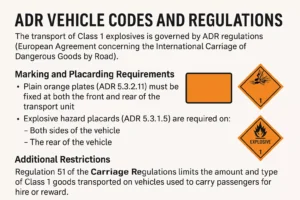 What vehicle codes apply to the transport of ADR Class 1 goods?
The vehicle codes and regulations that apply to the transport of Class 1 goods (explosives) are primarily governed by the ADR (European Agreement concerning the International Carriage of Dangerous Goods by Road), under which Class 1 is categorised within the UN Model Regulations’ classification system.
For vehicles transporting Class 1 goods, specific marking requirements must be met:
- Plain orange plates (ADR 5.3.2.1.1) must be fixed at both the front and back of the “transport unit,” as is standard for vehicles carrying packaged dangerous goods.
- Extra display requirements (ADR 5.3.1.5) mandate that vehicles carrying Class 1 (explosives) or Class 7 (radioactive substances) must display placards (hazard diamonds) on both sides and the rear of the vehicle.
Furthermore, Regulation 51 of the Carriage Regulations sets down additional restrictions specifically applicable to the amount and type of Class 1 goods that can be transported on vehicles used to carry passengers for hire or reward.
What types of vehicles are authorised to carry explosives?
The types of vehicles authorised to carry explosives are defined by regulatory classifications, specifically referencing:
- Type I
- Type II
- Type III
Beyond these standard types, the authorisation and operation of vehicles are influenced by the carrier and the context of the carriage, often adhering to the European Agreement concerning the International Carriage of Dangerous Goods by Road (ADR). For example, Ministry of Defence (MoD) vehicles operate in line with ADR, though MoD tankers are typically placarded and plated according to ADR practice rather than standard GB practice. Commercial carriers delivering to MoD premises are treated conventionally, but the Secretary of State for Defence may issue specific authorisations to allow MoD vehicles to work outside ADR regulations in special cases (Regulation 12).
What are the required vehicle design and safety features?
The required vehicle design and safety features are determined by the nature and quantity of the materials being transported, particularly when dealing with explosives or exceeding the small load threshold under ADR regulations.
While vehicles carrying under the small load threshold may be exempted from many ADR requirements, the operator of any vehicle or container used for the carriage of explosives must ensure the conveyance is suitable for the safety and security of the explosives being carried. To protect the explosives from external hazards and weather, specific design and construction obligations for these vehicles include:
- The vehicles shall be designed, constructed, and equipped to ensure the explosives are protected from external hazards and the weather.
- Vehicles must be closed.
- The driver’s compartment must be separated from the load compartment by a continuous wall.
- The loading surface shall be continuous, and load restraint anchorage points may be installed.
- All joints must be sealed.
- All openings shall be capable of being locked.
- Openings must be constructed and placed to overlap at the joints.
How are vehicle codes linked to transport categories?
Vehicle codes are linked to transport categories through the comprehensive classification system outlined in the Dangerous Goods List, found in Chapter 3.2 of the ADR. This crucial table links the name, description, UN numbers, and classification of dangerous goods (such as Class 1 explosives, which are assigned specific hazard divisions and compatibility groups) to their corresponding transport categories and all the relevant operational codes. These relevant codes detail necessary provisions for packaging, labelling, special provisions, and methods of carriage, including specifications for bulk carriage or carriage in tanks, thereby defining the required vehicle codes and operational qualifications necessary for transporting the goods.
 What labelling and placarding requirements exist for ADR Class 1?
The labelling and placarding requirements that exist for ADR Class 1 (explosives) emphasise safety and reaction potential during transport. It is mandatory to determine the compatibility group of the substance and mark it with the corresponding capital letter, chosen from A to L, N, or S. This marking is essential for the transport of potential explosives, as it indicates how different substances might react with each other, determining whether various groups, such as C, D, and E, may be packaged and transported together.
Which hazard labels are mandatory for ADR Class 1 goods?
The mandatory hazard label for Class 1 goods, which are defined as explosive substances and articles, is identified by a black icon or the number ‘1’ prominently displayed on an orange background. These goods represent a hazard risk of causing an explosion, whether it is a mass explosion, a light fire, or a blast wave.
What placards must be displayed on vehicles carrying explosives?
The placards and identification required on vehicles carrying explosives (Class 1 hazardous materials) include both plain orange plates and specific hazard placards (often referred to as hazard diamonds), which must be displayed at specific locations on the transport unit.
The mandatory displays include:
- Plain orange plates, described in ADR (5.3.2.1.1), which must be fixed at the front and back of the transport unit.
- Hazard placards (conforming to specific regulatory requirements) must be affixed to each side of the vehicle, trailer, semi-trailer, or freight container in which the explosives are carried.
- For Class 1 (explosives), placards (hazard diamonds) are additionally required on the rear of the vehicle (ADR 5.3.1.5).
- Overall, federal regulations require that transport vehicles or freight containers carrying hazardous materials display placards on each side and each end.
How are label codes linked to UN numbers?
Label codes are linked to UN numbers because the UN number uniquely identifies the hazardous substance, which, in turn, dictates the required risk labels. The four-digit UN (United Nations) or NA (North American) number is typically displayed in the centre of the placard and uniquely identifies the specific hazardous substance being transported. According to cargo labels regulation frameworks, the required label codes must accurately reflect the primary and subsidiary risks associated with that specific UN number. For example, the UN number UN2924, which identifies a flammable liquid, corrosive, n.o.s., requires both a flammable label and a corrosive label to reflect its associated risks.
 What are the key risks and safety measures for transporting ADR Class 1 explosives?
The key risks and safety measures for transporting ADR Class 1 explosives focus on preventing accidents, minimising harmful effects, and maintaining strict security throughout the process. The principal risks involve the potential for unintended detonation, accidents causing harmful effects or impact on people, assets, and property, and the threat of unauthorised access to or removal of the load. Operators and personnel engaged in the carriage or custody of explosives must take all reasonable steps to address these dangers and ensure risks are kept As Low As Reasonably Practicable (ALARP), often by limiting transportation to absolute necessities and taking action to reduce both the likelihood and consequences of an incident.
Specific and mandated safety measures implemented to mitigate these risks include:
- Risk Management and Assessment: Conducting comprehensive risk assessments to identify potential hazards, evaluating the suitability of transportation routes and storage facilities, and implementing strategic measures to avoid or minimise risk exposure, thereby limiting the need for handling and carriage to absolute necessities.
- Personnel Competence: Ensuring all personnel involved in handling and carriage undergo rigorous, appropriate training, including regular refresher courses, to maintain competence and awareness of safety procedures, reinforced by correct supervision.
- Security and Access Control: Implementing strict security protocols, including secure storage facilities, surveillance systems, and controlled access, to prevent unauthorised access to or removal of the explosives during transit or storage.
- Protective Equipment: Mandating the use of effective personal protective equipment (PPE), such as helmets, gloves, and safety goggles, for individuals handling the materials.
- Emergency Preparedness: Developing detailed emergency response plans to address potential incidents, coordinating with emergency services, and conducting regular drills to ensure readiness and reduce the harmful effects and impact of any accident that may occur.
Why is route planning critical for ADR Class 1 explosive materials?
Route planning is critical for ADR Class 1 explosive materials due to the immense risks and severe potential consequences associated with transportation accidents involving hazardous goods.
The necessity for meticulous route selection and planning is driven by several key factors:
- Minimising Severe Damage: The explosiveness of these materials ensures that an accident during transit will impose severe damage on surrounding targets, necessitating routes selected and planned specifically based on explosion accident risks to counteract the augmented risk caused by complex road networks.
- Mitigating Escalating Costs and Accident Frequency: With hazmat road accidents increasing significantly (more than doubling in the past decade), meticulous planning is vital to ensure compliant transportation and avoid catastrophic financial outcomes, such as spills that rack up costs exceeding $1.1 million.
- Supporting Real-Time Safety and Optimisation: For these sensitive scenarios, route planning must include in-day optimisation capabilities to proactively manage real-time challenges, and integrate in-telematics to identify driving styles unsuitable for the load, allowing for immediate driver coaching rather than intervention after an event has occurred.
What are the key storage separation and handling rules?
The key storage separation and handling rules primarily focus on mandatory distance requirements and the physical segregation of activity zones to mitigate potential risks and reduce the severity of an explosion. These rules include:
- Separation distance requirements set by regulations must be met, even when certain limited quantities of explosives are kept for short periods of time without the need for a license.
- Storage buildings must be physically separated from production buildings.
This separation is a critical measure aimed at ensuring that an explosion occurring in a production area, where the risk of detonation is often greatest, does not affect the storage buildings. Storage facilities typically house the greatest quantity of explosive substances or articles, and therefore pose the greatest overall hazard if compromised.
What emergency protocols are required during transport?
The emergency protocols required during transport include establishing comprehensive plans and specific procedures to manage incidents, security risks, and dangerous goods.
Key required emergency protocols are:
- Establishing robust emergency response plans to effectively respond to incidents or diversions that may occur along the way.
- Setting up communication channels that enable real-time tracking and immediate response in case of deviations or emergencies.
- Maintaining effective and up-to-date procedures for reporting and dealing with security threats, breaches of security, or security incidents.
- Adhering to critical safety mandates, such as the rule to never fight a fire that involves, or has the potential to involve, explosives (including containers like bags, drums, or cartridges), as the risk of detonation far outweighs any offensive attack.