
ADR Class 2 covers gases in compressed, liquefied, refrigerated, dissolved, or mixed forms and categorises them into flammable, non-flammable/non-toxic, and toxic divisions. Substances assigned UN 1001–1057 include widely used industrial gases such as acetylene, ammonia, chlorine, carbon dioxide, hydrogen, and helium, with some entries now obsolete.
Packing requirements for Class 2 gases are defined through ADR Table A, with instruction P200 providing the primary standards for pressure and cryogenic receptacles. These must withstand normal transport conditions without leakage or loss of integrity.
Vehicle codes and transport obligations follow ADR and the GB Carriage Regulations. Requirements vary by hazard division and load size, with small-load exemptions applying in cases such as LPG under its 333 kg threshold. Labelling must show the Class 2 hazard diamond along with hazard letters (A, O, F, T, C) that indicate asphyxiant, oxidising, flammable, toxic, or corrosive risks.
Key operational risks include gas accumulation, oxygen displacement, and flammability. Safety controls, therefore, focus on ventilation, open-vehicle transport where possible, risk assessments for enclosed transport, correct signage, and compliance with ADR rules on loading, unloading, documentation, and driver training.
Exemptions apply in limited circumstances, such as movements between private premises, while unstable gases require special precautions to prevent decomposition or polymerisation. Compliance is verified through inspections that review design plans and installation safety before final approval.
 What types of gases are classified under ADR Class 2?
The types of gases classified under ADR Class 2 are a diverse group encompassing various physical states and forms, which are further divided based on their primary hazards (e.g., flammable, non-flammable/non-toxic, or toxic).
Specifically, the scope of Class 2 includes the following physical types and forms of gases:
- Compressed gases.
- Liquefied gases and refrigerated liquefied gases.
- Dissolved gases.
- Mixtures of one or more gases with one or more vapours of substances from other classes.
- Articles are charged with a gas, such as aerosols.
An example of a specific hazard division within Class 2 is 2.1 Flammable Gas, which includes gases such as acetylene and hydrogen that ignite upon contact with an ignition source.
How is ADR Class 2 divided by physical and chemical properties?
The division of ADR Class 2 (Gases) by physical and chemical properties is not specifically detailed in the provided sources. The sources only confirm the general framework of the Dangerous Goods Regulations, stating that consignors have a duty to identify the hazards of the goods they intend to transport, and that the regulations utilise nine classes, some of which include divisions. One of the sources explicitly stated that it contained no information regarding the regulatory content or the specific division of ADR Class 2.
What are the subcategories: flammable, toxic, and non-toxic gases?
The subcategories for flammable, toxic, and non-toxic gases are defined within Class 2 of the hazardous goods classification system, which establishes nine classes and divisions to identify hazards for transport.
These specific gas types, which can pose serious hazards due to their flammability, toxicity, corrosiveness, or potential as asphyxiants, are categorised into the following divisions of Class 2:
- Division 2.1: Flammable gases
- Division 2.2: Non-flammable, non-toxic gases
- Division 2.3: Toxic gases
Why does ADR separate gases by risk type and transport behaviour?
ADR separates gases by risk type and transport behaviour because gases in Class 2, which include those that are compressed, liquefied, or dissolved under pressure, present diverse hazards, such as flammability, toxicity, and reactivity. Separating them into specific divisions is essential to ensure safe handling and transport, mitigating the potential for these dangerous goods to cause death, illness, poisoning, burns in people and animals, or damage to the environment in the event of an accident or non-compliance with rules.
Functionally, this classification acts as the precursor for the entire regulatory framework. Once a substance is properly categorised by its specific risk, all subsequent transport requirements are ascertained by working logically through the columns of Table A (ADR 3.2.1), allowing every requirement necessary for safe transit to be identified.
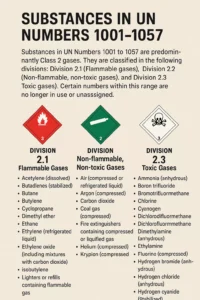 Which substances fall under UN Numbers 1001–1057?
The substances classified under UN Numbers 1001–1057 are predominantly Class 2 gases, encompassing flammable (Division 2.1), non-flammable/non-toxic (Division 2.2), and toxic (Division 2.3) materials. These entries facilitate the safe transport of compressed or liquefied gases, which are often used in industrial, medical, and agricultural applications and may carry subsidiary hazards such as oxidising or corrosive properties. It is important to note that certain specific numbers within this range (e.g., 1004, 1007, 1042, 1054) are currently listed as “no longer in use” or are unassigned, and substances may receive different UN numbers based on their physical state or level of purity/concentration.
The specific substances and products covered by this range include:
- Acetylene (dissolved)
- Air (compressed or refrigerated liquid)
- Ammonia (anhydrous)
- Argon (compressed)
- Boron trifluoride
- Bromotrifluoromethane
- Butadienes (stabilised), Butane, and Butylene
- Carbon dioxide and compressed Carbon monoxide
- Chlorine
- Chlorodifluoromethane, Chloropentafluoroethane, 1-Chloro-1,2,2,2-tetrafluoroethane, and Chlorotrifluoromethane
- Coal gas (compressed)
- Cyanogen and Cyclopropane
- Dichlorodifluoromethane and Dichlorofluoromethane
- 1,1-Difluoroethane
- Dimethylamine (anhydrous) and Dimethyl ether
- Ethane
- Ethylamine, Ethyl chloride, and Ethyl methyl ether
- Ethylene (refrigerated liquid) and Ethylene oxide (including mixtures with carbon dioxide)
- Fertiliser ammoniating solution with free ammonia
- Fire extinguishers containing compressed or liquefied gas
- Fluorine (compressed)
- Helium (compressed)
- Hydrogen bromide (anhydrous), compressed Hydrogen, anhydrous Hydrogen chloride, stabilised Hydrogen cyanide, anhydrous Hydrogen fluoride, and Hydrogen sulfide
- Isobutylene
- Krypton (compressed)
- Lighters or Lighter refills containing flammable gas
What gases are included in the UN 1001 to UN 1057 range?
The gases and substances included in the UN 1001 to UN 1057 range predominantly fall under the United Nations (UN) classification for Class 2 gases, as assigned by the Committee of Experts on the Transport of Dangerous Goods.
This specific numerical range, which is part of the larger sequence UN 1001 to UN 1100, is dedicated to encompassing substances categorised by their hazardous properties, often including groups of chemicals or products with similar characteristics (for example, UN 1057 is assigned to lighters and flammable gases). The specific divisions of Class 2 gases designated within this range include:
- Division 2.1: Flammable gases
- Division 2.2: Non-flammable, non-toxic gases
- Division 2.3: Toxic gases
How are these UN Numbers assigned to different gas types?
UN Numbers are assigned to different gas types and other dangerous goods by the United Nations (UN) Committee of Experts on the Transport of Dangerous Goods. These crucial four-digit numbers, coupled with a proper shipping name, serve as the standard technical identifiers used to describe the hazard properties and chemical composition of the material. They must be accurately listed in the Dangerous Goods Declaration and in Section 14 of the Material Safety Data Sheets (MSDS or SDS) to facilitate proper labelling and safe transport.
For consignors, the assignment process usually involves consulting existing classifications. Many substances and generic groups have already been classified, and the consignor must choose the UN number and proper shipping name that most accurately describes their shipment from the Dangerous Goods List. This list, often located in Part 3 of the ADR (European Agreement concerning the International Carriage of Dangerous Goods by Road), can be searched by UN Number (Table A) or alphabetically (Table B).
While some hazardous materials may share a common UN number due to similar properties, others are assigned specific, different UN numbers to specify unique hazards. It is important to note that goods not classified or regulated by the UN are instead designated four-digit North American (NA) numbers (ranging from 8000–9279), which are assigned by the United States Department of Transportation (DOT).
What role do UN Numbers play in documentation and labelling?
The role UN Numbers play in documentation and labelling is central to the safe and compliant transport of hazardous and dangerous goods. These unique four-digit numbers are assigned by the United Nations to classify and identify specific hazardous substances, helping to determine proper shipping names, packing groups, and compatibility groups, as well as identifying the specific dangers associated with the material. This system is essential for ensuring that substances are transported safely, handled with appropriate care, and maintained in compliance with international regulations to protect human health, safety, and the environment. In documentation, the UN Number is required to be listed in Section 14 (Transport Data) of the Material Safety Data Sheet (MSDS), which the producer or supplier is obliged to submit. For labelling and physical transport, these numbers are prominently featured on shipping labels, transport documents, and hazard placards to ensure proper handling and facilitate necessary emergency response.
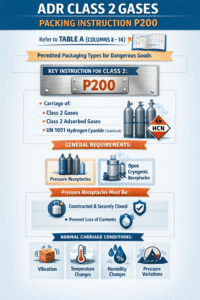 What packing instructions apply to ADR Class 2 gases?
The packing instructions that apply to ADR Class 2 gases are primarily determined by consulting Table A, specifically columns 8 to 14, which detail the sort of permitted packaging once the dangerous goods have been correctly classified. A key specific instruction applicable to Class 2 substances and goods is P200, which applies generally to the carriage of these materials, including Class 2 adsorbed gases and other substances such as UN 1051 hydrogen cyanide, stabilised.
This instruction provides general requirements for the use of pressure receptacles and open cryogenic receptacles. Pressure receptacles shall be constructed and closed to prevent any loss of contents that might be caused under normal conditions of carriage. These conditions include potential loss resulting from vibration or from changes in temperature, humidity, or pressure (such as those resulting from a change in altitude).
How are pressure vessels and cylinders regulated for ADR Class 2?
The regulation of pressure vessels and cylinders for ADR Class 2 (gases) is primarily governed by the Carriage of Dangerous Goods and Use of Transportable Pressure Receptacles Regulations (CDGCPL 2009, as amended), which cover Transportable Pressure Receptacles (TPRs) and replaced earlier legislation like Part V of the PSTGC Regulations.
To ensure compliance and suitability for transportable pressure vessels, the following mandatory requirements related to design, manufacture, and assessment must be met:
- The vessel must be safe and suitable for its intended purpose.
- The design, manufacturing, and testing must adhere to standards listed in Schedule 2 of the Regulations or any standard approved by the Executive that meets the relevant requirements outlined in Chapter 6.2 of the ADR (European Agreement concerning the International Carriage of Dangerous Goods by Road).
- The vessel must undergo assessment by a notified body, utilising the relevant conformity assessment procedures specified in Schedule 4, to confirm conformity with the identified standards. This assessment process often involves extensive quality assurance, particularly as hazard levels increase.
- The vessel must bear the required conformity marking, the identification number of the notified body, and any other markings required by the applicable standards. Products in categories 1 to 4 must be marked with the CE mark, while products categorised as Sound Engineering Practice (SEP) do not require this marking.
What are the key packaging groups and compatibility rules?
The key requirements for dangerous goods packaging involve understanding the different types of UN-approved packaging and ensuring strict adherence to essential compatibility rules necessary for compliance and maintaining the safety of shipments.
Crucial compatibility rules that the filler, packer, or consignor must follow, as they are responsible for ensuring compliance, are:
- The selected packaging must be UN-approved and compatible with the dangerous goods it contains.
- The contents must have similar or identical physical characteristics to the specific test substances or articles for which the packaging was successfully tested and approved.
- The actual packaging materials themselves must be compatible with the physical and chemical nature of the contents to prevent degradation or reaction.
How does ADR determine maximum filling ratios and limits?
ADR determines maximum filling ratios and limits by applying a specific definition for the ‘degree of filling’ and utilising formulas based on the state and properties of the substance being transported.
The ‘Degree of filling’ is a core measurement, defined as the ratio, expressed in percentage, of the volume of liquid or solid introduced at 15°C into the means of containment compared to the total volume of the means of containment ready for use.
For high-pressure liquefied gases and gas mixtures where relevant data is not available, the maximum filling ratio (FR) shall be determined using the formula: FR = 8.5 × 10⁻⁴ × dg × Ph. In this calculation, dg represents the gas density (measured at 15°C and 1 bar, in kg/m³) and Ph represents the minimum test pressure (in bar).
Furthermore, ADR specifies that certain degrees of filling shall not be exceeded in tanks intended for the carriage of liquids at ambient temperatures. These limits are especially applied to flammable substances and environmentally hazardous substances, even when the tanks utilise safety devices such as breather devices or safety valves (even if preceded by a bursting disc).
 What vehicle codes apply to the transport of ADR Class 2 materials?
The vehicle codes and regulatory requirements that apply to the transport of Class 2 materials are primarily governed by the International Carriage of Dangerous Goods by Road (ADR). ADR sets out comprehensive requirements covering the classification, packaging, labelling, certification, specific vehicle and tank needs, and other operational requirements for dangerous goods. In Great Britain (England, Wales, and Scotland), these regulations are implemented via the Carriage of Dangerous Goods and Use of Transportable Pressure Equipment Regulations 2009 (as amended).
Class 2 materials consist of gases and are classified into three divisions:
Division 2.1 (Flammable gas),
Division 2.2 (Non-flammable non-toxic gas),
Division 2.3 (Toxic gas).
The specific ADR requirements applicable may vary depending on the load size and category. For example, materials like LPG, which fall into Transport Category 2, have a small load threshold of 333 kg; if the total load of cylinders is less than this limit, only the minimum ADR requirements apply.
What types of vehicles are authorised for ADR Class 2 gases?
The types of vehicles authorised for ADR Class 2 gases, such as gas cylinders, primarily consist of open vehicles, open containers, or trailers. If transporting gas cylinders inside a closed vehicle is necessary, this practice must be subject to a specific risk assessment with appropriate controls implemented.
In all cases, good ventilation is required, often facilitated by the use of roof ventilators and side vents to help increase the quantity of ventilated air. If gas accumulation is a possibility within the vehicle’s storage space, appropriate warning signs must be displayed. Additionally, the carriage of Class 2 dangerous goods, which includes LPG (Transport Category 2 with a 333 kg small load threshold), must comply with minimum ADR requirements, and a copy of any relevant Multilateral Agreement (MA) must be carried on the vehicle.
What safety equipment and construction standards are required?
The safety equipment and construction standards required encompass both minimum Personal Protective Equipment (PPE) regulations and project-specific guidelines.
The minimum construction site PPE requirements include:
- High-visibility clothing.
- Head protection.
- Reinforced or protective footwear, which workers are expected to wear whilst on site and during heavy work. This footwear is critical for protecting the delicate bones of the foot and preventing movement-limiting damage, typically requiring steel toecaps (or equivalent) to guard against dropped objects, and midsole protection (usually a steel plate) to protect against puncture or penetration, such as treading on a nail.
Regarding construction standards and provisions, some regulations, such as PPE regulations, will apply to all projects. Other regulations, such as those governing confined spaces, will only apply if that specific type of work is being carried out. Employers are responsible for providing the basic standard of safety footwear to their workers at no cost, and must also pay for suitable kit if medical reasons prevent a worker from wearing the basic standard equipment.
How are vehicle codes matched with gas properties and risks?
Vehicle codes are matched with gas properties and risks primarily through adherence to specific engineering standards that categorise their suitability for operating in potentially explosive atmospheres, such as those governed by ATEX regulations. Standard EN 1755 sets out the requirements necessary for diesel-powered lift trucks designated for ATEX category 2 or 3. Electric-powered vehicles also achieve compliance by using a combination of the EN 1755 standard along with normal electrical standards. However, no specific standards are available for vehicles utilising spark ignition engines, and building such an engine economically to meet these requirements is considered unlikely.
 How is labelling managed for ADR Class 2 gases during transport?
The labelling for ADR Class 2 gases during transport is managed by stringent requirements dictated by the combination of the gas’s hazard class (Class 2) and its assigned Packing Group (PG). This combination dictates how dangerous goods, which include gases in compressed, liquefied, or dissolved forms such as hydrogen, propane, or nitrous oxide, must be packaged, labelled, and carried, specifying requirements for inner and outer packaging, material suitability, and the necessary marks and labels they must bear.
In addition to the primary ADR Class 2 designation, the specific degree of danger associated with the gas is marked using an accompanying capital letter:
- A – Asphyxiating
- O – Oxidising
- F – Flammable
- T – Toxic
- C – Corrosive
Furthermore, labelling management includes adhering to specific size requirements (such as those outlined in 5.2.2.2.1.1). Transport regulations, such as ADR, permit some flexibility in the labelling requirements for refrigerated liquid gases and also allow changes to be made to the background colour of flammable gas labels for specific UN numbers, including UN1011, 1075, 1965, and 1978.
What hazard labels are used for flammable and toxic gases?
The hazard labels used for flammable and toxic gases are differentiated according to their specific hazard classification (Class 2, Gases), which is typically categorised into three subdivisions. Under systems like GB CLP, the specific pictograms used to identify these hazards are:
- Flammable Gases: Identified by the flame symbol (or flame icon), often displayed on a red background. These substances belong to Class 2, Division 2.1, and include examples such as butane and propane.
- Toxic Gases: Identified by the skull and crossbones symbol (or skull icon), which specifically denotes Acute toxicity hazards. These substances belong to Class 2, Division 2.3 (e.g., chlorine or hydrogen sulphide), and the icon is typically on a white background.
What is the correct placarding for mixed gas consignments?
The correct placarding for mixed gas consignments involves specific placement rules for hazard diamonds on the transport unit, designed to communicate potential risks for handling, segregation, and emergency actions.
Placarding is the process of placing these hazard diamonds, analogous to labelling packages, on the tank, vehicle, or container. When a tank-vehicle or demountable tank carries two or more different dangerous goods in multiple compartments, the appropriate placards shall be displayed in a precise manner.
The placarding requirements for mixed consignments are:
- Appropriate placards must be displayed along each side of the vehicle at the position of the relevant compartments.
- One placard of each model required for the consignment must be shown on each side and at the rear of the vehicle.
- If all compartments within the vehicle require the same placards, these placards need only be displayed once along each side and once at the rear of the vehicle.
Precise details regarding the size and specifications of these placards are determined by regulatory standards, though smaller placards (package labels) may be used for small tanks or containers.
How are label codes derived from UN classifications?
The derivation of label codes from UN classifications is a structured process used primarily in the regulation of dangerous goods transport, where classification serves as the precursor for all subsequent requirements. This process begins with properly classifying the substance or article, which involves understanding the material being shipped (often via documentation such as the Safety Data Sheet or SDS) to select the correct UN number. Once the substance or article has been properly classified, shippers must identify the corresponding hazard class. This foundational classification allows specific requirements, including the choice of the appropriate label or placard code, to be logically ascertained by referencing organised regulatory tables, such as Table A (ADR 3.2.1), which allows users to work through columns to determine every applicable requirement.
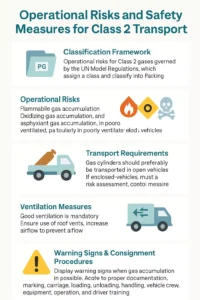 What are the operational risks and safety measures for ADR Class 2 transport?
The operational risks and safety measures for ADR Class 2 transport (gases) are governed by a classification system, such as the UN Model Regulations, which assigns each dangerous substance a class defining the type of danger and uses a Packing Group (PG I, PG II, or PG III) to further classify the level of hazard.
Operational procedures and safety measures focus on mitigating critical risks, such as the accumulation of flammable, oxidant, or asphyxiant gases (e.g., from dry ice or welding equipment), and require strict adherence to the following protocols:
- Gas cylinders should primarily be transported in open vehicles, open containers, or trailers to facilitate maximum ventilation.
- If transporting gas cylinders inside a vehicle is necessary, it must be subject to a specific risk assessment, and appropriate controls must be implemented.
- Good ventilation is required in all cases, often utilising roof ventilators along with side vents to increase the quantity of ventilated air within the vehicle.
- Appropriate warning signs must be displayed if there is any possibility of gas accumulating within the vehicle’s storage space.
- Safety measures are also ensured through comprehensive consignment procedures, including strict rules regarding documentation, vehicle marking, carriage, loading, unloading, handling (Part 7), and the required vehicle crews, equipment, operation, and driver training (Part 8).
Why are leak prevention and ventilation essential for ADR Class 2 gases?
Leak prevention and ventilation are essential for ADR Class 2 gases because they mitigate severe safety hazards, including asphyxiation and flammability risks, and ensure regulatory compliance during storage and transport. Even non-flammable, non-toxic Class 2 gases (such as those in Class 2.2) pose a serious danger, as any leak into a confined space can displace the oxygen in the air, creating an oxygen-deficient environment that leads to an asphyxiation hazard for workers, supervisors, contractors, and visitors. Consequently, constant monitoring and rigorous logistics, including keeping gases in certified containers and protected from heat, are necessary to prevent leaks and poisoning.
Furthermore, ventilation plays a critical role in managing flammable gases by controlling the extent of hazardous areas. Standards like the UK’s BS EN 60079 part 101 demonstrate a direct link between the rate of flammable vapour release and the ventilation available at that location, which ultimately determines the zone number and size of the hazardous area. Proper ventilation ensures that the risk of explosions is minimised, reinforcing the overall safe delivery and storage requirements for these sensitive, dangerous goods.
What emergency protocols apply during incidents?
The emergency protocols that apply during incidents generally involve managing immediate danger, coordinating services, and following established response plans, often utilising an all-hazards approach, such as the UKHSA Incident Response Plan (IRP), for managing public health emergencies across different phases of the response cycle. In all emergency instances, the initial procedural step involves calling 999 for professional assistance, followed by informing relevant local security or authorities of the situation.
Beyond initial contact, most event emergency plans must address the following basic requirements for incident response:
- Get people away from immediate danger.
- Summon and assist emergency services.
- Handle casualties.
- Deal with those who have been displaced but not injured (such as those affected at a festival or large event).
- Liaise with emergency services and other authorities and, where the situation is serious, hand over responsibility for the incident.
- Protect property.
What are the rules for segregation from incompatible substances?
The rules for segregation from incompatible substances require that these hazardous materials or dangerous goods be separated during storage and transportation to avoid possible reactions, such as fires, explosions, or the formation of toxic or flammable gases, that occur if they accidentally mix or spill. Segregation reduces these hazards by preventing the overlap of incompatible hazardous areas and mitigating the danger associated with accidental leakage or spillage. For incompatible materials, shared transportation or storage may still be allowed only if the materials are separated from each other by a sufficient minimum distance.
Specific guidelines and examples of substances that must be strictly segregated include:
- Oxidising agents and flammable substances, whose storage areas should not overlap.
- Strong acids and cyanide compounds must be kept separate.
- Peroxides should not be stored near any metallic compounds that could trigger decomposition and the uncontrolled liberation of oxygen.
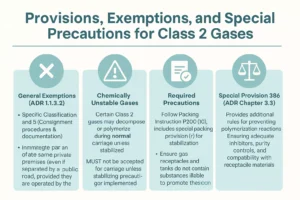 What provisions modify or exempt the handling of ADR Class 2 gases?
The provisions that modify or exempt the handling of ADR Class 2 gases relate to specific carriage conditions and the chemical stability of the materials, including general exemptions defined in ADR 1.1.3.2. Specific regulations (Parts 2 and 5) do not apply to the carriage of Class 2 goods by road in a vehicle used for delivering goods between private premises and a vehicle in the immediate vicinity of those premises, or passing between adjacent parts of the same private premises (even if separated by a road), provided both parts are occupied by the same person.
Special provisions are necessary for chemically unstable Class 2 gases, which shall not be accepted for carriage unless precautions have been taken to prevent the possibility of dangerous decomposition or polymerisation under normal conditions of carriage. These precautions include carrying the gas in accordance with special packing provision (r) of packing instruction P200 (10) of 4.1.4.1, and particular care must be taken to ensure that receptacles and tanks do not contain any substances liable to promote these reactions (referencing special provision 386 of Chapter 3.3 for necessary polymerisation precautions).
What special provisions apply to Class 2 gases under ADR?
The special provisions that apply to Class 2 gases under ADR cover technical specifications for tanks, mandatory loading procedures, and specialised driver knowledge requirements.
Concerning technical specifications for transport, in the case of gases and gas mixtures classified under n.o.s. entries, the values of the test pressure and the filling ratio shall be prescribed by an expert approved by the competent authority. For tanks containing compressed or high-pressure liquefied gases that have been subjected to a lower test pressure than shown in regulatory tables and are fitted with thermal insulation, a lower maximum load may be prescribed by the approved expert, provided that the pressure reached by the substance in the tank at 55 °C does not exceed the test pressure stamped on the tank.
Regarding the transport of packaged goods, packages containing Class 2 substances shall preferably be loaded in open or ventilated vehicles or open or ventilated containers. If packages are carried in other closed vehicles or containers, the cargo doors must be marked with the required text using letters that are not less than 25 mm high.
Furthermore, drivers transporting Class 2 substances are required to undergo training that provides an understanding of the characteristics of Flammable Gas, Compressed (Non-Flammable Non-Toxic Gas), and Toxic Gas, alongside marking/labelling requirements and specific dangers, including a BLEVE (Boiling Liquid Expanding Vapour Explosion).
When are limited quantity or pressure exemptions allowed?
The limited quantity (LQ) and general quantity-based exemptions are allowed under specific regulatory conditions, primarily related to the amount of dangerous goods carried and their assigned packaging limits:
- Limited Quantity (LQ) Exemption: This exemption is permitted when the dangerous goods are assigned an LQ “maximum quantity per inner packaging” value greater than zero, as specified in Column 7a of Table A in ADR. If the figure assigned for a substance is 0, no LQ exemption applies.
- Quantity Threshold Exemption (ADR 1.1.3.6): Goods may be carried in packages without applying many standard ADR provisions (such as Chapter 5.3, Chapter 7.2, and most of Part 8) if the total quantity carried on the transport unit does not exceed specific values. This applies either when the quantity does not exceed the values indicated in column (3) of the table in 1.1.3.6.3 for a given transport category (if all dangerous goods belong to the same category) or the value calculated in accordance with 1.1.3.6.4 (if they belong to different transport categories). Certain high-risk materials, such as specific Class 1 explosives and certain Class 7 excepted packages where the activity level exceeds the A2 value, remain subject to certain provisions like Chapter 1.10.
How do tank instructions vary across different gas types?
Tank instructions vary across different fuel types based on fuel characteristics, required engine performance, identification methods at the pump, and guidelines for mixing or switching fuels.
The most critical variation relates to the fuel’s octane rating, which indicates its resistance to ignition and engine knock. High-octane premium petrol is typically recommended by vehicle manufacturers for high-performance engines because these highly tuned motors generate greater temperature and compression. Conversely, premium petrol often yields little difference in regular economy cars or trucks.
Instructions also involve visual identifiers at the pump. Although fuel identification standards vary significantly (with no federal law requiring specific colours in the U.K.), common pump nozzle patterns help distinguish fuel types—such as green typically indicating diesel, and yellow often signifying E85 ethanol, while black, red, white, or blue represent different petrol grades. Users must always read the pump labels to confirm the exact fuel grade and type before filling.
Finally, instructions govern the safety of switching or mixing fuels. Since all fuel types share the same basic constituent elements on the hydrocarbon chain, it is generally considered relatively safe to change to another fuel type for a single, one-time fill during an empty-tank situation. However, long-term instructions mandate consistency, as using a different fuel type for an extended period can cause serious damage. If a user intends to switch back to their original fuel, they must ensure the old fuel is completely run out first.
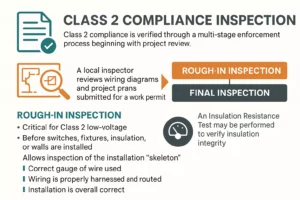 How is ADR Class 2 compliance assessed through inspections and enforcement?
Class 2 compliance is assessed through a multi-stage enforcement process that begins with project review and culminates in physical inspections.
The compliance process starts when the local inspector assesses the detailed wiring diagram and project plans presented for the work permit, ensuring they align with established law, standards, and guidance. Once the work permit is granted, the inspection typically consists of two main visits: the rough-in inspection and the final inspection.
Class 2 compliance for low-voltage installations is specifically checked during the critical rough-in inspection. This inspection occurs before any switches, fixtures, insulation, or walls are added, allowing the inspector to review the “skeleton” of the installation to confirm:
- That the correct gauge wire has been installed and harnessed correctly.
- The wiring has been properly installed overall.
- An Insulation Resistance Test may be performed to ensure the wiring insulation remains intact and effective.
How do authorities check for correct labelling and packaging?
Authorities check for correct labelling and packaging through formal processes, occurring as part of an inspection or investigation. Enforcement is often handled by local authorities, such as the Trading Standards office, which is enabled by regulations like the Food Information Regulations 2014 in England to enforce rules, including the European Food Information to Consumers (FIC) Regulation 1169/2011. Businesses with questions about how to correctly label their products can also seek guidance directly from their local Trading Standards office.
What penalties apply for ADR Class 2 violations?
The penalties that apply for Class 2 violations typically range from $800 to $1250 for first-time offences. Subsequent violations are subject to increased penalties, which depend on the nature of the specific violation. Furthermore, non-compliance resulting in illegal signs may be issued multiple violations returnable to the Office of Administrative Trials and Hearings, Hearings Division (OATH).
What are the common audit triggers during transport of gases?
The common audit triggers during the transport of gases are defined by the comprehensive scope of gas and chemical safety audits, which evaluate the effective management of chemical hazards across all stages, including transportation.
These detailed safety audits review how effectively an organisation manages the safe handling, storage, disposal, and, specifically, the transportation of chemicals and gases. Issues that frequently surface and constitute common audit triggers relate to failures in compliance regarding safety procedures, the operational status of safety equipment, and the efficacy of hazard communication protocols. Furthermore, areas of frequent non-compliance include deficiencies in critical control systems, such as ensuring proper labelling, adequate containment, and fully functioning ventilation systems are in place and regularly maintained. Experienced industry teams conducting these comprehensive gas safety audits accumulate a long list of these recurring non-compliance issues that arise frequently during reviews.