
What qualifies a substance for ADR Class 6 classification?
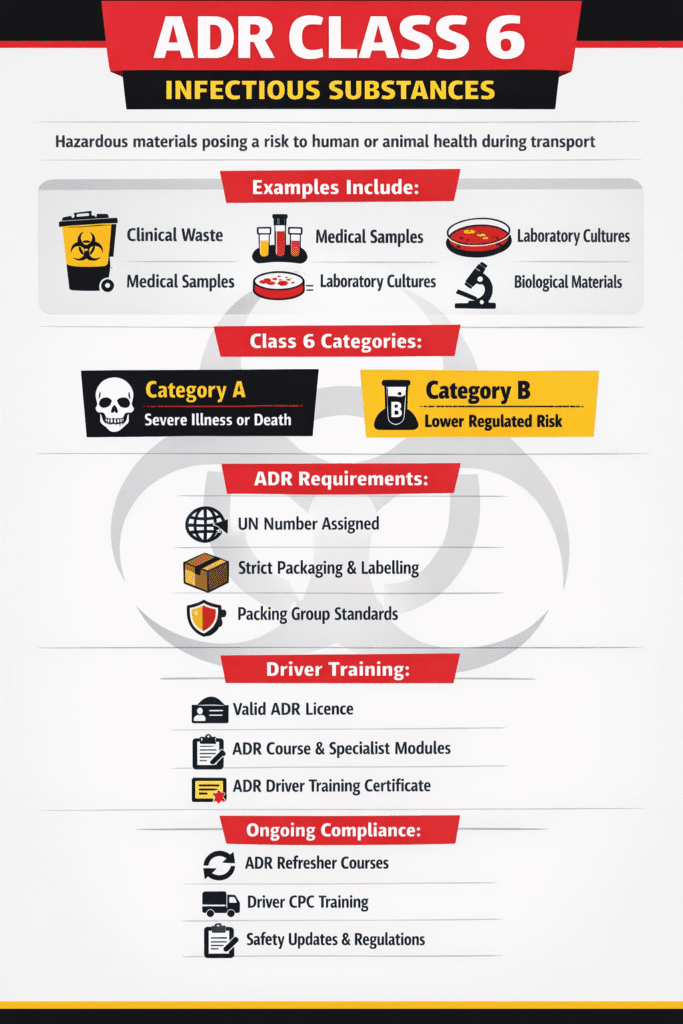
ADR Class 6 applies to infectious substances that pose a risk to human or animal health during transport. Under ADR regulations, a substance is placed in ADR Class 6 when it contains pathogens capable of causing disease after exposure. This includes clinical waste, medical samples, laboratory cultures, and biological materials used for diagnosis or research. These materials fall under dangerous goods class rules because of their potential to spread infection during handling or movement.
Class 6 is divided into Category A and Category B. Category A covers substances that can cause severe illness or death when exposure occurs, while Category B applies to materials presenting a lower but still regulated risk. Both are classed as hazardous goods and require strict packaging, labelling, and documentation under ADR carriage rules. Each substance is assigned a UN number, which identifies its hazard type and handling requirements. Packaging must follow the correct packing group standards to prevent leakage, contamination, or exposure.
Drivers transporting Class 6 goods must hold a valid ADR licence, gained through an approved ADR course or ADR training course. The ADR core module explains classification, documentation, and emergency actions, while specialist modules cover infectious substances and tank or package transport where required. Completion leads to an ADR certificate, often referred to as an ADR driver training certificate, recognised across the UK and Europe.
Ongoing compliance requires ADR refresher training, ensuring drivers remain aware of updates to ADR regulations, packaging rules, and safety procedures. This training is commonly delivered alongside driver CPC training, supporting professional standards for every HGV driver involved in the transport of hazardous materials.
How does ADR Class 6 define toxic and infectious substances?
ADR defines toxic substances as materials that can cause harm or death when inhaled, swallowed, or absorbed through the skin. These are assigned to ADR Class 6.1 and include industrial chemicals, pesticides, and pharmaceutical compounds. An infectious substance, under ADR Class 6.2, contains pathogens that can cause disease in humans or animals. This includes clinical waste, medical samples, and microbiological cultures.
Classification is determined by properties such as toxicity level, infection risk, and how the material behaves during transport. Each is assigned a specific UN number and packing group, guiding packaging, labelling, and carriage rules. These rules form part of every accredited ADR course, including both the core module and specialist segments.
Drivers involved in transporting hazardous materials must obtain an ADR licence by completing certified ADR training courses. This includes awareness of class-specific dangers, first response actions, and legal responsibilities under ADR regulations. Upon passing the assessment, a driver receives an ADR driver training certificate, often combined with Driver CPC training.
Professional understanding of these definitions is essential for safe carriage of dangerous goods. Approved training providers, accredited by the Scottish Qualifications Authority, include toxic and infectious classification content in all ADR training leading to the vocational training certificate for any HGV driver involved in hazardous goods transport.
What is the difference between ADR Class 6.1 and ADR Class 6.2?
Class 6.1 covers toxic substances, which are chemically harmful. Exposure occurs through inhalation, ingestion, or skin contact and can result in severe illness or death. Common examples include arsenic, cyanide compounds, and certain pesticides. These are part of the ADR dangerous goods framework and require specific packaging, labelling, and documentation for safe transport.
Class 6.2 refers to infectious substances. These contain live pathogens such as bacteria, viruses, or other microorganisms capable of causing disease. This class includes medical waste, diagnostic samples, and genetically modified microorganisms. Infectious materials are further divided into Category A (high risk to humans/animals) and lower-risk Group A substances.
The classification difference impacts the requirements for packaging type, labelling, UN number, and training. For example, ADR training courses will cover Class 6.1 and 6.2 separately under the core module and specialist class units. Safe handling procedures differ greatly between chemical toxicity and infection risk.
Anyone transporting these classes must gain an ADR certificate by passing an ADR training course, which includes both written tests and sometimes practical elements. The qualification allows drivers to carry out the carriage of dangerous goods under UK and EU law and must be refreshed every five years through ADR refresher training.
Drivers with a valid ADR licence are authorised to carry both classes if certified, but they must demonstrate knowledge and compliance with each category’s separate handling protocols.
Why are toxicity and infection risk the basis for classification?
Toxicity and infection risk are key classification factors under ADR regulations because they directly relate to the threat posed during transport. ADR’s purpose is to reduce harm to humans, animals, and the environment in case of accidents, spills, or exposure. Toxic substances (Class 6.1) can poison through chemical action. Infectious substances (Class 6.2) can spread disease. Both types require very different safety measures and emergency response strategies.
ADR classification ensures these risks are communicated clearly via UN numbers, hazard labels, and proper packing group assignments. Without this standardisation, response teams, handlers, and drivers would be exposed to unknown or mislabelled hazards, raising risks during carriage of dangerous goods.
The ADR core module within approved ADR training courses explains how these classifications are decided and why they matter. For example, a HGV driver transporting clinical waste must understand pathogen containment, whereas those moving chemical toxins focus on exposure limits and containment controls. This knowledge is tested as part of the ADR training course and is essential to earning the vocational training certificate.
Drivers need a valid ADR licence to transport any goods under ADR class 6, proving they meet the standards set by the Scottish Qualifications Authority and comply with both national and EU carriage laws. Classification based on toxic or infectious threat ensures public and environmental safety at every stage of the supply chain.
Which materials fall under UN Numbers 2813–2900?
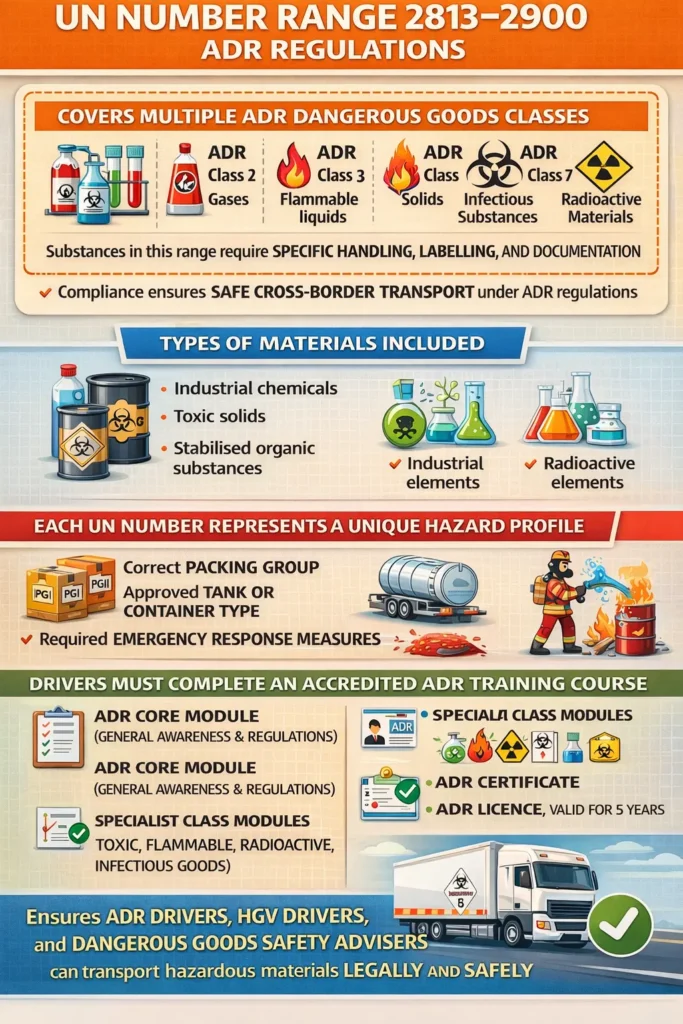
The UN Number range 2813 to 2900 includes a set of dangerous goods categorised under various ADR classes, including Class 2 gases, Class 3 flammable liquids, Class 4 flammable solids, Class 6 infectious substances, and Class 7 radioactive materials. These substances require specific handling and labelling procedures to comply with ADR regulations and ensure safe transport across borders.
Materials within this range include industrial chemicals, toxic solids, stabilised organic substances, radioactive elements, and infectious or clinical waste products. Each UN number in this range represents a distinct hazard profile, which determines the correct packing group, tank container type, and emergency response measures. These materials are classified according to their chemical composition, reactivity, and physical state.
Drivers transporting substances from this UN range must complete an accredited ADR training course covering the appropriate ADR class modules. The ADR core section includes general awareness and regulatory understanding, while specialist class modules cover handling of toxic, radioactive, or flammable materials. Passing the training results in an ADR certificate, which qualifies the individual for an ADR licence, valid for five years.
Courses approved by the Scottish Qualifications Authority cover this content as part of recognised ADR training courses, including refresher training, Driver CPC training, and the issuance of a vocational training certificate. These ensure every ADR driver, HGV driver, or dangerous goods safety adviser can carry regulated hazardous materials safely and legally.
What are common examples of ADR Class 6 substances in the UN 2813–2900 range?
Within the UN Number 2813–2900 range, several entries are classified under ADR Class 6, which includes toxic substances (Class 6.1) and infectious substances (Class 6.2). These are transported under strict control due to their ability to harm human or animal health.
Examples of Class 6 materials in this range include:
- UN 2814 – Infectious substance, affecting humans (Category A)
- UN 2815 – Infectious substance, affecting animals only
- UN 2851 – Alkaloids, solid, toxic (used in pharmaceuticals)
- UN 2900 – Infectious substance, affecting animals only (Category A)
These materials are often linked to clinical waste, diagnostic samples, and hazardous chemicals used in research or healthcare. Their classification requires trained ADR drivers with a valid ADR licence and ADR certificate obtained through an approved ADR training course.
To transport any ADR dangerous goods, drivers must complete the core module, then specialist training for ADR Class 6. Certified ADR training courses often aligned with Scottish Qualifications Authority standards prepare each HGV driver or dangerous goods safety adviser to manage risks and ensure legal carriage of hazardous materials.
How are UN numbers assigned to toxic and infectious substances?
UN numbers are four-digit identifiers assigned by the United Nations to classify dangerous goods for safe international transport. Each number represents a specific substance or type of hazard. For ADR Class 6 (toxic and infectious substances), the assignment follows a standard process based on chemical properties and biological risk.
Criteria for assigning UN numbers:
- Toxicity level (measured in LD50 for Class 6.1)
- Infectivity potential for Class 6.2 (e.g. exposure risk, transmission method)
- Chemical form and state (liquid, solid, gas)
- Application and source (e.g. medical, industrial, clinical)
Examples:
- UN 2814 – For high-risk pathogens like Ebola (Category A)
- UN 2900 – Animal-only infectious substances
- UN 2851 – Toxic alkaloids
Correct classification ensures proper packing group, label, emergency code, and documentation. Drivers must understand this as part of the ADR course syllabus, particularly in the core module and specialist class sessions for Class 6. Completion of an ADR training course results in a vocational training certificate, allowing the issue of an ADR driver training certificate.
All ADR training includes awareness of UN numbers, ensuring that drivers and dangerous goods safety advisers apply the right identifiers during ADR carriage.
What role do UN numbers play in identification and documentation?
UN numbers are central to the safe carriage of ADR dangerous goods. They ensure that every stakeholder from the consignor to the ADR driver and emergency responder can identify the substance accurately and apply the correct safety procedures.
Key roles of UN numbers in the transport process:
- Identification: Each UN number corresponds to a specific hazard class (e.g. ADR Class 6) and substance name.
- Labelling and Placarding: Determines the correct signage on vehicles and containers.
- Documentation: Included in the transport document, ADR certificate, and driver CPC training materials.
- Packing Instructions: Guides selection of containers and packing group for leak prevention.
- Emergency Response: UN numbers link to protocols in the Emergency Response Guidebook.
For example, an HGV driver transporting UN 2814 (infectious material affecting humans) must carry documents clearly displaying the number, along with proper labels and emergency contact instructions.
This topic is thoroughly covered in approved ADR training courses, which form part of the required qualifications for the ADR licence. Training ensures every ADR driver knows how to interpret, apply, and verify UN numbers, supported by refresher training, and monitored under standards set by the Scottish Qualifications Authority.
What packing rules apply to ADR Class 6 substances?
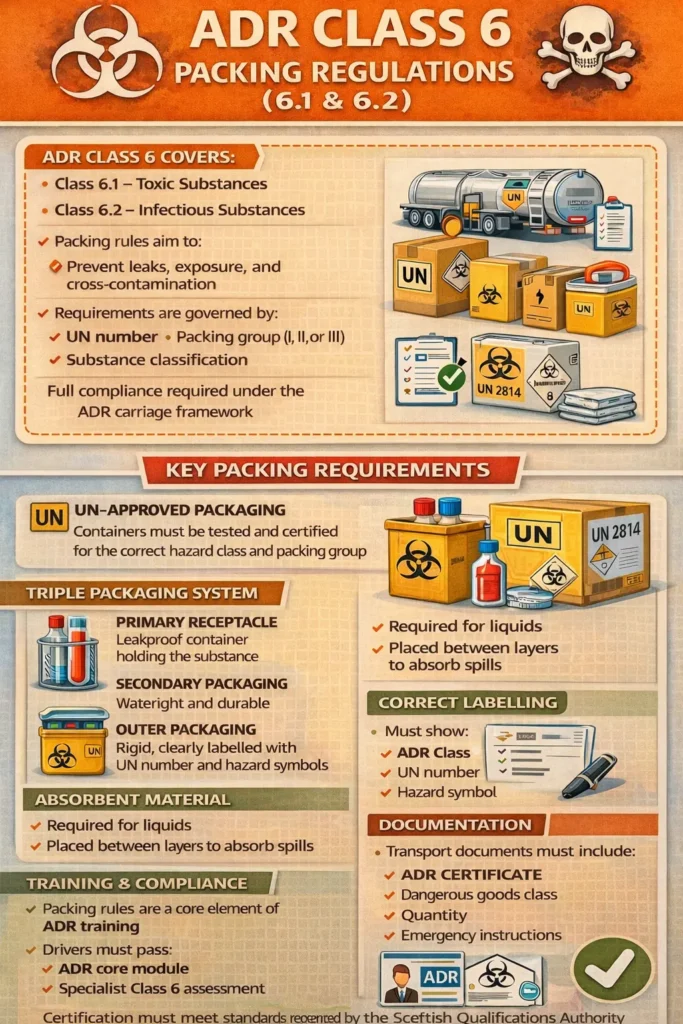
ADR Class 6 substances comprising toxic materials (Class 6.1) and infectious substances (Class 6.2) are subject to strict packing regulations under the ADR carriage framework. The goal is to prevent leaks, exposure, and cross-contamination during handling and transport. These rules are governed by the UN number, packing group, and substance classification, and must be followed to maintain compliance with ADR regulations.
Key Packing Requirements for ADR Class 6:
- UN-Approved Packaging: All hazardous goods must be packaged in containers tested and certified for their hazard class and packing group (I, II or III).
- Triple Packaging System (Class 6.2):
For infectious substances, a three-layer system is mandatory:- Primary receptacle (leakproof container for the substance)
- Secondary packaging (watertight and durable)
- Outer packaging (rigid and labelled with the correct UN number and hazard symbols)
- Absorbent Material: Must be placed between layers to absorb any spillage (required for liquids).
- Temperature Control: For some clinical waste or infectious substances, packaging must include insulation or refrigeration components.
- Correct Labelling: Labels must reflect the assigned ADR class, UN number, and hazard symbol.
- Documentation: Transport documents must specify the dangerous goods class, proper shipping name, quantity, and emergency instructions.
These packing rules are a central part of the ADR training course. Drivers must demonstrate this knowledge in both core module and specialist class assessments to receive an ADR certificate. Only then can a driver apply for an ADR licence and lawfully carry Class 6 materials.
Refresher coverage is provided through ADR refresher and Driver CPC training, ensuring HGV drivers transporting hazardous materials maintain awareness of current packing standards. Certification must comply with frameworks recognised by the Scottish Qualifications Authority.
How are packaging groups assigned for ADR Class 6.1 and ADR 6.2?
Packing groups (PG) classify the level of hazard posed by ADR Class 6.1 substances. This system helps define packaging strength and test performance required during ADR carriage. ADR Class 6.2 (infectious substances) is not divided by packing groups but instead classified by Category A or Group A based on infection risk.
Packing group criteria for ADR Class 6.1 (Toxic Substances):
- Packing Group I
Substances with high toxicity (e.g. cyanides). Requires strongest packaging and greatest ADR awareness. - Packing Group II
Moderate toxicity levels. Requires UN-approved packaging with intermediate performance tests. - Packing Group III
Low toxicity levels. Minimum strength requirements still apply.
Classification criteria for ADR Class 6.2 (Infectious Substances):
- Category A
Capable of causing permanent disability or life-threatening illness (e.g. Ebola, Anthrax). - Group A (Animal only)
High-risk infectious substances affecting animals but not humans.
The correct assignment is determined during course instruction in the ADR core and specialist class modules. Approved ADR training courses cover this content in detail, leading to the issue of an ADR certificate and ADR driver training certificate for all certified ADR drivers. Ongoing refresher training ensures packaging group assignments remain accurate and up to date.
What containers and materials are authorised for safe transport?
For Class 6.1 and 6.2 dangerous goods, only containers that meet UN certification standards may be used. These are rigorously tested to withstand pressure, puncture, and leakage. Each type of hazardous material must be matched with packaging that meets the necessary packing group or infectious category requirements.
Authorised containers include:
- UN-approved drums and boxes – for solids and liquids under Class 6.1
- Pressure-tested glass or plastic bottles – inner receptacles with chemical resistance
- Sealed ampoules or tubes – for clinical and lab samples under Class 6.2
- Rigid leakproof outer boxes – used in triple packaging systems
- Tank containers – certified for toxic liquids in bulk, covered under ADR tanks regulation
Required features:
- Chemical resistance – ensures the container can hold corrosive or toxic materials
- Impact strength – protects contents from spillage during accidents
- Secure closures – prevents tampering and accidental opening
- Correct labelling and marking – must include UN number, ADR class, and hazard symbol
ADR training courses, including the core module, provide ADR drivers and HGV drivers with hands-on instruction on proper container use. Drivers must demonstrate knowledge of container standards to qualify for their ADR licence. Training must be completed through centres approved by the Scottish Qualifications Authority, with periodic ADR refresher and Driver CPC training sessions.
How does ADR Class 6 handle triple packaging and absorbent materials?
For ADR Class 6.2, which includes infectious substances, triple packaging is a mandatory requirement. This packaging method ensures that if one layer fails during transport, the remaining layers continue to contain the hazard safely. It is a key focus area in all ADR training courses covering clinical waste, biological specimens, and high-risk pathogens.
Triple packaging system components:
- Primary receptacle
Leakproof and sealed. May be glass, plastic, or metal, depending on the substance. - Secondary packaging
Watertight and durable. Holds one or more primary receptacles with cushioning. - Outer packaging
Rigid structure that protects internal components from damage during handling and loading.
Additional absorbent materials:
- Required when liquids are involved – absorbs full content of the primary container if broken.
- Placed between primary and secondary layers – commonly cellulose-based or synthetic polymer pads.
- Prevents contamination of handlers, equipment, or other hazardous goods.
This packaging method is explained in detail during the ADR course and reinforced during refresher training. Drivers are trained to inspect packaging for compliance, label each layer correctly, and document all materials using the assigned UN number and dangerous goods class details.
Certification is issued upon completion of an ADR training course, covering this subject within both the core module and specialist class assessments. Holding a valid ADR driver training certificate ensures the driver can legally handle infectious substances under UK and EU law.
What vehicle codes apply to the transport of ADR Class 6 goods?
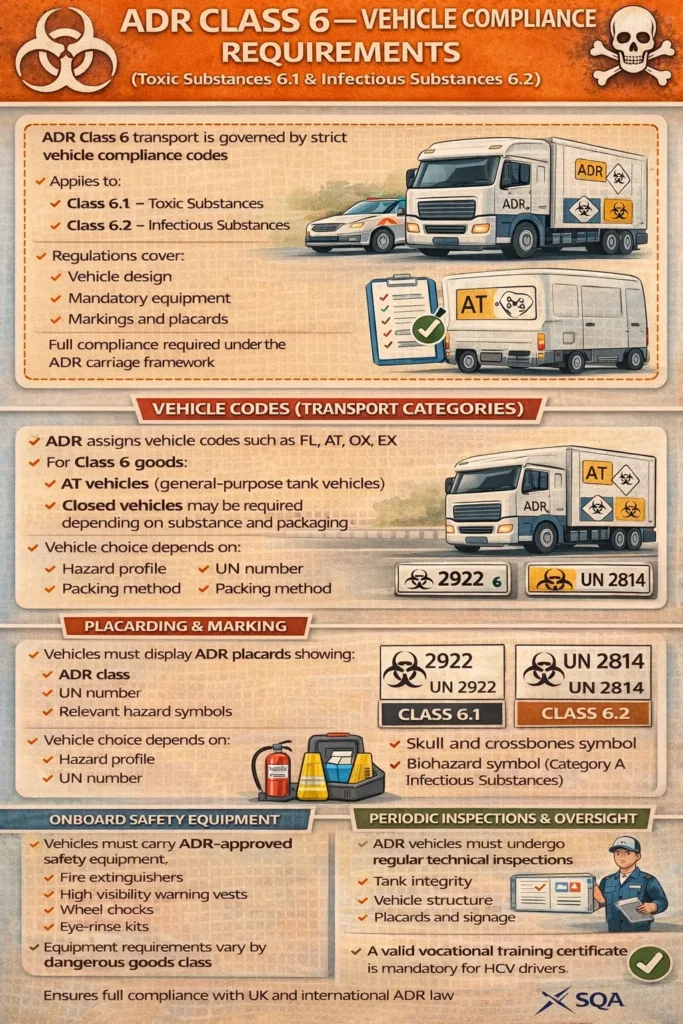
The transport of ADR Class 6 goods—toxic substances (Class 6.1) and infectious substances (Class 6.2)—is regulated under strict vehicle compliance codes within the ADR regulations. These codes specify the vehicle design, equipment, markings, and driver qualifications necessary to carry hazardous materials safely.
Key vehicle requirements under ADR for Class 6 transport:
- Vehicle Codes (Transport Categories):
ADR assigns codes like FL, AT, OX, and EX depending on the hazard. For Class 6 goods, AT vehicles (general-purpose tanks) and closed vehicles are often used, depending on the substance and packaging. - Placarding and Marking:
Vehicles must display hazard placards with the correct ADR class, UN number, and packing group symbols.- Class 6.1 → Skull and crossbones symbol
- Class 6.2 → Biohazard symbol (Category A)
- Onboard Safety Equipment:
Fire extinguishers, warning vests, wheel chocks, and eye-rinse kits are required. Equipment must match the vehicle’s dangerous goods class. - Driver Qualifications:
Only a certified ADR driver may operate these vehicles. They must complete a recognised ADR course covering the core module and relevant specialist class, followed by testing to earn their ADR certificate and ADR licence. - Periodic Inspections:
Vehicles used in ADR carriage must undergo regular technical inspections for tanks, structural integrity, and signage under guidance from authorities and trained dangerous goods safety advisers.
These requirements are taught in accredited ADR training courses, approved by the Scottish Qualifications Authority, and refreshed every five years through ADR refresher and Driver CPC training. A valid vocational training certificate is essential for every HGV driver carrying ADR Class 6 goods in compliance with national and international law.
What types of vehicles are authorised for ADR Class 6 consignments?
Vehicles used for ADR Class 6 consignments must meet specific construction and safety standards under ADR regulations, depending on the substance type, packaging method, and transport volume. These vehicles are categorised under codes such as AT, FL, OX, and EX, but for Class 6 goods, closed vehicles, AT vehicles, and specialist tank containers are commonly used.
Authorised vehicle types for ADR Class 6 transport:
- Closed rigid vehicles: Required for infectious substances (Class 6.2) and small packaged toxic goods (Class 6.1).
- AT vehicles: Used for tank transport of toxic liquids, covered under ADR tanks classification.
- Refrigerated vehicles: Necessary for temperature-sensitive infectious substances, including some clinical waste.
- Container vehicles: May carry UN-approved tank containers secured to the frame.
Every ADR driver must hold a valid ADR licence, gained after completing an accredited ADR training course covering the core module and specialist class content. These courses, approved by the Scottish Qualifications Authority, result in the issue of an ADR driver training certificate.
All authorised vehicles must be placarded, inspected, and operated according to the assigned dangerous goods class, relevant UN number, and packing group to maintain legal compliance during international ADR carriage.
How are vehicle codes linked to risk type and quantity?
ADR vehicle codes are linked to both the risk level of the dangerous goods and the quantity being transported. These codes define the structural, operational, and safety features that must be in place during ADR carriage, particularly for Class 6 goods involving toxic or infectious substances.
Common vehicle codes and their Class 6 relevance:
- AT – General-purpose tank vehicles for toxic liquids (Class 6.1).
- FL – Vehicles carrying flammable liquids, referenced when Class 3 goods are transported with Class 6.
- OX – Vehicles for oxidising agents; applicable if mixed with ADR Class 6 cargo.
- EX – Used in cases where Class 6 goods are in proximity to Class 1 explosives.
Quantity implications:
- Thresholds for vehicle markings and documentation: When quantities exceed ADR limited quantity (LQ) limits, full compliance with vehicle codes, placards, and driver certification is required.
- Small load exemptions: Some Class 6 goods under LQ thresholds may be carried with reduced requirements but still demand ADR awareness and proof of competence.
Drivers must complete a recognised ADR course, including modules on load thresholds and vehicle classification. Passing earns a vocational training certificate, allowing legal transport under the assigned vehicle code. These topics are reinforced in refresher training and Driver CPC training, ensuring HGV drivers remain compliant with quantity-based transport rules.
What are the structural and safety features required for transport?
Vehicles transporting ADR Class 6 substances must be equipped with specific structural and safety features to prevent contamination, leakage, and exposure. These requirements apply to both Class 6.1 (toxic substances) and Class 6.2 (infectious substances) and vary based on the UN number, packing group, and method of carriage (tank, package, or container).
Structural features:
- Sealed cargo compartments – Prevent escape of vapours or infectious fluids.
- Load securing systems – Prevent movement of hazardous goods during transport.
- Tank pressure relief valves – Required for ADR tanks carrying Class 6.1 liquids.
- Spill retention trays – Especially for clinical or liquid waste.
Safety equipment on board:
- Fire extinguishers – Based on vehicle mass, readily accessible.
- Warning vests and cones – For emergency stops and hazard identification.
- Eye rinse and first aid kits – Mandated for toxic and infectious materials.
- Placards and labels – Must display correct ADR class, UN number, and hazard symbol.
Drivers are trained in these requirements during their ADR training course, with testing included in the core module and specialist class assessments. A valid ADR certificate is required to operate such vehicles legally, and periodic ADR refresher training ensures continued compliance.
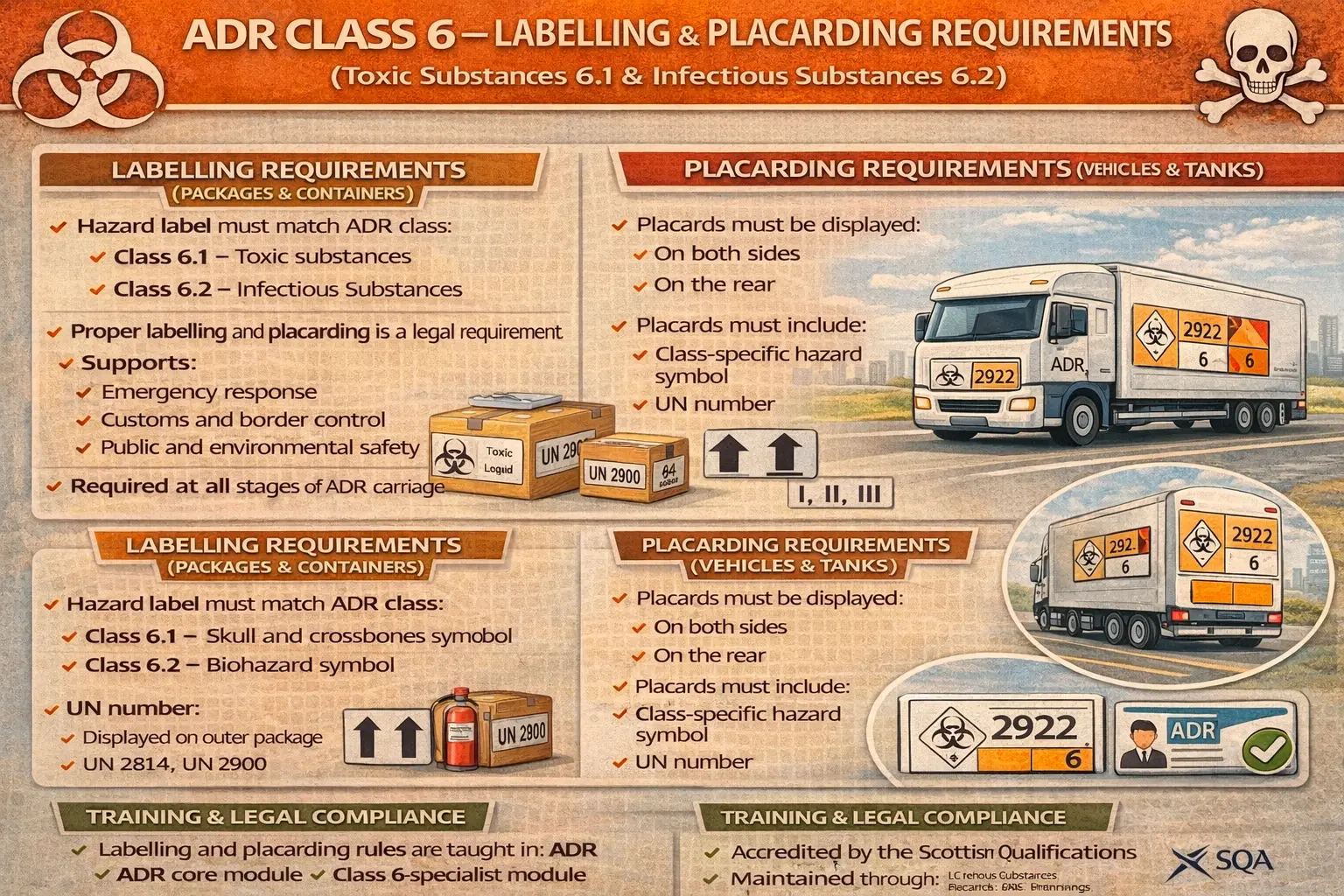
How are ADR Class 6 goods labelled and placarded during transit?
ADR Class 6 goods covering both toxic substances (Class 6.1) and infectious substances (Class 6.2)—must be labelled and placarded according to the ADR regulations to ensure clear hazard identification during transport. Proper marking supports emergency response, customs control, and public safety, and is a legal requirement during all stages of ADR carriage.
Labelling requirements (on packages and containers):
- Hazard label must match the ADR class:
- Class 6.1 → Skull and crossbones symbol
- Class 6.2 → Biohazard symbol
- UN number: Displayed on the outer package (e.g. UN 2814, UN 2900).
- Proper shipping name: Must be shown clearly (e.g. “Infectious Substance, Affecting Humans”).
- Orientation arrows: Required if the material is a liquid.
- Packing group (I, II, III) must be identified for Class 6.1 goods.
Placarding requirements (on vehicles and tanks):
- Placards placed on both sides and rear of the vehicle.
- Must include:
- Class-specific hazard symbol
- UN number
- Orange-coloured reflective panels
These requirements are taught in the ADR course under the core module and specialist class sections. Only trained ADR drivers with a valid ADR licence and ADR certificate are authorised to transport these materials. Courses, accredited by the Scottish Qualifications Authority, ensure that each HGV driver is competent in hazard communication procedures, as verified during vocational training certificate assessment and refresher training.
What hazard labels are required for toxic and infectious materials?
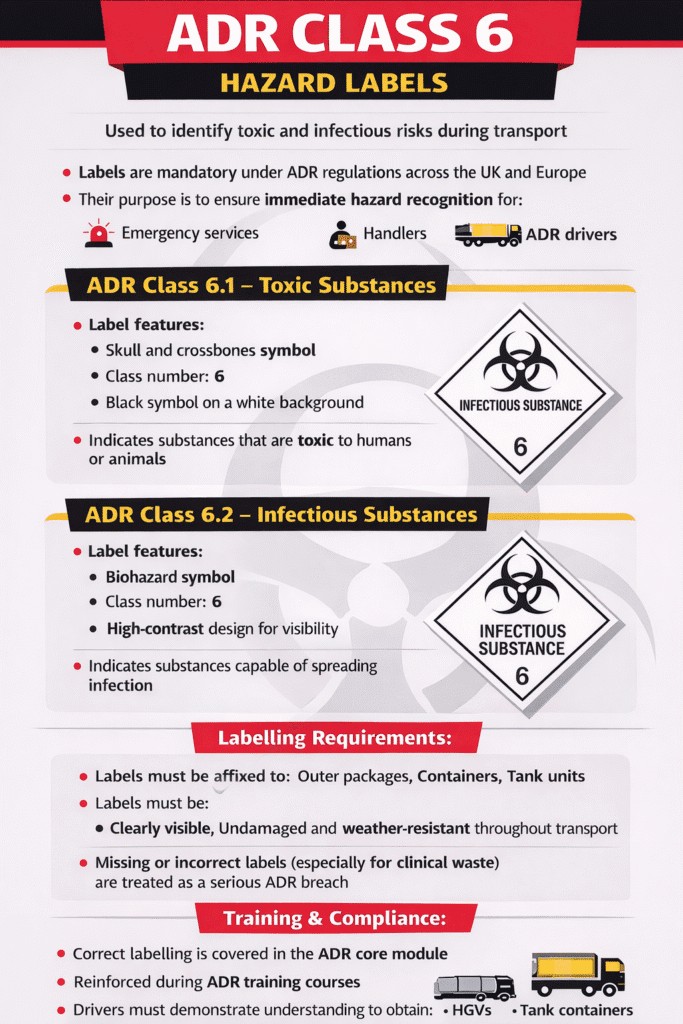
Hazard labels for ADR Class 6 substances are used to identify the risks posed by toxic and infectious materials during transport. These labels are mandatory under ADR regulations and form part of the legal framework governing ADR carriage across the UK and Europe. Their purpose is to allow emergency services, handlers, and ADR drivers to recognise hazards immediately.
For Class 6.1 (toxic substances), the required label displays:
- A skull and crossbones symbol
- The class number 6
- Black symbol on a white background
For Class 6.2 (infectious substances), the label must show:
- The biohazard symbol
- The class number 6
- Clear contrast for visibility
These labels must be affixed to all outer packages, containers, and where required, tank units. They must remain visible, undamaged, and weather-resistant throughout transport. Where clinical waste or infectious substances are involved, incorrect or missing labels are treated as a serious breach of ADR regulations.
Correct labelling is covered in the ADR core module and reinforced during ADR training courses. Drivers must demonstrate understanding before being awarded an ADR certificate or ADR licence. The requirements apply regardless of whether the load is transported by HGV, tank container, or packaged goods vehicle.
Label compliance is assessed during audits conducted by a dangerous goods safety adviser and forms part of ongoing ADR refresher training and Driver CPC training.
How are placards used for mixed loads with ADR Class 6 items?
Placards are required when vehicles carry ADR dangerous goods above threshold limits or when transporting mixed hazardous loads. For Class 6 goods, placards ensure that the presence of toxic or infectious materials is clearly communicated during transport, especially where multiple dangerous goods classes are involved.
When Class 6 substances are carried alongside other materials such as:
- Class 2 gases
- Class 3 flammable liquids
- Class 4 flammable solids
- Class 7 radioactive materials
The vehicle must display placards representing each applicable hazard. This allows emergency responders to assess combined risks instantly.
Key placarding rules include:
- Display on both sides and the rear of the vehicle
- Use of orange plates with the correct UN number
- Hazard symbols matching each ADR class
- Additional placards for tank containers or bulk loads
Mixed-load transport is covered in ADR training courses under the specialist class section. Drivers must understand how placards change depending on load composition and quantity. Incorrect or missing placards invalidate ADR compliance and may result in enforcement action.
Understanding mixed-load placarding is a core part of the ADR driver training certificate, reinforced through ADR refresher programmes and monitored under Scottish Qualifications Authority standards.
How are labelling requirements linked to UN numbers and packing instructions?
UN numbers form the foundation of ADR labelling and packaging rules. Each UN number identifies a specific substance, hazard level, and transport requirement. For ADR Class 6, the UN number determines:
- The hazard label to be used
- The packing group (for Class 6.1)
- Whether triple packaging is required
- The approved packing instruction code
- Vehicle marking and documentation standards
For example:
- UN 2814 identifies infectious substances affecting humans
- UN 2900 applies to animal-only infectious substances
- Each UN number links directly to packing instructions within ADR tables
These codes dictate container type, absorbent material requirements, and whether outer packaging must be rigid or pressure-tested. Packaging rules also determine when tank containers may be used instead of packages.
This relationship is taught in the ADR core module and reinforced during ADR training courses, ensuring drivers understand how to interpret documentation correctly. The information must appear consistently across:
- Transport documents
- Vehicle placards
- Package labels
- Emergency instructions
Accurate use of UN numbers is mandatory for the issue of an ADR certificate and is tested during vocational training certificate assessments. It remains a key focus of ADR refresher training, ensuring continued legal compliance and safe handling of hazardous materials.
What are the critical risks associated with ADR Class 6 transport?
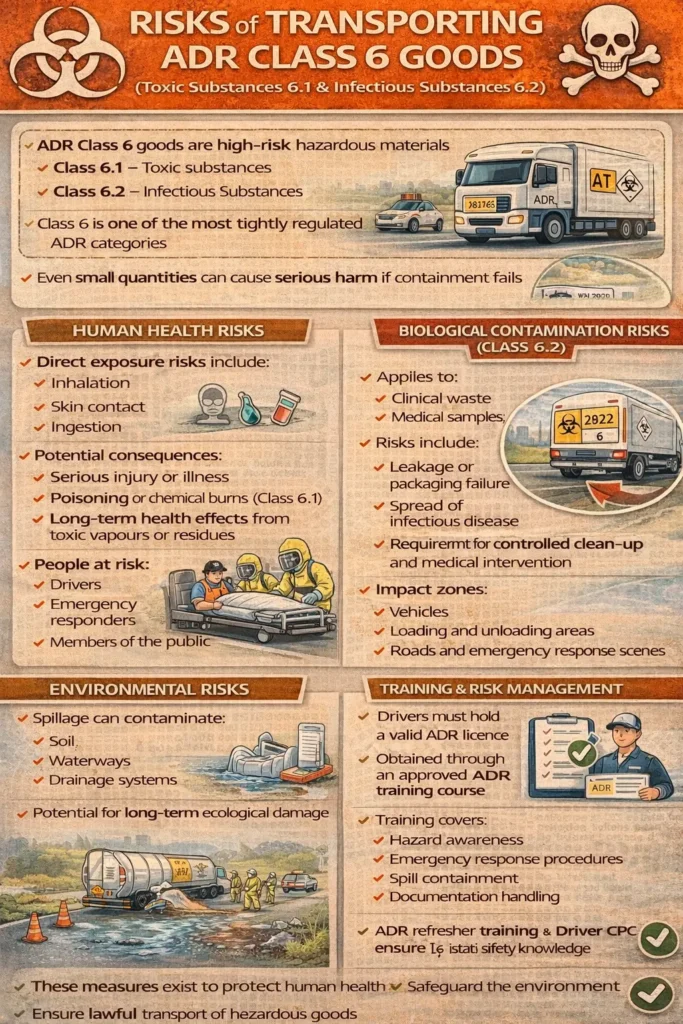
Transporting ADR Class 6 goods presents significant risks because these substances include toxic materials (Class 6.1) and infectious substances (Class 6.2). The primary danger lies in direct exposure, which may occur through inhalation, skin contact, ingestion, or accidental release during transport. Even small quantities can cause serious harm to drivers, emergency responders, and members of the public if containment fails. These risks make Class 6 one of the most tightly regulated categories under ADR regulations.
A major concern is biological contamination when transporting infectious substances such as clinical waste or laboratory samples. Leakage or packaging failure may lead to the spread of disease, requiring controlled clean-up and medical intervention. For toxic substances, risks include poisoning, chemical burns, or long-term health effects caused by exposure to hazardous vapours or residues. These dangers extend beyond the vehicle itself, affecting loading areas, road users, and emergency services attending incidents.
Environmental harm is another critical risk. Spillage of Class 6 materials can contaminate soil, waterways, and drainage systems, leading to long-term ecological damage. Because of this, ADR carriage rules require strict packaging standards, vehicle controls, and emergency equipment.
To manage these risks, drivers must hold a valid ADR licence, obtained through an approved ADR training course. Training covers hazard awareness, emergency response, containment procedures, and documentation handling. Regular ADR refresher training, supported by Driver CPC training, ensures that every HGV driver involved in Class 6 transport understands current safety practices and legal responsibilities. These measures exist to protect human health, maintain environmental safety, and ensure lawful movement of hazardous goods.
Why is containment vital for infectious substances?
ADR Class 6.2 covers infectious substances capable of transmitting disease. These include medical samples, clinical waste, research specimens, and diagnostic materials. The containment of these substances during ADR carriage is critical to prevent exposure, contamination, and outbreak.
Reasons why containment is essential:
- Infection control: Pathogens such as bacteria, viruses, or fungi must be sealed within the packaging to avoid transmission through leaks or spills.
- Worker protection: Drivers, handlers, and warehouse staff are at risk if containment fails. Proper packaging safeguards their health.
- Environmental safety: A single breach can contaminate surfaces, vehicles, drains, or public roads, requiring biohazard intervention.
- Compliance with Category A and B classification:
- Category A substances can cause serious or fatal disease.
- Category B are lower risk but still regulated.
- Triple packaging is mandatory:
- Leakproof primary receptacle
- Watertight secondary packaging
- Rigid outer box with correct hazard labelling and UN number
Containment standards are addressed in the ADR core module and specialist class training. A qualified ADR driver must hold a valid ADR licence and ADR certificate confirming competence in handling Class 6.2 materials. Ongoing ADR refresher training ensures up-to-date knowledge of containment protocols.
What exposure risks do ADR Class 6.1 toxins pose to handlers?
ADR Class 6.1 includes toxic substances that can cause injury or death through direct or indirect exposure. These chemicals often affect the nervous system, respiratory tract, or internal organs and require strict handling procedures under ADR regulations. Handlers and ADR drivers must understand the risks to ensure personal and public safety.
Key exposure routes and effects:
- Inhalation:
Vapours or dust can enter the lungs, causing respiratory failure or systemic poisoning. - Dermal contact:
Some Class 6.1 substances absorb through skin and mucous membranes, leading to delayed effects. - Ingestion or cross-contamination:
Residue on hands or surfaces can be transferred to food, water, or skin. - Pressurised leaks:
Damaged containers may release airborne toxins or cause splashing during loading.
Risk substances may include:
- Industrial solvents
- Pesticides
- Pharmaceutical intermediates
- Alkaloids and chemical reagents
To mitigate these hazards, handlers must use personal protective equipment (PPE), follow proper loading/unloading procedures, and inspect all packaging for compliance. ADR training courses cover these aspects in depth, supported by the issue of an ADR driver training certificate and regular refresher training.
A certified HGV driver carrying Class 6.1 goods must always comply with the relevant UN number, packing group, and hazard labelling requirements defined by their ADR course and vocational training certificate standards.
How should ADR Class 6 materials be segregated from incompatible loads?
Segregation of Class 6 materials during ADR carriage is essential to prevent chemical reactions, cross-contamination, or compounding hazards in case of leakage. ADR regulations provide strict rules on how toxic (6.1) and infectious (6.2) substances must be kept apart from other dangerous goods classes.
Key segregation requirements:
- Incompatible with:
- ADR Class 3 flammable liquids (risk of fire spreading toxins)
- ADR Class 4 flammable solids.
- ADR Class 5 oxidising agents (can react violently with some toxins)
- ADR Class 7 radioactive materials (risk of amplified contamination)
- Foodstuffs or pharmaceuticals (risk of absorption or contamination)
- Physical separation:
Must be in different compartments, UN-approved intermediate bulk containers (IBCs), or placed with barriers between. - No shared pallets:
Toxic and infectious materials cannot be stacked or packed with other classes unless ADR exemptions apply. - Documentation must reflect segregation:
Mixed-loads must declare all UN numbers, classes, and packing groups, along with relevant placarding.
ADR training courses cover segregation planning and vehicle layout strategies, reinforced in the core module and specialist class instruction. Only certified ADR drivers with a valid ADR licence may legally operate vehicles transporting segregated Class 6 loads, subject to checks by a dangerous goods safety adviser and ongoing Driver CPC training.
What exemptions and special provisions apply to ADR Class 6?
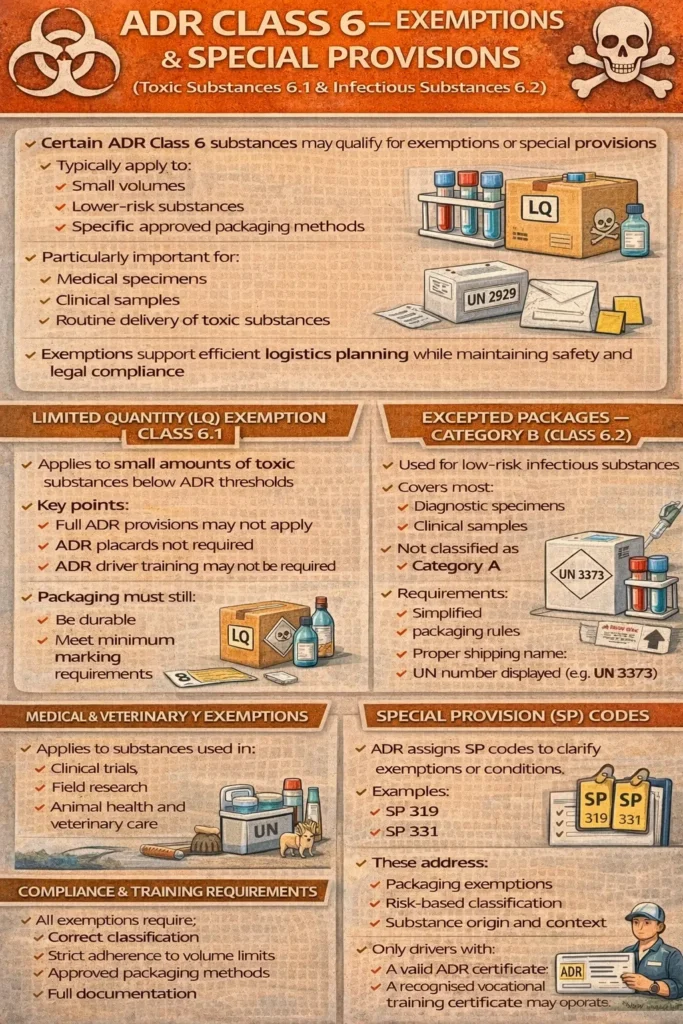
Certain ADR Class 6 substances may qualify for exemptions or special provisions under ADR regulations, particularly in cases involving small volumes, low-risk categories, or specific packaging methods. These exemptions are critical for logistics planning, especially for operators handling medical specimens, clinical samples, or toxic substances in routine delivery contexts.
Common exemptions include:
- Limited Quantity (LQ) exemption:
Small amounts of toxic materials (Class 6.1) below specified thresholds may be exempt from full ADR provisions. Packaging must still meet minimum durability and marking requirements, but placards and ADR driver training may not be required. - Excepted Packages – Category B:
Used for infectious substances (Class 6.2) that pose minimal risk. These include most diagnostic or clinical specimens not classified as Category A. Labelling still requires the proper shipping name and UN number (e.g. UN 3373), but packaging rules are simplified. - Medical or veterinary exemptions:
Certain substances used in clinical trials, field research, or animal health may qualify for limited packaging and carriage exemptions especially if packed in accordance with the triple packaging system. - Transport under special provision codes (SP):
ADR assigns SP codes to define exemptions or clarifications. For example, SP 319 and SP 331 address packaging exemptions for infectious substances based on origin and risk level.
Each exemption requires full documentation and strict adherence to volume, packaging, and classification rules. These are covered in accredited ADR training courses, under the core module and relevant specialist class sessions. Drivers must understand how to identify, apply, and operate within exemptions to maintain lawful carriage and protect public health. Only those holding a valid ADR certificate and vocational training certificate may manage loads under special provision rules.
When can limited quantity exemptions be used for toxic or infectious goods?
Limited Quantity (LQ) exemptions under ADR Class 6 allow reduced regulatory requirements when toxic substances (Class 6.1) are transported in very small volumes that present minimal risk. These exemptions apply only when strict quantity limits and packaging standards are met.
Conditions for Limited Quantity use:
- Applies only to Class 6.1, not Class 6.2 infectious substances
- Substance must fall below the maximum LQ volume listed in ADR tables
- Packaging must be strong, leakproof, and capable of withstanding normal transport conditions
- Outer packaging must display the LQ mark, even when ADR placards are not required
What LQ exemptions allow:
- No vehicle placarding required
- No ADR driver licence needed
- Reduced documentation
- Simplified transport requirements
What LQ exemptions do not allow:
- Use with Category A infectious substances
- Carriage in bulk or tank containers
- Transport of substances with high toxicity ratings
Even under LQ rules, the carrier remains legally responsible for safe handling and containment. These exemptions are covered in the ADR core module and reinforced in ADR training courses to ensure drivers understand when simplified rules apply and when full ADR compliance is required.
LQ rules are frequently assessed during ADR refresher training and Driver CPC training, ensuring drivers can identify when an exemption applies and avoid misclassification that could lead to enforcement action.
What special provisions apply to medical or diagnostic specimens?
Medical and diagnostic specimens are often transported under special provisions within ADR to reflect their lower risk when properly packaged. These provisions mainly apply to Class 6.2 infectious substances, particularly those not classified as Category A.
Common special provisions include:
- UN 3373 – Biological Substance, Category B
Applies to most routine clinical samples such as blood, urine, or swabs. - Triple packaging requirement:
- Leakproof primary container
- Watertight secondary container
- Rigid outer packaging with absorbent material
- Simplified marking:
- UN 3373 diamond marking
- No hazard placards required for vehicles
- No ADR licence required for drivers when conditions are met
Additional conditions:
- Samples must not be intentionally infectious
- Packaging must withstand pressure and temperature changes
- Documentation must clearly describe contents
These provisions allow hospitals, laboratories, and veterinary services to transport diagnostic samples safely without full ADR compliance, provided packaging rules are followed.
Training on these exemptions is included in ADR awareness and core module instruction, particularly for healthcare transport operators. Although an ADR certificate is not required in all cases, many organisations still require staff to complete ADR training courses to ensure consistency and legal certainty.
How do exceptions apply to biological products and waste materials?
Certain biological products and waste materials qualify for ADR exceptions when their risk profile is low or when they have been treated to remove infectious properties. These exceptions are carefully defined to avoid unnecessary regulatory burden while maintaining safety.
Examples of exempt or conditionally exempt materials:
- Decontaminated clinical waste
- Medical samples containing inactive pathogens
- Biological products approved for medical use
- Waste that has undergone sterilisation or chemical neutralisation
Key conditions for exemption:
- Substance must not contain viable infectious agents
- Packaging must prevent leakage or exposure
- Waste must be clearly identified as treated or neutralised
- Transport documentation must confirm exemption status
What still applies:
- Secure packaging
- Clear labelling
- Spill prevention measures
- Staff training in safe handling
Even when exemptions apply, operators must still follow ADR regulations related to general safety, vehicle condition, and documentation accuracy. These rules are explained during ADR training courses, particularly within the specialist class covering Class 6 substances.
Understanding these exceptions is essential for dangerous goods safety advisers, logistics managers, and HGV drivers responsible for moving clinical or biological waste. Regular refresher training ensures ongoing compliance with changing ADR guidance and enforcement standards.
Why must drivers be specially trained to transport ADR Class 6 substances?
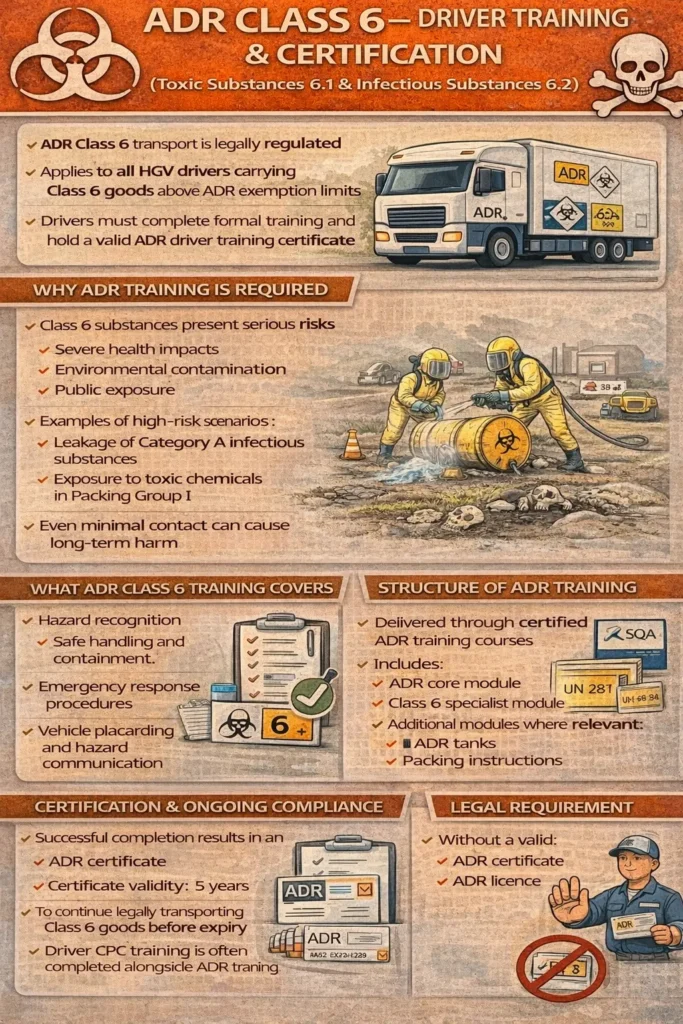
Drivers transporting ADR Class 6 substances including toxic (6.1) and infectious (6.2) materials—are required by law to complete formal training and hold a valid ADR driver training certificate. This certification ensures they understand the risks associated with these dangerous goods and can respond correctly during normal operations and emergencies. The requirement applies to all HGV drivers who transport Class 6 materials in quantities that exceed ADR exemptions.
Class 6 substances can cause serious health risks, environmental contamination, or public exposure if mishandled. For example, a leak involving a Category A infectious substance or a toxic chemical in Packing Group I could result in long-term harm, even with minimal contact. To reduce this risk, drivers must be fully trained in hazard recognition, safe handling, emergency protocols, vehicle placarding, and documentation procedures.
The training is delivered through certified ADR training courses, covering the core module, specialist class for Class 6, and any relevant modules such as ADR tanks or packing instructions. Courses must be approved by a national authority, such as the Scottish Qualifications Authority, and include both theoretical and practical assessments.
On successful completion, drivers receive an ADR certificate valid for five years. To continue transporting these substances legally, they must complete ADR refresher training before expiry. In many cases, Driver CPC training is also completed in parallel to meet broader professional driver standards. Without this certification, Class 6 transport is not permitted under ADR regulations.
What training modules cover toxic and infectious materials?
ADR training for Class 6 transport includes both general and specialised instruction. Drivers must complete modules covering the legal, procedural, and safety aspects of handling toxic (Class 6.1) and infectious (Class 6.2) substances. The modules are structured to match the type of goods and method of carriage.
Required training modules:
- Core module – Mandatory for all ADR drivers. Covers:
- General legal framework
- Responsibilities of the driver
- Vehicle requirements and documentation
- Incident response and personal protection
- Specialist module for Class 6.1 – Focuses on:
- Identification of toxic substances
- Risk assessment and containment procedures
- Label and placard interpretation
- Emergency actions in case of exposure or spillage
- Specialist module for Class 6.2 – Includes:
- Safe carriage of infectious substances
- Triple packaging systems
- Segregation from incompatible goods
- Biohazard precautions and public health protection
- Optional: ADR tanks module – Required if Class 6 goods are carried in tankers
These modules are delivered by accredited ADR training providers, following national guidance such as that issued by the Scottish Qualifications Authority. Successful completion is required to gain the ADR driver training certificate and legally transport Class 6 goods.
What certification is required under ADR for Class 6 transport?
Drivers transporting ADR Class 6 substances must hold a valid vocational training certificate, often referred to as the ADR certificate. This certification proves the driver has completed appropriate training and passed the required assessments to handle toxic and infectious goods lawfully and safely.
Certification requirements include:
- ADR driver training certificate
- Issued upon passing the core module and specialist class modules
- Valid across the UK and EU for 5 years
- Specialist Class 6 endorsement
- Specifically noted on the certificate to indicate eligibility to carry Class 6.1 and/or 6.2 materials
- Covers packaging rules, UN number application, emergency response, and containment
- ADR tanks certification (if applicable)
- Required for tank carriage of Class 6 substances
- Includes training on pressure systems, inspection routines, and safe loading/unloading
- Driver CPC training (where required)
- Often combined with ADR training for HGV drivers, especially when working full-time in hazardous goods transport
These certifications are mandatory for compliance with ADR regulations, enforceable by national authorities and subject to roadside and depot inspections. Certification records are monitored by dangerous goods safety advisers and must be kept up to date to maintain legal operation.
How often must driver training be updated for these substances?
Drivers certified to carry ADR Class 6 goods must refresh their training every five years to retain legal authorisation. This is a mandatory requirement under the ADR framework and ensures that drivers stay up to date with evolving safety standards, regulations, and response procedures.
Renewal and update requirements:
- ADR refresher training
- Must be completed before the expiry date of the current certificate
- Covers all previously passed modules, including core, specialist Class 6, and ADR tanks if applicable
- Includes updated content on:
- Emergency protocols
- Regulatory changes
- Equipment and packaging standards
- Reassessment
- Drivers must pass an exam again for each relevant module
- The new certificate is valid for another five-year period
- Driver CPC hours
- Many ADR drivers use the refresher course to count towards their 35-hour periodic CPC training
- Helps meet professional driving standards alongside ADR compliance
Training updates must be completed at approved centres, and failure to renew on time results in loss of certification, meaning the driver cannot legally transport dangerous goods class 6 materials. This requirement is enforced through vehicle inspections, company audits, and public safety regulations.